
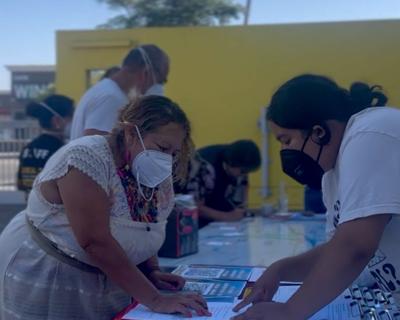


In June, Inner City Struggle began collecting data on how community members were affected by the Lineage Fire. Photo by Brenda Verano
More than seven weeks have passed since the Lineage fire broke out in Boyle Heights on June 17, and community members continue to feel the environmental and physical effects of what is considered to be one of the biggest industrial fires in the state of California.
Because many children start classes at the Los Angeles Unified School District schools next Wednesday, community members worry about the persistent rotten odor, hordes of rats, bad air quality, contaminated water supplies and other issues they say have been left behind by the fire.
Maria Patino Gutierrez, a resident from East L.A., said she does not feel comfortable with her kids going to school in a time when cleaning efforts are still ongoing. Her son’s school is about a mile and a half from the burned warehouse and her daughter has asthma.
Gutierrez's son, who is in elementary school, was one of the youngest community members to give a public comment at the South Coast Air Quality Management District public hearing on Wednesday and Thursday afternoon.
“It was my birthday when the fire started,” he said. "Also, my baseball games got cancelled. Everything was cancelled because of the fire.”
Community concerns
Similar to Gutierrez and her family, Benjamin Pineda, a senior at James A. Garfield High School who lives a mile away from the cold storage facility fire, attended the public hearing to talk about the unaccounted impacts the fire has taken on the majority Latino community.
“The fire has impacted my family by restricting us from participating in our day-to-day activities,” he said. “We were not able to go to church due to how close it was to the fire and the risk it posed to our health.”
Pineda said for many families, not only has the fire affected their physical health but also their spiritual well-being.
“Why must we stress about health problems caused by corporations like Lineage and the lack of necessary support from elected officials?’ he said.
Air quality fines
Since July 12, the South Coast Air Quality Management District has received nearly 4,000 odor complaints all tracing back to the cold storage warehouse where tons of food continue to rot.
On Thursday, after days of public comment, the South Coast Air Quality Management District unanimously approved a petition for an abatement order against Lineage, which means the cold-storage company will now have to take additional cleaning steps to disinfect concrete and wash the surfaces surrounding the facility. Despite the numerous regulations, the cold-storage facility was not fined.
The five-member committee’s decisions have left Lineage Logistics to comply and legally implement more than 90 new cleaning measures, including having to remove 80 pounds of food weekly, sanitize freezers, track ammonia levels and establish a public notification system to update residents on the cleanup’s progress.
Last week, a spokesperson from Lineage told CALÓ News via phone that cleaning efforts are powered by hundreds of workers, contractors and experts working on-site to accelerate the cleanup, reduce odors and protect public health.
“Reducing odors is a key priority during the cleanup effort. Lineage has already put several odor-control measures in place and is continuing to work with South Coast AQMD to identify additional solutions to reduce odors where possible,” Lineage said in a statement.
Cleaning efforts fall short
When it comes to the smell, Lineage said they have installed fixed odor-control spray systems around the building to deodorize the air as well as odorous material around the site, applied odor neutralizer to waste materials multiple times each day and continue to have portions of the building wrapped to help keep odors contained.
Yet for many residents, the bad smells have been unbearable, especially during high-temperature days, when they are left to choose between staying inside without air conditioning or turning it on but also contaminating their home with the harsh-smelling air.
“I know you all won’t come to our homes and smell inside,” Eva Garcia with Community Power Collective said in a message to the Lineage.
Garcia said the fire was an act of environmental racism and mentioned the 2025 Palisades Fires as a clear example of fast solutions in comparison to the community of Boyle Heights.
“They paid a lot of attention because it was a rich area, and what about us?” she said. “The community is not to blame for what we are living [through].”
Tiff Sanchez, an organizer at East Yard Communities for Environmental Justice, said she has seen many of her youth members and families have nosebleeds, migraines, vomiting of blood, nausea and fly bites, among other health impacts.
“This is more than just odor,” she said. “This is a health catastrophe.”
She said she, along with many environmental justice advocates, urges the South Coast Air Quality Management District to press charges against Lineage. “Lineage has never proven that they can be trusted in our communities,” she said.
Lineage 63 fires in 10 years
A recently published CBS News investigation found that in the last ten years, the company had at least 63 fires in and around its Lineage facilities worldwide, some involving its buildings, vehicles or trash on its sites.
The company acknowledged 34 building fires, including fires in Finley, Washington; Pasadena, Texas; Everett, Washington; and Massachusetts.
The CBS investigation also stated that, according to government watchdog data, Lineage has incurred $4.5 million in penalties for alleged workplace safety and environmental violations, including incidents involving hazardous chemical releases.
In January 2020, one worker died following an ammonia leak at a Lineage warehouse in North Carolina.
In the town hall on Wednesday, Sanchez said she believes ammonia levels have also been contaminating the neighborhoods in Boyle Heights.
To alleviate pests and harsh odors, Lineage said they have roll-off bins into which food waste is loaded and sealed immediately once they are full. The sealed bins then leave as soon as possible, with some staging on site depending on truck route availability, but not for long.
Local leaders
On Tuesday, Mayor Karen Bass wrote an open letter directed to the shareholders of Lineage.
“No company chooses to experience a catastrophic fire. But every company chooses how it responds. That response reflects its leadership, operational preparedness and corporate governance,” her letter stated. “Unfortunately, Lineage's response has fallen short. Multiple government agencies have served Lineage notices of violation relating to public health and safety.”
She also accused Lineage of delayed communication, limited transparency and insufficient public engagement. “Boyle Heights did not choose this disaster. Lineage's response is a matter of choice,” she wrote.
On Friday, July 31, Bass issued an emergency executive order directing city departments to pause processing the plans submitted to rebuild the Lineage warehouse.
Other local leaders like Los Angeles City Councilmember Ysabel Jurado, whose district includes Boyle Heights, have also denounced the fire's aftermath.
On Tuesday, after council recess, she introduced a seven-motion Boyle Heights Fire Recovery and Environmental Justice Package, which calls for faster cleanup, on-the-ground casework and utility bill payments for affected residents.
The motions also request LA Sanitation and Environment (LASAN) to report final water-quality testing results connected to firefighting runoff. It also looked to develop an Environmental Justice and Advocacy Advisory Commission in order for impacted communities to help shape city environmental policy, emergency response and recovery.
"Boyle Heights families have spent weeks paying the price for a disaster they did not cause," Jurado said. "Recovery cannot mean removing debris and moving on. It must mean immediate relief from pests and unacceptable conditions, a faster cleanup, public answers, aggressive pursuit of every recoverable dollar from responsible parties and safeguards against treating this site like a routine rebuild. It must also give communities that have carried Los Angeles' environmental burdens real power over what happens next.”
Juardo said this motion comes from the real demands of the affected communities.
Lineage said that to date, no city, county or state officials have offered them resources that would expedite cleanup efforts beyond those that Lineage had already deployed.
Lineage has until the August 13 cleanup deadline to comply with an emergency executive order, issued by the city, which mandated the removal of millions of pounds of spoiled food waste and the clearing of the site in a total of 45 days. It is still unclear whether the company will finish on time given the new South Coast AQMD cleaning measures.



(0) comments
Welcome to the discussion.
Log In
Keep it Clean. Please avoid obscene, vulgar, lewd, racist or sexually-oriented language.
PLEASE TURN OFF YOUR CAPS LOCK.
Don't Threaten. Threats of harming another person will not be tolerated.
Be Truthful. Don't knowingly lie about anyone or anything.
Be Nice. No racism, sexism or any sort of -ism that is degrading to another person.
Be Proactive. Use the 'Report' link on each comment to let us know of abusive posts.
Share with Us. We'd love to hear eyewitness accounts, the history behind an article.