
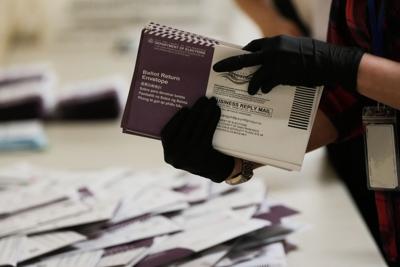


Department of Elections workers sort mail-in ballots for the California primary election at City Hall on Tuesday, June 2, 2026, in San Francisco. (AP Photo/Jeff Chiu)
The U.S. Supreme Court ruled Monday that states may count mail-in ballots that arrive after Election Day as long as they are postmarked beforehand.
The Court rejected a challenge brought by the Republican National Committee against a Mississippi law allowing mail-in ballots to be counted up to five days after Election Day. Similar laws are in place in 13 other states including California. The ruling is a blow to President Donald Trump who has frequently claimed without evidence that mail-in voting is rampant with fraud.
“Today’s decision recognizes a basic reality: Mail delays happen. When people vote by Election Day, their ballots should not be discarded because of those delays,” said California Attorney General Rob Bonta in a statement. “Since our nation’s founding, states have been primarily responsible for regulating elections, and we are pleased that the U.S. Supreme Court has respected that authority.”
A divided court ruled 5-4 in favor of upholding the mail-in voting laws, with two of the conservative justices siding with the three liberals on the bench. The decision avoids an upheaval of election laws only five months before Midterm Elections.
Trump took to Truth Social Monday disparaging the SCOTUS ruling, calling it a "tremendous loss,” and renewing his push for Congress to pass the SAVE Act, strict legislation that would require photo ID and proof of citizenship to vote. Voting rights advocates have warned the move would heavily restrict voting access across the country.
In the 2024 presidential election, over 13 million Californians voted with mail-in ballots, according to Secretary of State Shirley Weber’s office.
California allows election officials to count ballots that are postmarked on or before Election Day and arrive up to seven days after. Weber said in a statement this practice “helps protect voters from being disenfranchised because of mail delays outside their control.”
California’s June 2 primary became a dumping ground for election fraud claims. State officials have conceded that its laws result in slow ballot counts, but maintain those laws are necessary to ensure widespread voting access.
The state has passed several bills in the past two years meant to speed up ballot counts and safeguard elections from federal overreach.
“This is a win for voters, plain and simple,” Gov. Gavin Newsom said of Monday’s SCOTUS decision. “Despite ongoing attacks from the Trump Administration, we will continue our work throughout the Golden State to ensure every eligible Californian participates - because democracy is strongest when we all take part.”
SCOTUS is set to release its highly anticipated decision on birthright citizenship on Tuesday.

















(0) comments
Welcome to the discussion.
Log In
Keep it Clean. Please avoid obscene, vulgar, lewd, racist or sexually-oriented language.
PLEASE TURN OFF YOUR CAPS LOCK.
Don't Threaten. Threats of harming another person will not be tolerated.
Be Truthful. Don't knowingly lie about anyone or anything.
Be Nice. No racism, sexism or any sort of -ism that is degrading to another person.
Be Proactive. Use the 'Report' link on each comment to let us know of abusive posts.
Share with Us. We'd love to hear eyewitness accounts, the history behind an article.