
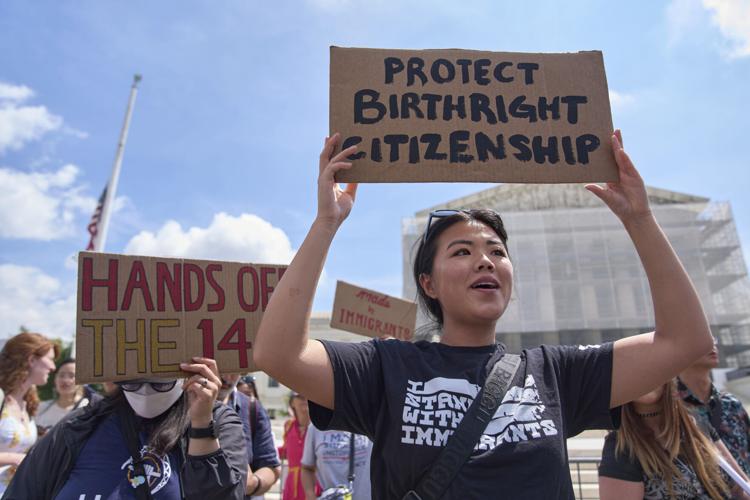


Hannah Liu, 26, of Washington, holds up a sign in support of birthright citizenship, May 15, 2025, outside of the Supreme Court in Washington. (AP Photo/Jacquelyn Martin, File)
The United States Supreme Court is expected to release a decision as early as this week on the merits of birthright citizenship, based on an executive order President Donald Trump signed in an attempt to restrict and redefine who is deemed a U.S. citizen.
Trump signed the executive order on day one of his second administration and was immediately sued by several states, joined eventually by the American Civil Liberties Union. When the Court heard arguments in the case, Trump v. Barbara, on April 1, many of the justices seemed doubtful of the administration’s argument.
“What this executive order is proposing is a radical departure from established law that will only sow confusion, upheaval and many other problems,” said Winnie Kao, senior counsel for the Asian Law Caucus and part of the legal team for Trump v. Barbara.
Kao was joined by others involved in defending birthright citizenship during a Tuesday press briefing hosted by ReThink Media.
Trump v. Barbara
During oral arguments in April, many of the judges, including those who have typically sided with Trump in the past, had questions doubting how the executive order would be implemented.
There was also pushback on the merits of this case since the Court ruled in 1898 in United States v. Wong Kim Ark that the 14th Amendment guarantees citizenship despite parents' citizenship or immigration status.

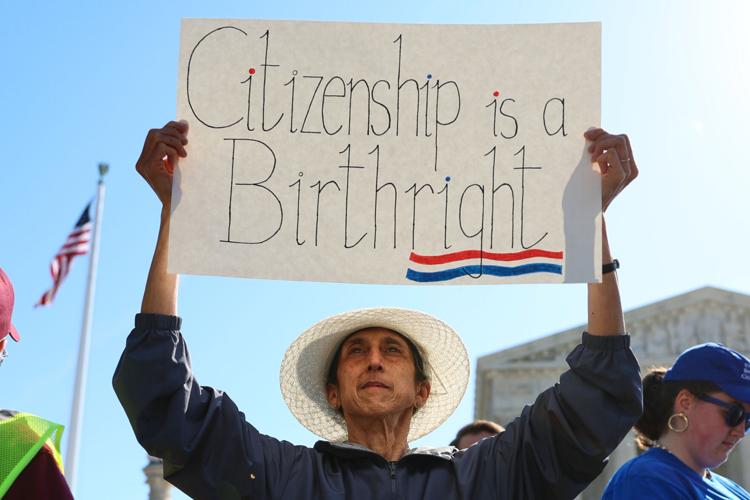
Demonstrators rally outside the U.S. Supreme Court as justices hear oral arguments on whether President Donald Trump can deny citizenship to children born to parents who are in the United States illegally or temporarily, on Capitol Hill in Washington, Wednesday, April 1, 2026. (AP Photo/Tom Brenner)
Kao said the Justices acknowledged implementing the executive order would be “an administrative and bureaucratic nightmare.”
“We’re hopeful that the Justices’ questions are indicative of where the court is headed and that it will strike the executive order down,” Kao said.
The executive order is an integral part of the Trump administration’s anti-immigration policy. The order would override the 14th Amendment and make it so that children born to parents who are not U.S. citizens do not automatically receive citizenship themselves, despite being born in the country.
The restriction would also apply to children of those in the country legally under visas or green cards.
The Pew Research Center estimates this could impact more than 250,000 babies born each year.
Individuals who are not legally recognized as a citizen by any country are considered “stateless.”
“That looks like a life in constant limbo of being afraid of being subject to deportation, long-term detention … without a place to be deported to,” said Betsy Fisher, advocacy counsel for United Stateless, an organization led by stateless individuals advocating for the human rights of those not recognized by their birth country.
The executive order is designed to create this struggle for generations, Fisher said. Decade after decade, children will be born to stateless parents, making them stateless as well. The struggle to be recognized by the U.S. would be never-ending.
The Department of Justice has already begun to instruct regional offices to refer hundreds of cases to begin the process of denaturalization, according to Fisher. This is just “another plank” in the administration's agenda, Fisher argued.
“Since this administration came into power, we have watched in real time as our laws and precedents have been manipulated to answer one question: ‘who is American and who is not?’ That is a political question, not a legal one,” said Beatriz Lopez, executive director of Voto Latino.
If the administration decides to do so, which many advocates believe it will, 1.8 million legal residents could retroactively lose their citizenship if the order is allowed to go through.
What can we expect?
SCOTUS issued opinions on Tuesday, but the birthright decision was not released. The Court will also issue opinions on Thursday, June 25 at 7 a.m. PST, although it is not certain that the birthright citizenship ruling will be among those released this week. The decision will be released by early July, at the latest.
Kao reiterated Tuesday the team defending birthright citizenship is optimistic the decision will "lean our way” given the “skepticism” the Court showed in April.
If SCOTUS surprises everyone and does choose to uphold the executive order, Kao said there would still be an implementation period and nothing would go into effect immediately. No matter what, “I think we can expect chaos,” Kao said.
If the Court rules against Trump, the administration will certainly find a way to fight back. Trump has already taken to Truth Social to criticize SCOTUS for potentially striking down the order, in advance of that actually happening.
“The administration will be emboldened to fight and do more damage and we can’t let them,” Lopez said.






(0) comments
Welcome to the discussion.
Log In
Keep it Clean. Please avoid obscene, vulgar, lewd, racist or sexually-oriented language.
PLEASE TURN OFF YOUR CAPS LOCK.
Don't Threaten. Threats of harming another person will not be tolerated.
Be Truthful. Don't knowingly lie about anyone or anything.
Be Nice. No racism, sexism or any sort of -ism that is degrading to another person.
Be Proactive. Use the 'Report' link on each comment to let us know of abusive posts.
Share with Us. We'd love to hear eyewitness accounts, the history behind an article.