
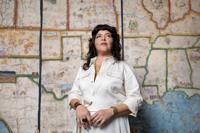
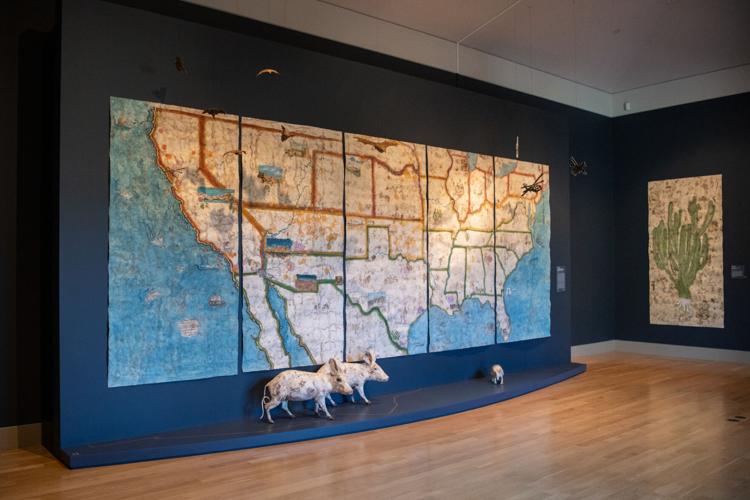

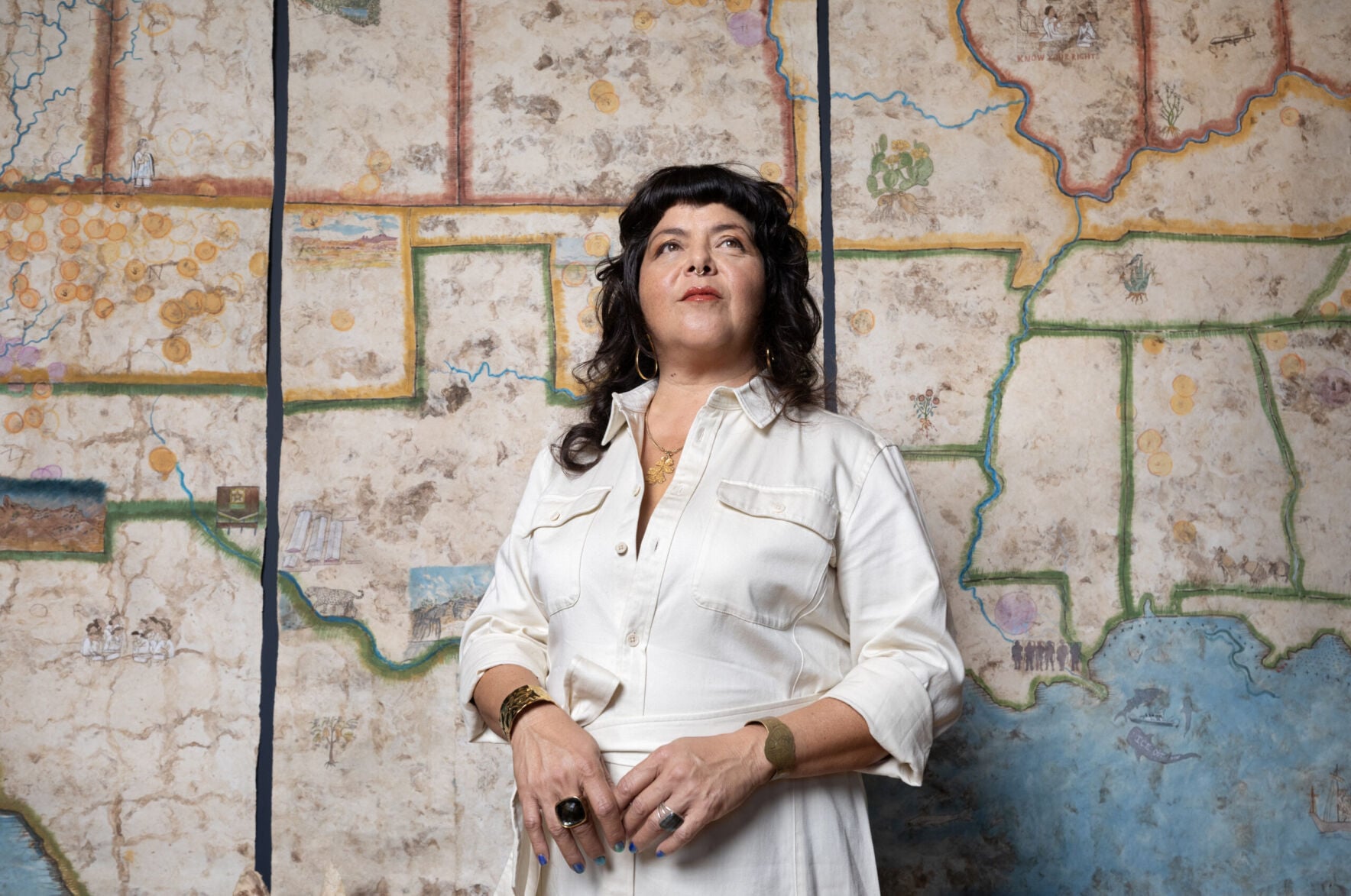
Artist Sandy Rodriguez with a large map from her exhibition “Book 13,” part of a 10-year project that combines art with painstaking historical research about the border region’s political history and culture, particularly its long and troubled story of immigration enforcement. The installation is at the Huntington in San Marino., California. (Steve Appleford)
This article was produced by Capital & Main. It is published here with permission.
The huge map on the museum wall has the look of an ancient document, though it charts a history that is anything but finished: centuries of violence and pain in the American borderlands continuing into the present moment of crisis.
Across the map’s sepia surface, the artist Sandy Rodriguez has incorporated small drawings of immigration agents and detainee camps, Florida’s “Alligator Alcatraz,” and the burning of a Spanish mission during a Quechan tribe uprising in 1781. As part of an installation titled Book 13, the map is the latest chapter of a 10-year project that combines art with painstaking historical research. Now on view at the Huntington in San Marino, California, it is the culmination of Rodriguez’s deep investigation into the border region’s political history and culture, particularly its long and troubled story of immigration enforcement.
Her map of North America includes tent cities and protesters, militarized police in New Orleans, and the merchant ship SS Emancipación, hired by the U.S. government to deport Mexican immigrants during the notorious Operation Wetback in 1954 — a multi-ship campaign that led to several drownings at sea. Another image on the map is from an incident last year showing Venezuelans at a Texas detention center standing together to form the distress signal “SOS” for anyone watching from the sky.
Significant archival study went into what Rodriguez calls her “maps of resistance” to the “ongoing cycles of colonial violence and aggression that we keep seeing over and over.” Some of that research unfolded at the Huntington Library, Art Museum, and Botanical Gardens, where the historical collection includes surveys of the border after the Mexican-American War.

The wall-sized map and javelina sculptures of Book 13. Photo: Linnea Stephan/The Huntington.
To bring that history to vivid life, she has turned to Indigenous artistic traditions, making her own paints by grinding minerals and insects and using paper made from the bark of amate trees — a material once outlawed by colonial authorities for its use in rituals.
“When I’m talking about resistance narratives of the Americas, it makes perfect sense to use a sacred ceremonial paper that was outlawed in the colonial period,” Rodriguez said with a smile while standing next to the 20-foot-wide map.
Like many artists trained in the United States, Rodriguez had long worked with European-style paper, canvas, premade paints and other materials. She found using Indigenous elements transformative.
“It has a power when you hold it,” she said. “To paint with ground minerals from these places that I’ve visited and done field study [on] — when you’re smelling that earth and you’re grinding that paint, you’re impregnating the fibers with the life force of that place.”
Working with these materials, she added, brings her closer to the generations who have lived this history. She gathers the ingredients during her frequent research trips around the country, which also yield information and sketches for later reference.
“I pack the car, and I go off-grid — no phone, no water, no service of any kind,” she said. “I don’t want to know what’s happening in the outside world. I am out at these sites doing field study, looking at how the land holds memory, looking at native plants that are used for ceremony, color, protection, ritual. These endemic plants and landscapes [were] witness to everything that has happened here.”
Beyond current events, Rodriguez bases her work on sources going back to the 16th century. They include the 12-volume Florentine Codex, which documented the region’s history, Indigenous culture, rituals, economy, geology and wildlife. The study of what the codex called New Spain was created by a Franciscan missionary. It is because of the work’s 12 books that she titled her project Book 13.
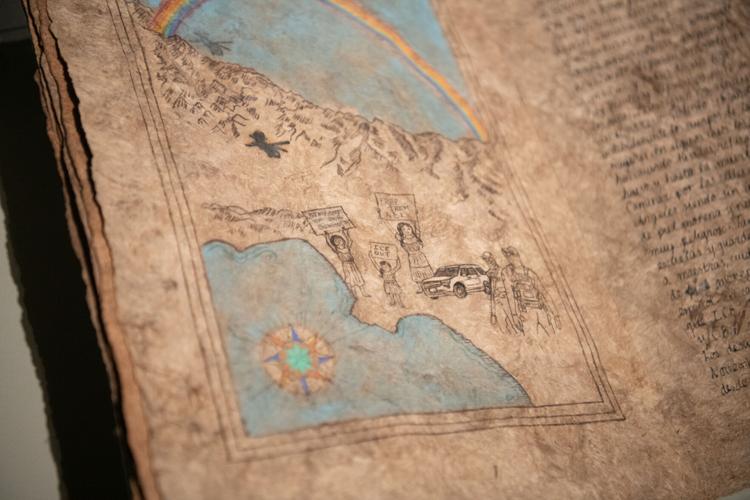
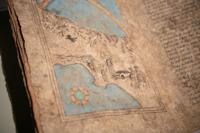
Sharing the gallery space with the map is the next volume of her own codex, still a work in progress, with three chapters so far. Inside a glass case, the book is left open to a page with an illustration that juxtaposes the past and present: A woman holding an “ICE OUT” sign is surrounded by militarized Immigration and Customs Enforcement agents while spectral figures of colonial soldiers on horseback loom behind them. Rodriguez’s intention is to collapse time, connecting the colonial past with the very recent actions of immigration and border enforcement agencies.
“When you read this text about this invasion and battles from 500 years ago, you understand that this is an ongoing [story],” she explained. Her inclusion of recent events is essential to her work: “We look at the invasion of Los Angeles over the past year and change, and the kidnappings of our neighbors and the hunting of residents.”

A page from Book 13, artist Sandy Rodriguez’s modern addition to the ancient Florentine Codex. Photo: Linnea Stephan/The Huntington.
Rodriguez is a third-generation Chicana painter. Growing up in Southern California, she became more politically aware during mass protests against Proposition 187, the infamous 1994 California ballot measure to deny undocumented immigrants access to education and social services. (The initiative was approved by voters but was ultimately ruled unconstitutional.)
Currently based in Los Angeles, Rodriguez considers her art part of a vital tradition. “When you’re grinding pigments and when you’re reciting the recipes and texts … from the Florentine Codex, you’re invoking the ancestors of all painters of the Americas,” she said.
The Huntington, which has commissioned works by Rodriguez for the past five years, is scheduled to keep her Book 13 installation on display through April 26, 2027. She is planning a reading from her codex in the spring, with live musical accompaniment and a discussion of the border’s history and ongoing struggle.
The Huntington’s exhibit includes a centuries-old map of the continent from its collection along with smaller works by Rodriguez. In front of Rodriguez’s map, close to the floor, are sculptures of javelinas, pig-like mammals that populate the border area. Above them hang depictions of the region’s native bats, which appear to be in conflict with border enforcement helicopters.
Another map she created, which has been shown at the National Museum of Mexican Art in Chicago, plotted the locations where children died in ICE custody. The story that Rodriguez’s art tells is open-ended and often tragic.
In a polarized era, her work inevitably provokes some negative feedback, which Rodriguez said she doesn’t mind.
“I get unwanted emails, unwanted perspectives, and that’s great,” she said. “It means I’m doing my job.
“I’m here to bear witness,” Rodriguez added. “I’m here to make work that provokes conversation and to hopefully prompt some engagement with the injustice that is being played out right before our eyes every single day.”






(0) comments
Welcome to the discussion.
Log In
Keep it Clean. Please avoid obscene, vulgar, lewd, racist or sexually-oriented language.
PLEASE TURN OFF YOUR CAPS LOCK.
Don't Threaten. Threats of harming another person will not be tolerated.
Be Truthful. Don't knowingly lie about anyone or anything.
Be Nice. No racism, sexism or any sort of -ism that is degrading to another person.
Be Proactive. Use the 'Report' link on each comment to let us know of abusive posts.
Share with Us. We'd love to hear eyewitness accounts, the history behind an article.