
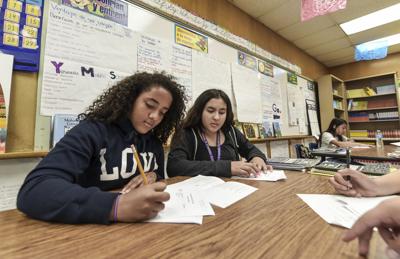

A dual-language immersion class in Fresno Unified.
Top Takeaways
- In California, local school districts decide the criteria that determine whether an English learner can be reclassified as proficient.
- One Pomona Unified student had “well developed” English based on her score on a required exam, but remained an English learner for three more years well into high school.
- A state proposal, which has encountered virtually no opposition in the Legislature, would set a uniform criteria to reclassify English learners.
Araceli Peñate’s daughter first scored a 4 on the English Language Proficiency Assessment of California while in sixth grade, meaning her English was “well developed” by state standards.
Yet she remained classified as an English learner well into high school — an experience that underscores how California’s patchwork criteria for English learners is holding some students back even after they demonstrate language proficiency.
In California, students who began school as English learners must meet four criteria in order to be reclassified as “fluent English proficient.” First, they must earn a score of 4 on the ELPAC. Then, teachers must agree the student is proficient in English, parents must be consulted, and the student must demonstrate “basic skills” comparable to those of their English-proficient peers.
The last three criteria are up to school districts to decide, and they vary widely, though that could change if a state proposal becomes law.
In Peñate’s district, Pomona Unified School District, students have to meet or exceed the standard on the English Language Arts Smarter Balanced tests, achieve a grade-level reading score, known as a Lexile score, or pass a different English diagnostic test. In addition, they must also pass a writing exam to be reclassified as “fluent English proficient.”
From seventh grade into high school, Peñate watched her daughter struggle to pass all the other tests until she was finally reclassified in 10th grade.
“It was really hard,” Peñate said in Spanish. “She would get depressed. Sometimes she would come home upset, saying she still hadn’t passed. It was too much.”
The idea behind testing students’ “basic skills” in addition to English language proficiency is to make sure students are prepared to succeed in school after they are reclassified and no longer receive extra help provided to English learners.
But multiple recent studies have found that keeping students as English learners after they achieve proficiency on the ELPAC does not necessarily help them academically. Research shows the delay may keep students from enrolling in advanced courses and electives in middle and high school and can affect their motivation and attendance. When students remain English learners throughout high school, they are less likely to graduate and to complete the courses required for UC and CSU admission.
Assembly Bill 2555 aims to eliminate district variability by only requiring a score of 4 on the ELPAC to classify students as “fluent and proficient” and eliminating the other three criteria. The bill would require districts to start using only ELPAC scores next school year in 2026-27. By 2027-28, the California Department of Education (CDE) would automatically classify students when they score a 4, instead of waiting for districts to make the change.
AB 2555, authored by Assemblymember Darshana Patel, a San Diego County Democrat, passed the state Assembly in May with virtually no opposition.
Thousands of students face delays in reclassification after achieving proficiency. According to a CDE analysis, most students reclassified in 2024-25 were reclassified within a year of their first ELPAC score, but a quarter of students remained in English learner status for more than nine months after scoring a 4 on the ELPAC for the first time.
More than 10% of students had to wait two or more years. The analysis found that 6.2% of students reclassified in 2024-25 had achieved their first overall score of 4 on the ELPAC two school years prior, in spring 2023. Another 4.7% had first achieved an overall score of 4 on the ELPAC three years prior, in spring 2022.
The longest wait was 1,222 days — more than three years.
If Peñate’s daughter had attended a neighboring district, she might have been reclassified sooner.
An EdSource analysis of the reclassification criteria of districts surrounding Pomona Unified — Claremont Unified, Walnut Valley Unified, Chino Valley Unified and Bonita Unified — showed wide discrepancies. While all require students to meet or exceed standards on the Smarter Balanced test or a similar reading assessment, only Pomona Unified requires the additional writing exam.
The criteria for teacher evaluation also vary widely. Claremont Unified, for instance, does not specify criteria beyond “teacher evaluation of language acquisition skills.” Bonita Unified requires a grade of C or better in English language arts. Chino Valley Unified requires a C or better in all academic subjects, including math, history and science.
The Los Angeles-based Parent Organization Network, which works with parents in several Southern California districts, including Pomona Unified, has found similar disparities in criteria for reclassification between districts.
“We have trained 450 parents across 23 schools in seven school districts and the narrative doesn’t change,” said Daisy Amezcua, the network’s director of programs and community organizing. “The current reclassification criteria are inequitable and confusing, not only for parents, but also (for) administrative leaders because there are too many requirements to be met within one school year, with too much variation in implementation.”
The Parent Organization Network helps parents analyze their children’s test scores and understand the criteria their children must meet in order to exit English learner status. Often, Amezcua said, they find that children achieved a 4 on the ELPAC in prior years but were not reclassified and then faced harder tests the following years.
Researchers from Stanford University also found wide variability among reclassification criteria of nine districts in Northern California, near the university.
“We see it as an acute problem when we’re working with districts that feed into the same high school district, and the high school district would say we’re getting students who are being reclassified at really different thresholds and using different assessments,” said Laurel Sipes, senior research associate at Stanford University, at a webinar where researchers shared their findings.
Peñate said Assembly Bill 2555 is a game changer.
“I think it’s a great opportunity for the students, so they aren’t as stressed, because it’s not easy to do all those exams,” she said. “My children have already finished the process, but there are many, many students who are stuck, who maybe passed some of the criteria but not all. This would be something very important for them.”






(0) comments
Welcome to the discussion.
Log In
Keep it Clean. Please avoid obscene, vulgar, lewd, racist or sexually-oriented language.
PLEASE TURN OFF YOUR CAPS LOCK.
Don't Threaten. Threats of harming another person will not be tolerated.
Be Truthful. Don't knowingly lie about anyone or anything.
Be Nice. No racism, sexism or any sort of -ism that is degrading to another person.
Be Proactive. Use the 'Report' link on each comment to let us know of abusive posts.
Share with Us. We'd love to hear eyewitness accounts, the history behind an article.