
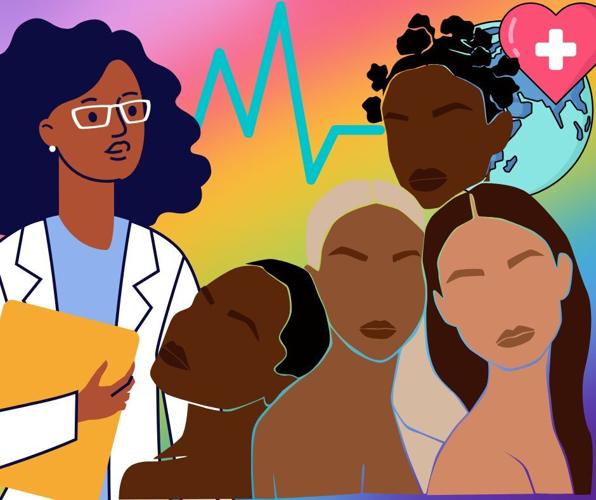







(Canva art by Amairani Hernandez.)
Next week, the U.S. Supreme Court will hear oral arguments in Kennedy v. Braidwood Management Inc., a case that questions the legality of Affordable Care Act’s (ACA) provisions mandating that health insurance plans cover specific preventive services at no cost to patients.
Public health and women’s healthcare experts held a brief on Thursday, April 17, to discuss the types of preventive services that are covered under the Affordable Care Act, which include annual wellness visits, cancer screenings, pregnancy care and more. The discussion also addressed the potential consequences that could arise if the Supreme Court fails to uphold these vital aspects of healthcare coverage in the United States.
Speakers in the briefing included Dr. Georges Benjamin, executive director of the American Public Health Association, Dorianne Mason, director of health equity at the National Women's Law Center and member of the Multidisciplinary Steering Committee for the Women's Preventive Services Initiative, and Kathy Hempstead, a senior policy officer at the Robert Wood Johnson Foundation, where she works on healthcare issues related to insurance costs and access to care.
As the first speaker, Dr. Benjamin highlighted that the United States spends approximately $5 trillion annually on healthcare, yet the nation ranks among the lowest in terms of health outcomes. “One of the reasons for that–rhere are lots of them–but one of the reasons is the inadequate use of primary care and preventive services compared to the other industrialized nations. Now Congress and the framers of the Affordable Care Act recognized this when they crafted the law and put in place measures to promote prevention,” he said.
Dr. Benjamin explained that one key measure involved implementing requirements aimed at eliminating barriers and providing incentives to expand access and encourage the use of preventive health services to improve overall health outcomes for patients.

Dr. Georges Benjamin, executive director of the American Public Health Association. (Photo courtesy of Dr. Georges Benjamin.)
“We knew, for example, that cost-sharing and often the cost of basic screening for many of these preventive services resulted in disincentives for people to actually get them done. We also know that if you find many of these problems early, you can actually reduce the costs of health care.” Dr. Benjamin said. “First dollar coverage to reduce the fiscal barriers and promote cost savings was a high priority of the crafters of the Affordable Care Act.”
He also explained that the evidence shows that implementing these measures ends in successful results. Dr. Benjamin said that there has been an increase in the use of preventive services, such as screenings for blood pressure, cholesterol, and blood sugar levels and getting their flu shots.
“There have been lots of studies that have actually looked at the cost savings for a variety of these preventive services. And of course, at the end of the day, if you can reduce these costs and get people into care earlier, you can actually improve the quality of life,” Dr. Benjamin said. “Interestingly enough, this is one area where the Trump Administration has supported the task force's expertise and authority. And in fact, they're on board with supporting the same position that we are supporting [of] the Preventive Health Services Task Force's work.”
Dr. Benjamin also emphasized that if the court ruled against them, that would mean there would be an increase in cancer, heart disease, strokes, complications from pregnancy, drug misuse and more.
“If our coverage is removed and the authority of the task force is undermined, many insurers and some employer plans will reinstate costs, copayments and other increases in costs going forward. If that happens, we believe pretty strongly that preventive health screenings must be preserved,” Dr. Benjamin said.
Mason emphasized that, depending on Monday's Supreme Court decision, those seeking to eliminate preventive services are targeting the entire system, warning that if they succeed, the impact will be widespread—affecting women, families, communities, and ultimately, the entire nation.
“To put the Braidwood challenge in full context, we do have to revisit life for women before the Affordable Care Act. Before the ACA, women simply were not accessing the preventive care that they needed. They delayed care, they denied care and sometimes life-saving immunizations and screenings in large part, as we just heard, because of cost,” Mason said.
She also explained that when out-of-pocket costs are imposed, fewer women access preventive care. “This shouldn't surprise us when people are struggling to have their needs met. Even the fear of cost could serve as a barrier to care,” Mason said.

Dorianne Mason, director of health equity at the National Women's Law Center and member of the Multidisciplinary Steering Committee for the Women's Preventive Services Initiative. (Photo courtesy of Dorianne Mason.)
Mason highlighted that women, people of color and LGBTQ+ individuals all experience higher rates of poverty, lower wages and more financial insecurity. In the United States, more women than men live in poverty. According to U.S. Census Bureau data, of the 38.1 million people living in poverty in 2018, 56 percent—or 21.4 million—were women.
According to a 2019 Williams Institute analysisof Behavioral Risk Factor Surveillance System (BRFSS) data, which showcases evidence on poverty in the LGBTQ+ community, more than one in five LGBTQ+ adults (22%) are living in poverty, compared to an estimated 16% of their straight and cisgender counterparts.
When looking across race/ethnicity, poverty rates among LGBTQ+ people of color in the U.S. tower over those of other groups. For example, almost half of Latine transgender adults (48%), as well as approximately four in ten Black transgender adults (39%), are living in poverty.
“The ACA required most insurance carriers to provide coverage of this needed care without cost-sharing services such as vaccines, medication and genetic counseling to reduce women's risk of cancer, pregnancy and postpartum screenings,” Mason said “Preventive services guidelines also require plans to cover contraception without cost sharing, and as of November 2021, we knew that over 61 million women were accessing that benefit with no out-of-pocket cost, and in 2013 alone, women saved over $1 billion in that out-of-pocket cost.”
According to Mason, when health insurance effectively meets patients' needs, it allows them to save money that can be used for essentials like rent, utilities and food. Preventive services not only reduce healthcare costs but also contribute to earlier cancer detection and increased mental health screenings, with higher rates of participation that have led to improved mental health outcomes.
“Increased use and adherence to contraception has also decreased unwanted pregnancies. It's been a win-win-win, including $26 billion in annual savings from identifying cancer early and $19 billion saved annually from contraception results,” Mason said.
Another key point that she shared was that since the ACA’s passage, racial and ethnic health disparities have narrowed. “For example, for Hispanic and Black women, rates of hypertension and coronary heart disease have lowered and there's been a statistically significant increase in mammography screening utilization, hoping to close the racial gap for Black women who have historically faced higher rates of breast cancer mortality,” she said.
Mason also stated that the contraceptive coverage requirement is a critical racial justice issue because accessing contraception plays a vital role in addressing the Black and Indigenous maternal mortality crisis.
“Women with unintended pregnancies face a significantly higher risk of maternal mortality, maternal morbidity, maternal depression and physical violence during pregnancy,” Mason said. “But this case threatens all of this progress. This is not the time for market confusion and threats. This is a time to reinforce access to health care and uphold this crucial preventive care provision.
Hempstead reassured the audience of their commitment to the belief that health is a right, not a privilege. She emphasized that this is both a critical coverage and affordability issue and made it clear that they care deeply about the outcome of this case.

Kathy Hempstead, a senior policy officer at the Robert Wood Johnson Foundation, where she works on healthcare issues related to insurance costs and access to care. (Photo courtesy of Kathy Hempstead.)
“The Supreme Court is going to consider what sounds like a sort of narrow question about whether it is constitutional to base no-cost coverage recommendations on the recommendations of a task force,” Hempstead said. “What’s at stake is very significant.”
She also explained that preventive care saves lives and improves the quality of life. “Since the ACA has expanded, no-cost access to these services has increased. The ruling is really threatening access to these lifesaving services that have been made available since 2010,” Hempstead said. “We are going to see an increase in preventable illness and death if we don't continue access to these no-cost preventive care [services].”
Hempstead shared that since 2010, a lot of services have been added and now they are currently at direct threat as well, depending on the outcome of this case. For example, these services include screening for lung cancer for high-risk patients and the extension of screening for colorectal cancer to younger adults.
“We've all heard news about how the prevalence of colorectal cancer among younger adults is rising. And so, accordingly, there's a change in the screening recommendations, allowing younger adults to get screened. And that's very important,” Hempstead said. “If we got rid of that lower screening age recommendation, the prescription of statins, for example, to prevent cardiovascular disease is something that would be at risk, as would medications to reduce the risk of breast cancer.”
Additionally, Hempstead emphasized that if the court rules against maintaining preventative care services, it will have consequential and real tangible impact on people's ability to protect themselves, prevent disease and be as healthy as they can be.








(0) comments
Welcome to the discussion.
Log In
Keep it Clean. Please avoid obscene, vulgar, lewd, racist or sexually-oriented language.
PLEASE TURN OFF YOUR CAPS LOCK.
Don't Threaten. Threats of harming another person will not be tolerated.
Be Truthful. Don't knowingly lie about anyone or anything.
Be Nice. No racism, sexism or any sort of -ism that is degrading to another person.
Be Proactive. Use the 'Report' link on each comment to let us know of abusive posts.
Share with Us. We'd love to hear eyewitness accounts, the history behind an article.