
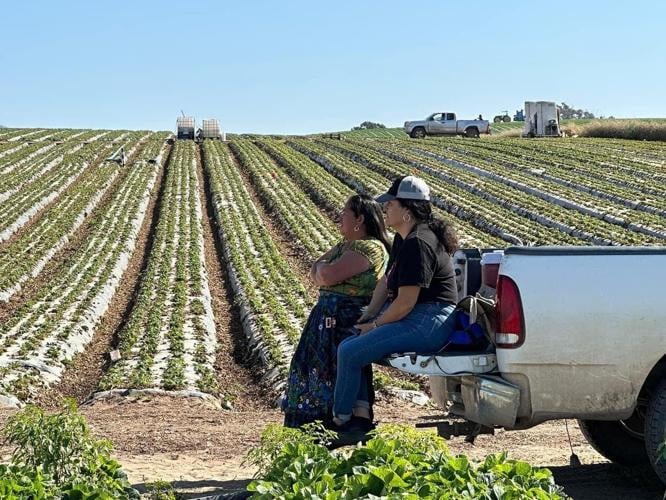



Credit: Líderes Campesinas en California.
New rules for immigrant and temporary farmworkers not only threaten to cut their wages, but also to make it more difficult for these workers to have their legal work authorization approved.
The Departments of Labor and Homeland Security are in the final stages of implementing rules that will lead to significant pay cuts for H2-A workers and will eliminate the automatic extension of work authorization documents, which allows individuals to continue their work while their applications are being processed. California Attorney General Rob Bonta joined two multi-state coalitions this week opposing the new rules.
“Immigrant workers help fuel California's economic engine,” said Bonta in a statement regarding the new authorization rule. “Let’s be clear: Jamming up employment authorizations for workers who have already been vetted doesn’t make us any safer, and it doesn’t benefit anyone. It’s just another tool for the President to exploit as part of his callous and unrestricted mass deportation agenda.”
Work authorizations
The rule, opposed by Bonta and an 18-state coalition, is led by DHS and eliminates the current 540-day automatic extension of Employment Authorization Documents (EADs).
In 2016, DHS implemented a 180-day extension so workers could continue their jobs while the lengthy authorization process took place. It takes DHS more than six months to process and approve EAD renewals for asylum seekers, according to Bonta.
In 2020, in response to a hiring freeze and lack of workers due to COVID-19, the extension was expanded to 540 days. According to DHS, between 306,00 and 468,000 employment authorizations would have lapsed without the automatic renewals.
“As the golden door of opportunity, California has an obligation to stand with and uphold the humanitarian interests of immigrant workers and refugees - and we will continue to do so,” said Bonta.
The coalition formally opposed the rule in a letter on Monday, arguing that DHS did not properly abide by the Administrative Procedure Act, and that it is “procedurally deficient.” The letter also states the rule will harm immigrant workers’ physical and mental health and financial security, as well as their housing and health insurance.
The states also argue the rule will financially harm them by decreasing tax revenue and spending power of its residents, increasing health care costs and increasing the burden on non-profits in the state.
Wage scale
The Department of Labor (DOL) first issued the work authorization rule in October. Under the new rule, the Adverse Effect Wage Rate (AEWR), effectively a wage scale, will lower wages for H2-A workers. Under the H2-A program, agricultural employers can bring in temporary foreign workers under these visas to fill workforce needs.
The employers have always been responsible for providing housing and transportation as well as paying their workers a minimum wage, which is set by the AEWR. The new rule will now allow employers to charge for housing.
The new wage scale will see the entry-level minimum wage as low as $13.45 and the rate for “experienced” workers as low as $15.71; the new rates are lower than California’s $16.50 minimum wage. As a result of these changes, over $2.4 billion will be transferred from the workers’ wages to the employers.
The overall majority of these workers here under these visas are from Mexico and Central America. In 2023, 95% of all H2-A visa holders in the country were from Mexico, according to data from DHS.
Last year, California had over 40,000 H2-A farmworkers, among the highest of any other state in the country, according to the DOL. H2-A farmworkers, and the work they do, contributed nearly $56 billion in agricultural sales in California in 2022.
In a letter addressed to the DOL, Bonta and a separate 17-state coalition argue the new rule ignores reliable farm-specific data, which has been used in the past to establish the AEWR. The coalition also argues that, like DHS, the DOL did not properly abide by the Administrative Procedure Act and that the rule will result in farmworkers being paid less than or close to the federal poverty line and will lead to financial injuries to the states.
In the letter, the states say the new rule is “arbitrary and runs antithetical to the DOL’s statutory mission to promote and develop the welfare of wage earners.”

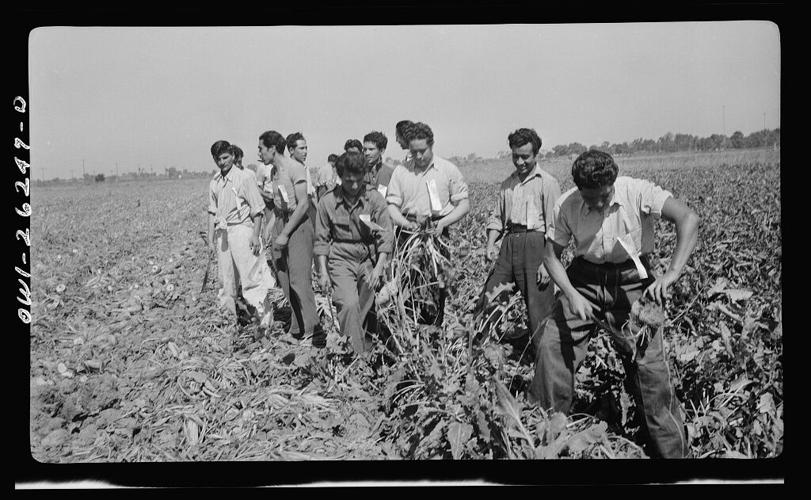
Mexican braceros in Stockton topping sugar beets in 1943. (Image courtesy of Library of Congress, Prints & Photographs Division, Farm Security Administration/Office of War Information Black-and-White Negatives.)
Looking back
The targeting of temporary farmworkers is reminiscent of the hardship that braceros underwent decades ago.
The Bracero Program ran from 1942 until 1964 and was created to fill labor shortages in the agriculture and railroad industries as a result of World War II. The agreement between the U.S. and Mexico brought over four million Mexican men to be temporary workers, according to the Library of Congress. The program, while economically beneficial to the U.S., resulted in severe exploitation and hardship to the workers themselves.
The braceros were subjected to poor living and working conditions, low wages and severe discrimination. As a result of pressure from labor and civil rights groups and strikes and protests from the braceros themselves, the program eventually ended in 1964.
Notably, the Bracero Program served as a direct influence for the H-2 program we have now.
Braceros were brought in to fill a large labor shortage, and they did so successfully; when the program ended, the U.S. needed another way to attract similar kinds of workers.
The Immigration and Nationality Act of 1952 established the original H-2 visa for temporary workers and in 1986, the H-2A program was added. By splitting the program, the government created more pathways for agricultural and other kinds of temporary and foreign workers to contribute to the economy.








(0) comments
Welcome to the discussion.
Log In
Keep it Clean. Please avoid obscene, vulgar, lewd, racist or sexually-oriented language.
PLEASE TURN OFF YOUR CAPS LOCK.
Don't Threaten. Threats of harming another person will not be tolerated.
Be Truthful. Don't knowingly lie about anyone or anything.
Be Nice. No racism, sexism or any sort of -ism that is degrading to another person.
Be Proactive. Use the 'Report' link on each comment to let us know of abusive posts.
Share with Us. We'd love to hear eyewitness accounts, the history behind an article.