As the Trump administration pushes to rewrite the nation’s history, communities across the country are pushing back against who gets to tell it.
“It’s a push we are witnessing not only on the streets of Minneapolis, but in efforts to resist an escalating series of executive orders to cancel exhibits at national museums, rename national parks and censor school curricula,” said ACoM Co-Director Sandy Close, introducing a briefing highlighting these efforts as July 4th approaches.
Nor are these orders limited to this second administration. Two in 2020 alone include Executive Order 13950 (“Combating Race and Sex Stereotyping), restricting federal agencies, contractors, and grantees including museums and schools from using frameworks associated with systemic racism or “divisive concepts,” and Executive Order 13958 (Establishing the President’s Advisory 1776 Commission), signaling federal pressure on schools, museums and cultural institutions to abandon critical historical narratives in favor of a “patriotic” version of American history.
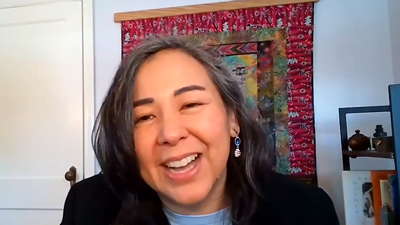
“We’re nearing the 250th anniversary of the United States, and it requires all of us to ask a fundamental question: Who gets to decide what this country remembers, and who gets to decide what it forgets or erases?” said Ann Burroughs, CEO of the Japanese American National Museum (JANM) and chair of the International Board of Amnesty International.
For Burroughs, the institutional stakes hit close to home.
The Japanese American National Museum was founded to document the incarceration of more than 125,000 Japanese Americans during World War II: “They were imprisoned without due process. Communities were destroyed. They were dispossessed, and essentially had to rebuild themselves,” she said, adding that the museum exists “to ensure that the history of the incarceration of Japanese Americans is never forgotten, but also that it never happens to anybody else.”
As museums face federal pressure, “What we’re seeing today are the echoes of that history,” Burroughs continued: “We’ve faced incredible pressures as museums to alter interpretation, avoid histories, conform to political expectations. We’ve also been further weaponized by having our funding threatened … When civic space is shrunk, one of the first things that goes is First Amendment rights.”
Despite the Civil War being fought largely in the South and along the East Coast, “there are Confederate memorials in nearly every state in the country … and these memorials were put into place not after the war but “60, 80 years later, when the narrative of white supremacy was very much at the forefront in fighting back against the Civil Rights Movement,” as activists nationwide demanded that Jim Crow laws be overturned, she explained.
Though over 100 Confederate memorials have been removed since 2015, over 2,000 still remain nationwide.
Huang also pointed to U.S. Army’s decision last June that military bases that had been changed to remove references to Confederate generals have these names reverted: “This administration has decided to revert back to people who actually fought against our country.”
As a case of resistance in Montgomery, Alabama, she highlighted the work of artist Michelle Browder, who has campaigned to remove a statue of J. Marion Sims, a 19th-century doctor who developed modern gynecological surgical techniques by operating without anesthesia on enslaved women.
“He developed the tools of this practice. He developed the procedures and surgeries of this practice, and he did so by abusing women, enslaved women who he specifically chose because of their inability to reject or demand that they not be included in his efforts,” Huang said.
After failing to persuade lawmakers to remove the statue, Browder built the Mothers of Gynecology Monument, a memorial to three of the women subjects — Anarcha, Betsy and Lucy — using welded metal, including metal from gynecological tools.
Proceeds from visitors now fund a mobile health clinic providing care in a state where, Huang noted, “44 counties offer no obstetric or gynecological care at all.”
Journalist Ray Suarez described this current moment’s clash of narratives as a broader attempt to redefine who qualifies as American.
He cited the 2017 Unite the Right rally in Charlottesville, Virginia, where marchers chanted “You will not replace us.” That phrase, he said, captures a deeper “anxiety that being able to dictate who is American, being a gatekeeper to say ‘Yes, this person is one of us, and this person isn’t.’”
Suarez also pointed to the recent popularization of the term “Heritage Americans” by conservative commentators.
Explaining the term, he said “If you’ve been here for a couple of generations, your Americanness is more valid, more real, your story is more notable and honorable than mine.” But, he argued, “America has been multicultural since day one. It always has been. It always will be.”
“If you think of this as a canvas on which three empires fought a multi-century shoving match … you think of American history as a different thing,” he added. “Latino history is American history, and American history is Latino history … The idea that we’re just Johnny-come-lately to the American story is one that’s very convenient for this project of creating this new white centrality.”
Anneshia Hardy, executive director of Alabama Values, described this project as a coordinated effort to “control historical meaning.”
“We’re seeing national museums being pressured to cancel or sanitize their exhibits. We’re seeing school curricula being restricted in the name of neutrality or limiting ‘divisive concepts,’” Hardy said. “None of this is described as erasure … Instead, it is being framed as common sense or patriotism.”
“In practice, this is narrative governance … It is an attempt to reassert a version of America that is white-centered, orderly, unbothered by the violence and exclusion that made this nation possible,” she continued, noting as example that in Alabama “there isn’t a single state-funded museum dedicated to documenting the full history of slavery.”
To counter this, Hardy has launched her own project, “This Is America,” bringing together historians, political scientists, journalists and community storytellers to document U.S. realities in advance of the semiquincentennial.
“The goal is not to produce a single sanitized story of the nation. It is to tell the full story honestly, rigorously, in community,” she said. “Every expansion of freedom that we point to today exists because people forced the country to move … When we stop pushing, the nation doesn’t stand still. It slides backwards.”
“This country is not going to turn the corner on its own,” Hardy added. “It only moves when enough people decide that maintaining humanity is worth more work than maintaining power.”
Keep it Clean. Please avoid obscene, vulgar, lewd,
racist or sexually-oriented language. PLEASE TURN OFF YOUR CAPS LOCK. Don't Threaten. Threats of harming another
person will not be tolerated. Be Truthful. Don't knowingly lie about anyone
or anything. Be Nice. No racism, sexism or any sort of -ism
that is degrading to another person. Be Proactive. Use the 'Report' link on
each comment to let us know of abusive posts. Share with Us. We'd love to hear eyewitness
accounts, the history behind an article.









(0) comments
Welcome to the discussion.
Log In
Keep it Clean. Please avoid obscene, vulgar, lewd, racist or sexually-oriented language.
PLEASE TURN OFF YOUR CAPS LOCK.
Don't Threaten. Threats of harming another person will not be tolerated.
Be Truthful. Don't knowingly lie about anyone or anything.
Be Nice. No racism, sexism or any sort of -ism that is degrading to another person.
Be Proactive. Use the 'Report' link on each comment to let us know of abusive posts.
Share with Us. We'd love to hear eyewitness accounts, the history behind an article.