
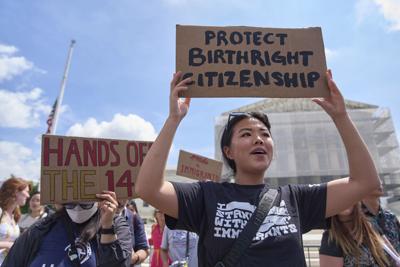


Hannah Liu, 26, of Washington, holds up a sign in support of birthright citizenship, May 15, 2025, outside of the Supreme Court in Washington. (AP Photo/Jacquelyn Martin, File)
As the U.S. Supreme Court finished hearing oral arguments regarding the challenge to the Trump administration's birthright citizenship executive order on Wednesday afternoon, many local and federal organizations have expressed what is truly at stake for immigrants, mixed-status families and citizens in this highly anticipated case.
“This executive order and the way the administration is proposing its implementation will affect everyone in this country, not only immigrant communities,” Eileen Ma, director of the Asian Law Caucus’s (ALC) National Democracy Initiative Program, told CALÒ News.
The ALC is part of a coalition serving as co-counsel on the Trump v. Barbara case, which could deny citizenship to children born on U.S. soil if their parents lack permanent immigration status and could force families to navigate invasive documentation requirements.
As CALÒ News previously reported, on the first day of his second term, Trump signed an executive order restricting birthright citizenship, challenging the 14th Amendment, which affirms that children born in the U.S. are entitled to immediate citizenship, even if their parents do not have that status.
After the lower courts blocked the executive order, the American Civil Liberties Union (ACLU) and other partners sued the administration.
On April 1, over a year and two months since Trump signed the order, oral arguments began in a heavily packed courtroom, where phones and recording devices were not allowed.
While a definitive ruling by the Supreme Court is not expected until early summer, Ma said ALC has been working closely with the ACLU to prepare and protect the rights of American citizens even after the hearing and ruling.
The defending attorneys from the ACLU and co-counsel were led by Cecillia Wang, who argued against ending birthright citizenship, while Solicitor General D. John Sauer argued on behalf of the Trump administration.
Ma said that, with some of the administration's proposed changes under the executive order, such as the Enumeration at Birth (EAB) process, negative connotations of ending birthright citizenship will fall on all Americans, as many will find it difficult to claim and prove their citizenship.
For decades, the EAB system has allowed parents to check a box at the hospital to receive a Social Security number for their newborn child.
In this process, a state birth certificate is sufficient evidence for the Social Security Administration to process this request, confirming U.S. citizenship based on the location of birth, but under Trump's executive order, a birth certificate will not suffice. Issuing a Social Security number would require evidence that at least one parent is a U.S. citizen or a lawful permanent resident at the time of birth.
Ma explained that this requirement would effectively force many parents to visit an SSA office in person to submit proof of their immigration status. She said many parents will not only fear being racially profiled, but it will also create a confusing and difficult-to-navigate bureaucratic process for elders and first-generation parents, many of whom are Latinos and only speak Spanish.
“It’s no secret that the large immigrant communities in this country are Latino and Asian. For generations now, people have relied on their birth certificates to prove their citizenship and this executive order radically alters that. You will have to then somehow prove, either through whatever flawed Social Security database the government chooses to do,” Ma said. “The generational impact over and the instability that that causes in our community will be unspeakable.”
According to the Pew Research Center, more than 250,000 babies are born to undocumented immigrant parents in the U.S. each year.
Local leaders said these kids deserve the stability that the 14th Amendment has provided for more than 150 years, since it was passed in 1866, granting citizenship to all persons "born or naturalized in the United States," including those formerly enslaved.
“Birthright citizenship is not only a cornerstone of our democracy but is also enshrined in both the 14th Amendment of the U.S. Constitution and laws passed by Congress. Every person born on U.S. soil deserves the inherent rights and protections that citizenship provides. President Trump's executive order fosters an environment of fear and uncertainty,” said Angelica Salas, executive director of the Coalition for Humane Immigrant Rights (CHIRLA). “It is essential to ensure that citizenship at birth is a bedrock guarantee, not something to be granted or rescinded subject to the whims of bigoted rulers.”
For organizations like the ALC, executive orders like that of terminating birthright citizenship are closely linked to Trump's anti-immigration agenda, including the intense U.S. Immigration and Customs Enforcement (ICE) raids in cities like Los Angeles, which began in June 2025 and continue in 2026.
“We have these unrestricted ICE raids, where there's massive racial profiling going on. We can imagine that this [executive order] would be almost like a show-your-papers kind of thing for anyone at any time,” Ma said.
According to Trump's executive order, birthright citizenship is not a universal given right under the Constitution's 14th Amendment. Although the amendments stated that “all persons born or naturalized in the U.S., and subject to the jurisdiction thereof, are citizens of the U.S. and of the State wherein they reside,” he argues that the phrase “subject to the jurisdiction thereof” requires more than just being physically present on U.S. soil when born and instead subject to U.S. laws.
“What’s on the line isn’t just a question about citizenship. It is about upholding the Constitution. It’s respecting the rule of law and keeping the promise that the 14th Amendment has held for more than 150 years. Don’t just take my word for it — the courts have upheld it over and over again, and we’re going to do it again once and for all,” said U.S. Sen. Alex Padilla (D-Calif.) at a rally outside the Supreme Court building on Wednesday.
Ma said the constitutional implications of this case are what make it even more impactful.
“If this executive order is allowed to take effect, it will mark such a drastic change in how we understand our democracy and how we understand constitutional law,” she said. “If this passes, we're saying that one person can change what the rights are for our democracy and I think that should be alarming to everybody.”





(0) comments
Welcome to the discussion.
Log In
Keep it Clean. Please avoid obscene, vulgar, lewd, racist or sexually-oriented language.
PLEASE TURN OFF YOUR CAPS LOCK.
Don't Threaten. Threats of harming another person will not be tolerated.
Be Truthful. Don't knowingly lie about anyone or anything.
Be Nice. No racism, sexism or any sort of -ism that is degrading to another person.
Be Proactive. Use the 'Report' link on each comment to let us know of abusive posts.
Share with Us. We'd love to hear eyewitness accounts, the history behind an article.