
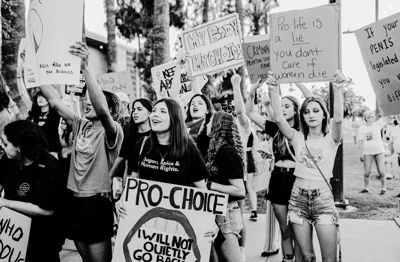



On June 24, 2022, Roe v. Wade was overturned, allowing states to ban abortion. Photo by Lauren Mitchell
A day like today, on January 22, 1973, the United States Supreme Court issued its 7-2 decision in Roe v. Wade, legalizing abortion nationwide. Since 2022, that decision has been overturned, making abortion no longer a protected constitutional right.
Reproductive rights advocates say abortion bans, misinformation and even the recent immigration raids have pushed abortion care further out of reach for women, including Latinas.
L.A organizers call the court's decision to overturn Roe v. Wade a “violently revoked” constitutional right. Emiliana Guereca, an activist and president of Women's March Foundation L.A said this decision has led to devastating and immediate consequences throughout the country.
“For 53 years, Roe v. Wade represented what many of us considered settled law: a constitutional protection affirming a woman’s right to bodily autonomy and the power to make her own reproductive decisions. However, we have learned the painful lesson that rights are only as secure as the courts interpreting them,” Guereca said. “The current Supreme Court has demonstrated a willingness to reinterpret, or simply erase long-standing precedent at will.”
Nationwide, other organizers claim that women's rights and abortion accessibility, as well as immigration justice are interconnected struggles.
Lupe M. Rodríguez, executive director of the National Latina Institute for Reproductive Justice, said abortion rights, even when legal nationwide, were inaccessible to many working-class women, but today that reality has worsened.
“While [today] would have been the anniversary of Roe v. Wade, we know that the protections it provided were never enough. Even before Roe was overturned, it was difficult for many people, especially Latinas and immigrant communities, to get the abortion care they needed,” she said. “Over the last few years, abortion bans, misinformation about abortion, cruel immigration raids and cuts to Medicaid have made a difficult healthcare landscape even worse.”
In California, where abortions are not only legal but heavily protected, health providers fear that the U.S. Immigration and Customs Enforcement (ICE) raids have caused many women, especially those who are undocumented, to avoid clinics, delay care or skip necessary medical services entirely.
Undocumented patients
Locally, clinics in L.A., such as St. John’s Community Health, have reported a dramatic increase in canceled appointments.
St. John’s Community Health told Spectrum News last June that no-show rates rose to 30% or more, particularly among their at least 25,000 undocumented patients.
“Now, in 2026, the country is witnessing the most extreme attacks on reproductive health and abortion access in modern history. Clinics are being forced to close nationwide. Access to care is becoming scarcer, more expensive, and, in far too many cases, entirely unavailable,” Guereca said.
According to new data from Physicians for Human Rights (PHR) and Migrant Clinicians Network (MCN), which surveyed 691 health care workers across 30 states working with immigrant populations, the risk of encountering immigration officials has kept many family members, including mothers, from accessing health screenings, putting their health at risk.
The PHR found that 84% of surveyed health care workers reported significant or moderate decreases in patient visits since the January 2025 executive orders on immigration. In addition, 26% of clinicians reported that immigration enforcement has directly affected patient care, with 7% reporting they have seen ICE or Customs and Border Patrol (CBP) inside their facilities.
Health care workers also reported that the services affected the most since the raids were preventive services, which for women include STI testing, pap smears and reproductive and maternal health.
“Our clinical network is sounding the alarm: fear is keeping migrant and immigrant children from critical care to stay safe and healthy,” Laszlo Madaras, chief medical officer for MCN, said. “Health care is a human right. When fear blocks care for some, it harms all of us.”
Planned Parenthood, the leading non-profit organization providing affordable sexual and reproductive healthcare, sex education and advocacy throughout the U.S., has consistently denounced the culture of fear ICE raids bring.
“No one’s health should be compromised because of their immigration status. Health care is a human right,” the organization states on its website. Planned Parenthood serves over 560,000 Latino patients each year, according to Latinos for Planned Parenthood.
Background
On June 24, 2022, Roe v. Wade was overturned, allowing states to ban abortion. In Dobbs v. Jackson Women’s Health Organization, the Supreme Court concluded that the right to an abortion is not a fundamental right recognized by the Constitution, making the right upheld for nearly half a century no longer existent.
The majority opinion, authored by Supreme Court Justice Samuel Alito, argued the Fourteenth Amendment's Due Process Clause guaranteeing liberty didn’t protect abortion because it wasn't recognized at the nation's founding, citing common law and early state laws criminalizing abortion.
“We hold that Roe and Casey must be overruled. The Constitution makes no reference to abortion, and no such right is implicitly protected by any constitutional provision, including the one on which the defenders of Roe and Casey now chiefly rely—the Due Process Clause of the Fourteenth Amendment,” he said.
The decision returned abortion regulation to "the people and their elected representatives," meaning that abortion laws are now completely determined by state laws.
In states like Alabama, Idaho, Indiana, Louisiana, Mississippi, North Dakota and Oklahoma, among others, abortion is fully banned and in Florida, Georgia, Iowa, Massachusetts, Nebraska and South Carolina, among others, the abortion laws are strict and have restrictions.
“It’s time for true reproductive justice for all of us. We must put people before politics and ensure that everyone, no matter who they are, where they live, how much they earn or their immigration status, can get the care they need and make their own decisions about their bodies and futures,” Rodríguez said.
Locally
Local leaders believe the fight in support of abortion rights and expanding reproductive rights to other states continues, especially as California is often referred to as the "haven state" for reproductive care.
Today, California protects abortion access, making it legal and accessible, even for out-of-state residents, with strong laws preventing restrictions based on gestational age, allowing minors to consent without parental notice and shielding providers and patients from liability.
“There is no law on the books that governs men's bodies. There are certainly none that can be arbitrarily interpreted and enforced against them at the state level,” Guereca said. “History will remember this moment—not just for the rights that were taken, but for the resistance that rose in response. Silence is not neutrality; it is permission. And women are done asking for permission.”






(0) comments
Welcome to the discussion.
Log In
Keep it Clean. Please avoid obscene, vulgar, lewd, racist or sexually-oriented language.
PLEASE TURN OFF YOUR CAPS LOCK.
Don't Threaten. Threats of harming another person will not be tolerated.
Be Truthful. Don't knowingly lie about anyone or anything.
Be Nice. No racism, sexism or any sort of -ism that is degrading to another person.
Be Proactive. Use the 'Report' link on each comment to let us know of abusive posts.
Share with Us. We'd love to hear eyewitness accounts, the history behind an article.