
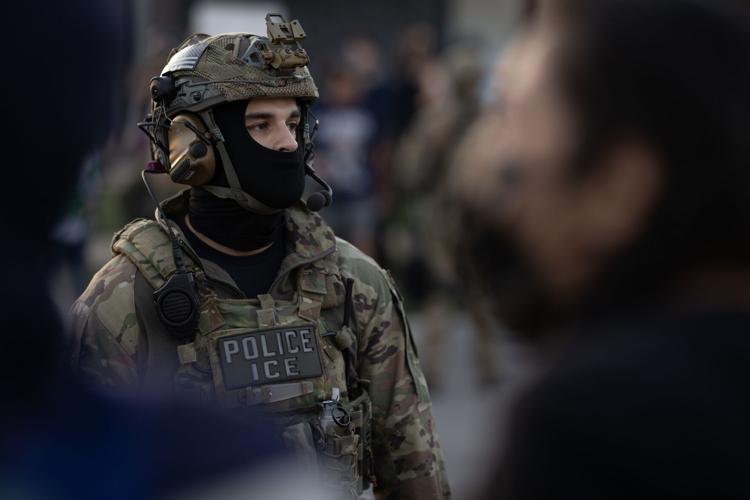

Federal law enforcement agents confront demonstrators protesting outside of an immigrant processing center on September 27, 2025 in Broadview, Illinois. (Photo by Scott Olson/Getty Images)
As federal immigration authorities reportedly prepare a significant increase in enforcement operations in metro Phoenix, community leaders and organizers are drawing on lessons learned from when former Maricopa County Sheriff Joe Arpaio was rounding up immigrants in the early 2000s to face the potential threat to the immigrant communities that make up the Valley.
Speaking to former Department of Homeland Security (DHS) personnel, The Bulwark reported last week that the department intends to transform the Valley into a “hub of removal” for the Southwest. The surge in enforcement operations would mirror recent large-scale actions in other major metropolitan areas, such as Los Angeles and Chicago.
Phoenix, a city home to one of the largest populations of Latinx people in the country, has been put on edge since news broke of a potential expanded deployment of federal immigration agents.
The reportedly planned “focus of arrests, detentions, and deportations” in the city would follow a year of intensified activity in Arizona, where data shows Immigration and Customs Enforcement (ICE) arrests have already tripled over the last fiscal year.
Amid speculation, the Arizona Governor’s office has moved to gather more information, with Press Secretary Liliana Soto confirming that the administration has contacted the federal government for clarification.
Gov. Katie Hobbs has maintained a clear stance, emphasizing that the state will not participate in “indiscriminately rounding up individuals” or enforcement activities that violate civil rights and harm communities, Soto said in an email statement sent on Wednesday to CALÓ News.
An ICE spokesperson declined to comment on any plans for more enforcement operations in Phoenix. “Due to operational security and officer safety consideration ICE does not discuss any alleged ongoing, upcoming, or planned immigration enforcement operations,” the spokesperson said in an emailed statement to CALÓ News.
Community organizes to meet the moment
Beth Strano, co-founder and executive director of the Borderlands Resource Initiative, said local groups have been preparing for an escalation — assisting migrants with notarized family preparedness documents, court accompaniment and legal filings — in anticipation of the announcement of a new ICE Phoenix Field Office director.
News broke last October of a shakeup in senior leadership affecting ICE’s field offices.
Field directors in the country’s biggest cities, including Phoenix, were to be reassigned and replaced with leaders from other parts of DHS. Speculation surrounding the motive for the leadership purge centers on a strategic shift toward the more aggressive enforcement model seen in recent operations by Customs and Border Protection (CBP) in major cities.
“Our approach is rooted in resilience, not reaction,” Strano said.

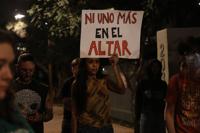
As heightened immigration enforcement activity makes its way into Phoenix and Tucson areas, these groups are stepping up to support immigrants.
Strano argued that increased enforcement “only intensifies fear and separation,” noting that ICE presence in public spaces does not make the community feel safer.
“The threat of mass street-level arrests, raids and surveillance is meant to intimidate and isolate. Our response is to build deeper solidarity and stronger community ties,” Strano said.
Raquel Terán, the former Arizona Democratic Chair who now works with Proyecto Progreso, an Arizona-based immigrant rights group, emphasized that while news of a potential surge is intimidating, community members have a long-standing history of organizing in response to such targeting.
“Things may seem scary and intimidating at times, but what we have learned over the years is that there is power in numbers,” Terán explained.
The organizers, responding to the recent increase in immigration law enforcement, are leveraging decades of experience to inform and safeguard residents through observation and information sharing, she said.
“We’ve revamped what we have learned over the decades. Whether it was during the reign of Arpaio or during the SB 1070-high or even the last administration,” Terán said. “The folks who have already been through the trenches. We're able to put it into a structure, a rapid response hotline and the infrastructure of getting people out into the community to observe.”
Arizona’s history of resilience has demonstrated to the community that “there is power in informing our community, there’s power in educating our community” as a key way to protect against targeted immigration enforcement efforts, she added.
John Mitchell, an Immigrants’ Rights Attorney with the American Civil Liberties Union (ACLU) of Arizona, warned that an increase in both enforcement and detention would be “catastrophic” for the region.
“This is an obvious area of concern for us at the ACLU of Arizona to hear about potential plans for increased both in enforcement and in detention capacity,” Mitchell told CALÓ News in a phone interview on Tuesday.
He noted that the organization is closely monitoring these developments, drawing on observations from affiliates in other major cities where similar surges have occurred.
For months now, the ACLU of Arizona’s organizing team has routinely conducted “Know Your Rights” presentations to ensure residents understand their constitutional protections and the legal limitations of law enforcement.
Mitchell emphasized that an “enduring democracy depends on engagement and understanding of the rights that are guaranteed to everyone within Arizona”. He argued that it is critically important for anyone present in the U.S., regardless of status, to understand how their rights apply in real-world scenarios, such as law enforcement encounters or protests.

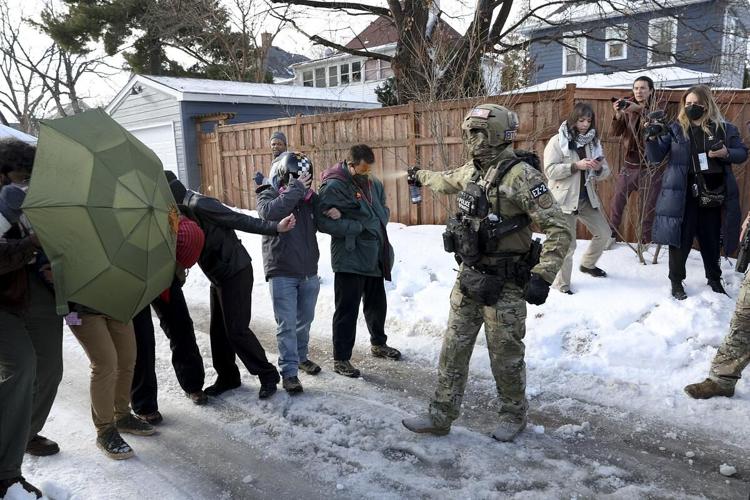
A federal agent sprays a protester with pepper spray while protesters block an alleyway nearby the scene where an observer of immigration enforcement officers was shot as ICE continues Operation Metro Surge on Wednesday, Jan. 7, 2026, in Minneapolis, Minn. Credit: Ellen Schmidt/MinnPost/CatchLight Local/Report for America
Lawmakers warn that increased immigration law enforcement hurts families
As community members prepare and intensify their efforts, state lawmakers and congressional members have called on the Trump administration to call off the reported expanded operation in Phoenix.
On Tuesday, State Senator Analise Ortiz (D-Phoenix) told CALÓ News that enforcement actions have effectively transformed “brown skin” into “probable cause.”
“Trump lied to the American people when he said he would only go after the most violent, dangerous people,” Ortiz said. She noted that recent raids, including one that occurred this week at a Phoenix Home Depot on 36th Street and Thomas Road, have targeted “hardworking members of our community” and small business owners.
U.S. Rep. Greg Stanton (D-AZ) also criticized the reports on social media, stating that targeting community members “tears families apart and sows fear in our neighborhoods,” while his colleague, U.S. Rep. Yassamin Ansari (D-AZ), who represents Arizona’s 3rd Congressional District, condemned the reports of expanded raids.
“The reports of a planned ICE surge in Phoenix are an affront to the values of our community,” Ansari stated in a video shared on social media. “We cannot allow our neighbors to be targeted and warehoused in repurposed buildings like products. This administration’s focus on tearing families apart rather than fixing our immigration system is a tragedy for Arizona.”
Hobb’s office, over the past year, has repeatedly said it was willing to work with federal partners regardless of party to reduce the number of drugs on Arizona’s streets coming over the southern border.
But Soto explained that while the governor supports law enforcement that prioritizes public safety, she rejects “political stunts designed to create chaos or instill fear” and policies that “chase deportation quotas” instead of stopping drug smuggling and human trafficking.
Soto urged the federal administration to fulfill promises of removing “drug dealers and criminals” rather than targeting established community members.
Data shows rising arrest rates
Internal data from the Immigration and Customs Enforcement agency shows a significant shift toward more “street-level” arrests in Arizona following President Donald Trump’s inauguration.
A CALÓ News analysis of ICE arrest records, obtained via a FOIA request by the Deportation Data Project, shows over 6,000 arrests in Arizona during the 2025 fiscal year (from Oct. 2024 to Sept. 2025).
While “custodial” arrests—where individuals already booked into local jails are taken into custody—more than doubled, “non-custodial” or street-level arrests increased sevenfold. About 70% of those apprehended at the street level had no prior criminal convictions.
The anticipated surge aligns with a broader federal effort to industrialize and accelerate the deportation process.
Speaking at the 2025 Border Security Expo at the Phoenix Convention Center last April, Acting ICE Director Todd Lyons outlined an expansive logistical vision that likened federal immigration operations to the efficiency of e-commerce operations.
“We need to get better at treating this like a business,” Lyons said during a “State of the Border” panel, explaining his goal of achieving a removal speed similar to a 24-hour delivery window. “So, trying to figure out how to do that with human beings and trying to get them pretty much all over the globe is really something for us.”
U.S. border czar Tom Homan echoed this call for private-sector integration, telling industry leaders he wants to offload administrative responsibilities to contractors to “let the badge and guns do the badge-and-gun stuff.”
To support this high-volume model, ICE is scouting large-scale “mega-detention centers.” The Washington Post reported on Dec. 24, 2025, that the agency is considering renovating a warehouse site in Glendale to serve as a processing facility for up to 1,500 detainees.
Raphael Romero Ruiz is a journalist and a graduate fellow at the Howard Center for Investigative Journalism and now lives in Baltimore. Born and raised on the southside of Tucson, Arizona, he formerly covered the border beat for The Arizona Republic, reporting on immigration issues and communities across the Arizona-Mexico borderlands.







(0) comments
Welcome to the discussion.
Log In
Keep it Clean. Please avoid obscene, vulgar, lewd, racist or sexually-oriented language.
PLEASE TURN OFF YOUR CAPS LOCK.
Don't Threaten. Threats of harming another person will not be tolerated.
Be Truthful. Don't knowingly lie about anyone or anything.
Be Nice. No racism, sexism or any sort of -ism that is degrading to another person.
Be Proactive. Use the 'Report' link on each comment to let us know of abusive posts.
Share with Us. We'd love to hear eyewitness accounts, the history behind an article.