
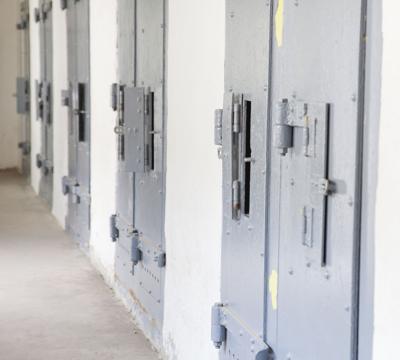


A new Harvard Law report details that ICE saw more than 14,000 placements in solitary confinement between 2018 and 2023.
This use of solitary confinement in its extensive form as the report documents, is not only contrary to ICE’s policies and guidance but it also violates U.S. constitutional law and international human rights laws like the UN’s directive on solitary.
As the election campaigns from Democrats, Republicans and independents ramp up, immigration to the U.S. has become one of the leading concerns and issues for voters and overall American public discourse. What remains interesting is that Barack Obama in 2012 to Hillary Clinton in 2016 and Joe Biden in 2020- Democrats have touted a positive support of immigration and a desire to decrease detention and support people who are currently detained in immigration facilities. Yet their rhetoric seems to keep shifting to conservative policies that only continue the reign of what experts and formerly incarcerated detainees call a tortuous process of immigrating to the United States.
The report is co-authored by the Immigration and Refugee Clinical Program, Dr. Arevik Avedian, a lecturer on law and director of Empirical Research Services at Harvard Law School, and partners at the Harvard Student Human Rights Collaborative.
The comprehensive almost ten-year report is titled “Endless Nightmare:Torture and Inhuman Treatment in Solitary Confinement in U.S. Immigration Detention.”
Through the use of Freedom of Information Act requests and carefully conducted interviews with former detainees nationwide, the researchers and law students were able to capture a historic picture of the nationwide legacy of solitary confinement in immigration detention centers.
Solitary confinement continues
The report shows that the use of solitary is still prevalent between the Trump and the current Biden administration. During the 2020 campaign Biden promised to end solitary confinement, yet the report details an increase in the frequency of people being sent to isolation and the duration has also even extended.
During its first month in office, the Biden administration issued an executive order in January 2021 directing the Department of Justice to end its contracts with private prison companies but excluded ICE detention from the order. The number of immigrants detained by ICE and revenues for private prison companies — has only increased.
Sara Mortenson, managing attorney for the American Bar Association’s Immigration Justice Project tells me that she “has not seen an improvement between administrations.” In her time representing currently detained immigrants, she has seen multiple cases of people being sent to what ICE calls disciplinary segregation due to their mental illness.
Just last summer, she had a client, a man who grew up in this country who was on an ICE detainer. A Honduran immigrant in his 40s. In August of 2023 he was transferred from Imperial to Otay Mesa Detention center and struggled with paranoid schizophrenia. During his intake, he was triggered during the process and instead of receiving mental health care, officers came into the room in riot gear. Because he put his arm up to defend himself, they placed him into disciplinary solitary.
ICE doesn’t always inform their attorneys for the hearings or transfers to solitary. In some cases, they get an hour a day with a tablet and can’t communicate with anyone else but their attorney, like for Mortenson’s client. The room is a cement box, no windows, no one to talk to but the guard.
No entertainment but a tablet. That is their life line. Through it they communicate with only their attorney and can make orders through the commissary.
What are the solutions?
“You can go to solitary” for a fake sick call or threat to harm yourself, Mortenson said.
This type of environment makes people not get help for things that are serious, yet there are cases that when people ask for help, it doesn’t always go the best way. In 2018, Monika Langarica, senior staff attorney for the UCLA Center for Immigration Law and Policy, represented a woman who had been in solitary confinement for more than four months due to a suicide attempt.
Her multiple requests for her client to be released were met with rejections at the time and got to see her client’s mental health continue to deteriorate.
The top demands of the Harvard report are to stop solitary confinement in totality. Over the last two years, Langarica has dedicated her time in supporting law and policy to support immigrants across the country. Just two years ago, Newsom vetoed a bill that would've limited the use of solitary to no more than 45 days. Langarica was one of the lead supporters of this bill.
The bill would’ve been the first in the country to have started to both regulate and possibly end solitary in immigration detention centers.





(0) comments
Welcome to the discussion.
Log In
Keep it Clean. Please avoid obscene, vulgar, lewd, racist or sexually-oriented language.
PLEASE TURN OFF YOUR CAPS LOCK.
Don't Threaten. Threats of harming another person will not be tolerated.
Be Truthful. Don't knowingly lie about anyone or anything.
Be Nice. No racism, sexism or any sort of -ism that is degrading to another person.
Be Proactive. Use the 'Report' link on each comment to let us know of abusive posts.
Share with Us. We'd love to hear eyewitness accounts, the history behind an article.