
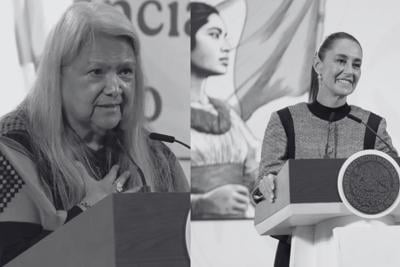


Inés Hernández-Ávila attended la Mañanera, Mexico’s daily presidential press conference. Collage made by Brenda Verano
Inés Hernández-Ávila, a native studies professor at the University of California, Davis, attended la Mañanera, Mexico’s daily presidential press conference led by President Claudia Sheinbaum, where she, along with other guest speakers, discussed Indigenous resistance and the reframing of Malintzin.
Malintzin, most popularly known as La Malinche, was a Nahua Indigenous woman commonly known for her role as a translator and intermediary for the Spanish conquistador Hernán Cortés.
“I come representing Chicana women in the United States—activists, thinkers, artists, poets, academics—who have made Malintzin our own,” Hernández-Ávila said in Spanish. “Malintzin represents for us [feminists] an inimitable and, therefore, inspiring Indigenous woman, for her incredible capacity to realize herself as an autonomous and brilliant being, despite her very complex and difficult circumstances. She lives in our hearts and in our consciences.”
Hernandez-Avila, who is of the Nimiipuu (Nez Perce) Indigenous people on her mother's side and Tejana (Mexican-Indigenous) on her father's side, also touched on the Chicano Movement of the 1960s, which took force in places like the East Los Angeles walkouts demanding educational equality, bilingual programs and a Chicano history curriculum.
“We are all looking for what had been prohibited from us in U.S. schools, where speaking Spanish was not allowed,” she said. “We teach [about Malintzi] in Chicano studies, a program we had to win through struggle, protest, marches and by demanding that universities open spaces for us to teach our perspective. That's where we come from, almost like orphans from Mexico.”
Hernández-Ávila, who is also an activist and poet, has taken on research interests that include Native American women's literature, Native American religious traditions, Chicana feminisms, womanisms and spiritualities.
One of the most impactful parts of her speech in the November 28 press conference was when she made reference to the Chicano community's support for the current leadership in Mexico.
“I want to say, on behalf of us, not only the women but all Mexicans in the U.S., but especially Chicanos: she gives us hope that another world is possible,” she said, referencing Sheinbaum, who was standing beside her. “Because right now, as you all know very well, we are experiencing hatred against Mexicans and hatred against women propagated by the 47th [president of the U.S.]
Before leaving the podium, she thanked Sheinbaum for allowing her the opportunity to address the people of Mexico.
Approximately 40 million people of Mexican origin live in the U.S., making them the largest Latino group.
On his first day in office, Trump issued an executive order seeking to end the constitutionally guaranteed right to birthright citizenship, putting thousands of Chicanos at high risk.
Despite this, birthright citizenship continues to stand today, partly because of organizations like the American Civil Liberties Union's appeals and organizing.
On Friday, December 5, Sheinbaum and Trump met for the first time in Washington, D.C., on the sidelines of the 2026 FIFA World Cup draw. Among other things, they discussed ongoing trade issues.





(0) comments
Welcome to the discussion.
Log In
Keep it Clean. Please avoid obscene, vulgar, lewd, racist or sexually-oriented language.
PLEASE TURN OFF YOUR CAPS LOCK.
Don't Threaten. Threats of harming another person will not be tolerated.
Be Truthful. Don't knowingly lie about anyone or anything.
Be Nice. No racism, sexism or any sort of -ism that is degrading to another person.
Be Proactive. Use the 'Report' link on each comment to let us know of abusive posts.
Share with Us. We'd love to hear eyewitness accounts, the history behind an article.