
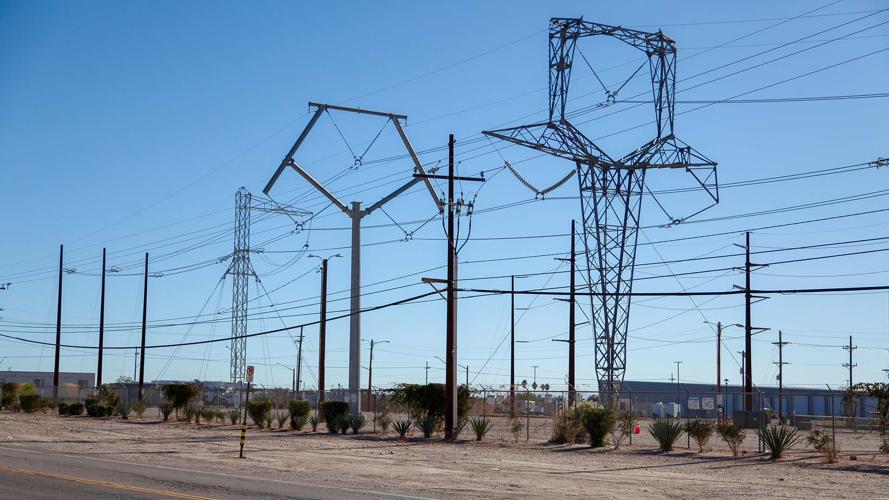

Power lines at the TEP Irvington Substation. (Daniel Ramirez/AZPM News)
The U.S. data-center boom could raise rates on Americans’ utility bills across the country. But, in places like Tucson, local governments are trying to get ahead of the curve and develop regulations to protect the surrounding communities’ best interests.
But some residents say that isn’t good enough.
“The fact that we have such limited resources here and for Mayor and Council to even think that it’s okay to even go this route for a possible data center is absolutely ridiculous,” says Diane Marzonie.
Marzonie, a Tucson resident, attended a community meeting hosted by the City of Tucson last Thursday, to provide input on a proposed data-center ordinance.
“Anybody that wants to put a data center like that in the desert seems sort of silly to me because the resources are so scarce,” she said.
Many Pima County residents have been vocal in their concerns that data centers will not only deplete precious water resources, but exacerbate demand on the local grid.
After numerous presentations and public meetings, Beale Infrastructure, the developer of Project Blue, changed its plans for a 290-acre prospective data center near the Pima County Fairgrounds.
“The data center will use an air-cooled design, which will consume no water for cooling,” Beale said in a press release. Beale also made the commitment to match 100% of energy use at the facility with renewable energy. “To achieve this, Tucson Electric Power will serve the data center through an energy supply agreement and Beale will seek to accelerate the development of new renewable energy resources for TEP’s grid that produce enough energy to match 100% of the data center’s energy consumption– at the data center’s cost.”
Tucson Electric Power has remained steadfast in assuring that its customers will be protected from paying for the energy demand needed to power Project Blue.
TEP has said that this energy supply agreement offers more consumer protections than required.
“Large industrial customers like the proposed data center help keep rates stable by spreading fixed system costs across more kilowatt-hours providing affordability benefits for all customers,”the company said in a press release.
TEP spokesperson Joe Barrios says the agreement would provide up to 286 megawatts of capacity, which the utility would be able to provide by using existing resources or some other clean energy projects under development.
Attorney General Kris Mayes isn’t convinced. In February, Mayes sued the Arizona Corporation Commission – Arizona’s utilities regulators – over that agreement, arguing that it allows TEP and Beale Infrastructure to change electricity rates without approval.
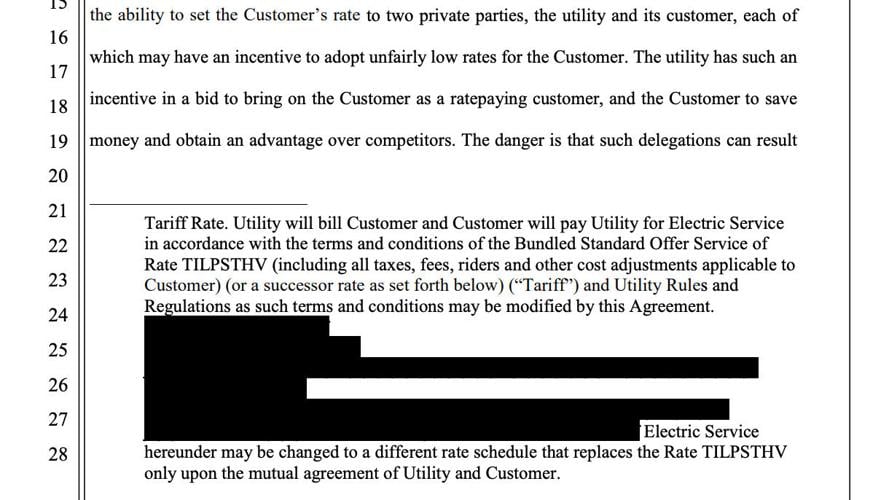
“I’ve never seen anything like that in all my time as Attorney General or as a Corporation Commissioner. They redacted the contract,” Mayes said.
Barrios says that the facility will be charged a standard commercial rate, "If the customer were to consider going on a different rate, that is still something that would have to be reviewed and approved by the Arizona Corporation Commission."

Screenshot taken from Attorney General Kris Mayes' rehearing request for the energy supply agreement between TEP and Beale Infrastructure. (Katya Mendoza, AZPM News)
Mayes has also intervened in a separate TEP proposal to raise residential consumer rates by 14%.
TEP says residential customers could expect to see their monthly bills rise by about $16 to$20, and that the increase is necessary to recover infrastructure costs, equipment, maintenance and improvements to the grid – investments that amount to $1.7 billion according to its website.
“I think that what’s causing prices to go up right now, has been delayed improvements to the grid and those have been put off for years across the country and utilities are now catching up,” says Mark Wolfe, executive director of the National Energy Assistance Directors Association. The organization represents state directors of the Low Income Home Energy Assistance Program.
Wolfe estimates about 85 active rate-increase cases nationwide.
“They feel they must improve the reliability of the grid, in part to meet the needs of data centers. Data centers need a much higher level of reliability than ordinary families need, even regular factories. So all that together is making the cost of electricity not just increase this year, but increase in the next couple of years,” Wolfe said.
What is actually raising rates?
Wolfe says it’s not just one thing, but about five things:
- the rising costs of natural gas, a major feeder fuel to produce electricity
- upgrades to the grid, the delivery system for electricity that gets electricity to homes
- data centers, large facilities that use enormous amounts of electricity to run around the clock
- inflation, wages are going up, so is equipment
- actions driven by the administration, requiring utilities to continue to use coal plants
“And then at the same time, the [Trump] Administration is pushing and increasing exports of natural gas, putting more pressure on domestic prices, so that together is making things very difficult for ordinary families.”
In the U.S., electricity prices have increased 13% in 2025, according to the climate advocacy organization, Climate Power.
How can families catch up?
Families can utilize the Low Income Home Energy Assistance Program known as LIHEAP. This is a program that helps households that pay a majority of their income on cooling or heating bills, that need assistance with payments for energy-related utilities.
According to DES, last fiscal year, about 31,900 Arizona households were served: “In FFY25, approximately $5.5 million of the total FFY25 LIHEAP allocation of $33.8 million helped eligible Pima County residents with utility assistance.”
LIHEAP receives about $4 billion from the federal government, Wolfe said. Last year, however, President Donald Trump threatened to eliminate funding for the program for fiscal year 2026. The Department of Health and Human Services also fired the entire LIHEAP program staff in April 2025.
“We expect [to] help close to six million households this year,” Wolfe said. “We’re again expecting the administration to zero out the program, but what’s happening is that rising temperatures in the summer mean we need to have more funds to help families pay their cooling bills in addition to continued cold winters.”
The affordability crisis
The average residential energy bill has increased by 30% since 2021, according to the Bureau of Labor Statistics.
“But since 2021, prices have been going up faster than inflation, that’s the problem,” Wolfe said.
“We are living in a time where people just can’t afford their lives anymore,” Mayes said. “When you throw on top of that, a proposed 14% rate increase, which follows two prior rate increases, it’s just too much.”
The last time TEP raised its rates was in 2023 by 10% after a rate-case proceeding and in 2021, by 6% due to increased costs and fuel and power.
“If it’s something that somebody needs for basic survival, then it should’ve be at the behest of profits, it shouldn’t be to make money, it shouldn’t be commodified,” says Ward 6 Councilmember Miranda Schubert.
Schubert attended Mayes’ town hall meeting on Feb. 24, and recalled a woman in the audience speaking about power disconnections during the summer months.
According to TEP, there were 13,389 residential disconnections in 2025 – about 96% of those customers were reconnected.
“I’m also worried that at some point, more and more people are going to be having to choose between paying their electric bill and feeding their families or taking medications, and that is just a choice that nobody should have to make,” Mayes said.
“The current system isn’t working well when more and more people can’t afford to pay the bill,” said Wolfe, the National Energy Assistance Directors Association director. “I think that long term, renewable energy is the solution to many of these problems.”
Others in Tucson believe that a publicly owned utility might be.
The push for public power
The Tucson Mayor and Council are considering what a municipally-owned utility would look like. Last year, it commissioned a study that suggested a full takeover of TEP’s assets would cost taxpayers up to $3.6 billion.
TEP has countered that, estimating $4 billion.
“There’s no reason we should trust those numbers and there’s no reason for the Mayor and Council to be repeating those numbers or saying that it’s going to take 10 years and drag out in court,” said Lee Ziesche, a climate justice organizer with the Tucson Democratic Socialists of America and vocal supporter of public power.
“I think there’s hesitance, just because it’s pretty unknown,” Schubert said. “I think the seeds are there and I just want to nurture them because I have heard from the community loud and clear that that is what they’re interested in.”
Schubert co-hosted a town hall with the Tucson DSA about rising energy rates last month.
Both Schubert and Ziesch said that they heard from individuals on fixed incomes whose budget billing has recently doubled.
“We really want people to buy into this vision of a better utility for us,” Ziesch said.
“I think that at least on paper, a municipally owned utility offers a lot of advantages,” Wolfe said. “The downside is that you have to buy out the existing utility and that might not be worth the trouble.”
President Trump has an alternative solution.
President Trump’s promises
President Trump spent the campaign trail for his second term pledging to slash grocery prices and power bills.
“I will cut the price of energy and electricity in half,” he said at a rally in Detroit, in 2024.
During this year’s State of the Union Address, he announced a new ratepayer protection pledge as a response to growing concerns for energy demand from AI data centers:
We’re telling major tech companies that they have the obligation to provide for their own power needs. They can build their own power plants as part of their factory, so that no one’s prices will go up and in many cases, prices of electricity will go down for the community, and very substantially then…This is a unique strategy never used in this country before. We have an old grid. It could never handle the kind of numbers, the amount of electricity that’s needed. So I’m telling them they can build their own plant, they’re going to produce their own electricity. It will ensure the company’s ability to get electricity, while at the same time lowering prices of electricity for you and could be very substantial.
“I’d like to see it on paper, because I think there’s a lot of promises that people can make, politicians or government employees that make promises like that,” Marzonie said.
“I don’t think consumers care whether data centers produce their electricity or not,” Wolfe said. “What they want to see is that data centers are paying for their cost of running the grid and for their cost of producing electricity.”
TEP will be providing as much power to the Project Blue project as it would take to cool about 57,000 homes. The 10-year energy supply agreement includes monthly billing requirements at the same standard rate as other large customers and offers a three-year notice to cancel the contract that would be enforced by a monthly billing requirement.
The Canadian-owned utility company has remained steadfast that residential ratepayers will not subsidize the rates for the data center.
“Data centers should pay for the marginal cost of upgrading now…of the increased usage of electricity. Those are the kind of things that I’d like to see and that would take pressure off bills” Wolfe said. “Trump’s proposal is a step in the right direction because these are trillion dollar corporations.”
For residents like Marzonie, the debate over data centers is about more than two proposed facilities in Pima County. It’s about whether an arid-place like Tucson should shoulder the costs of the rapidly expanding AI industry.











(0) comments
Welcome to the discussion.
Log In
Keep it Clean. Please avoid obscene, vulgar, lewd, racist or sexually-oriented language.
PLEASE TURN OFF YOUR CAPS LOCK.
Don't Threaten. Threats of harming another person will not be tolerated.
Be Truthful. Don't knowingly lie about anyone or anything.
Be Nice. No racism, sexism or any sort of -ism that is degrading to another person.
Be Proactive. Use the 'Report' link on each comment to let us know of abusive posts.
Share with Us. We'd love to hear eyewitness accounts, the history behind an article.