
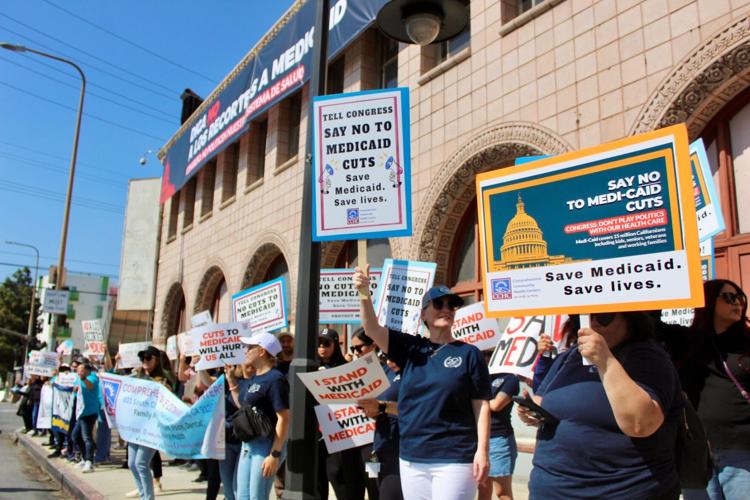


Hundreds of healthcare advocates, together with patients, gathered at the intersection of Santa Monica Blvd. and Vermont Avenue in Los Angeles on May 14, 2025. Photo by Brenda Verano
After months of negotiations, the California State Legislature is expected to pass a 2026-27 budget Monday evening that will delay various cuts to healthcare access proposed by Gov. Gavin Newsom.
The State Senate passed the $356 billion budget with a 28-9 party line vote Monday afternoon, with the State Assembly set to follow Monday evening. The budget pushes back on some of Newsom’s proposals from his May revision and takes yet another clear stance against federal budget cuts targeting healthcare and safety net programs.
June 15 is the formal deadline for both state houses to pass a Budget Act. Newsom is required to sign the final budget by the end of the month. Between now and the end of June, the real negotiation between the governor and Legislature begins, until a final budget is agreed upon and goes into effect on July 1.
“California Immigrant Policy Center is encouraged to see a legislative budget proposal that significantly improves on the governor's May revised budget with respect to investments in immigrant communities and we urge the governor to support the legislature's budget,” said CIPC Policy Director Josh Stehlik.
Many of the governor’s proposed restrictions to healthcare are due to changing federal requirements for Medi-Cal under the H.R. 1 budget bill passed last year by Congress. The bill is set to cost California around $30 billion in Medi-Cal funding and will result in 1.5 million Californians losing their healthcare coverage. In Los Angeles alone, around 600,000 residents are at risk of losing coverage.
Despite the Legislature proposing that the state delays most healthcare cuts, the budget is still being balanced “on the backs of [immigrants],” Sen. Maria Elena Durazo (D-Los Angeles) said during a Monday Senate budget hearing ahead of the Legislature’s vote.
Pushing healthcare cuts to another day
As seen in this budget, the Legislature is hesitant to adopt the governor’s plans to further restrict healthcare access for those with “unsatisfactory immigration status” (UIS), a term encompassing not just undocumented immigrants, but also asylees, refugees and human trafficking survivors.

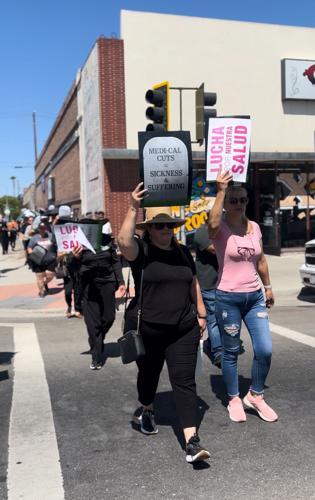
Hundreds marched to protest against the potential Medi-Cal cuts in May 2025. (Photo by Amairani Hernandez.)
In the Legislature's budget, there will be no change to the current asset limit in 2026-27; the test looks at the monetary value of the assets of seniors and adults with disabilities to determine Medi-Cal eligibility.
Newsom proposed lowering the limit to $2,000 in the upcoming 2026-27 fiscal year. Under the Legislature’s plan, the limit would be lowered to $21,000 in 2027-28.
The budget would also delay restrictions on dental benefits for UIS individuals by another year and prevent a new $50 premium for that population right now. Instead, the Legislature wants to leave this issue for the next governor to decide.
The Legislature adopted the governor’s proposal to move asylees and some undocumented immigrants to restricted-scope Medi-Cal, but again delayed this transition until 2027-28.
Newsom’s proposal to save around $570 million through moving UIS individuals to a fee-for-service system is still up in the air, as the Legislature’s budget notes it would “give the state time” to look into alternatives before the transition.
Under fee-for-service, individuals still receive full-scope coverage but will lose access to enhanced case management and community support services.
CIPC is ultimately supportive of the proposed delays, Stehlik said.
“Who is carrying the burden the most are poor, working class Black and brown Californians who are gonna be hurt the most by what we’re looking at today,” said Sen. Lola Smallwood-Cuevas (D-Los Angeles) during Monday’s budget hearing.
Originally introduced in the Senate’s budget proposal earlier this year, the Fair Share from Big Corporations Act now has formal support from the Assembly. The move would require big corporations in the state to pay into Medi-Cal.
Pouring into human services
Looking at securing safety net programs, the Legislature’s budget answers a call from immigrant rights activists to invest in immigration legal services. The budget allocates a one time $100 million increase of funding across a variety of support providers, in addition to the $75 million baseline funding.
The proposed budget addresses the federal cuts to CalFresh in part by allocating $30 million for emergency food banks, $100 million for the CalFood program and gives additional one-time funding to counties and hospitals in response to H.R. 1 cuts.
It also allocates $5 million to the California Food Assistance Program, the state’s alternative to CalFresh that provides food benefits to those who are ineligible for the federal program. Stehlik said this funding is a “stepping stone” to support humanitarian immigrants and those that are set to lose their CalFresh benefits due to updated work requirements through H.R. 1.
The Legislature’s budget also directs $900 million to the state’s homelessness fund, compared to Newsom’s proposed $500 million.











(0) comments
Welcome to the discussion.
Log In
Keep it Clean. Please avoid obscene, vulgar, lewd, racist or sexually-oriented language.
PLEASE TURN OFF YOUR CAPS LOCK.
Don't Threaten. Threats of harming another person will not be tolerated.
Be Truthful. Don't knowingly lie about anyone or anything.
Be Nice. No racism, sexism or any sort of -ism that is degrading to another person.
Be Proactive. Use the 'Report' link on each comment to let us know of abusive posts.
Share with Us. We'd love to hear eyewitness accounts, the history behind an article.