
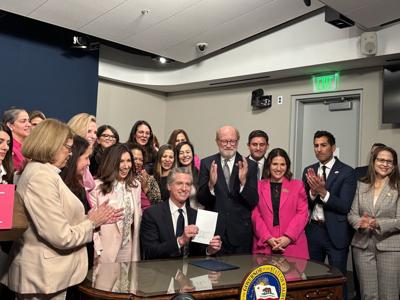


Governor Gavin Newsom was joined by the Legislative Women's Caucus on Wednesday when he signed into law $90 million in emergency funding for Planned Parenthood. (Andrea Valadez / CALÓ News)
In response to what California Democrats are calling a “war on women,” Governor Gavin Newsom signed into law on Wednesday a bill that allocates $90 million to Planned Parenthood health centers across the state.
State Senate Leader Monique Limón (D- Santa Barbara) and Assembly Speaker Robert Rivas (D-Salinas) announced Senate Bill 106 on Jan. 30 to take action amidst severe health care funding gaps that have persisted in the state since President Donald Trump’s H.R. 1 budget bill passed last July. The federal budget defunded Planned Parenthood and prohibited any Medicaid funding from being used for any services at the health care centers.
“Today is both a proud and somber moment,” Limón told reporters at a press conference on Wednesday. “The reality is, H.R. 1 has resulted in the loss of over $1.1 million per day for Planned Parenthood care centers in the state, and if California does not step up, centers will shutter. This $90 million investment will help keep their doors open and ensure that Californians will still have access to affordable care.”
Known for being the nation’s largest abortion provider, the nonprofit organization also provides a full spectrum of health care, including cancer screenings, STD testing and treatment, birth control services and more.
In July, Planned Parenthood Mar Monte, a Planned Parenthood affiliate with 30 health center locations in mid-California and Nevada, announced five of its health care centers would close due to the federal funding cuts. The clinic closures in Northern and Central California resulted in the loss of care for over 22,000 individuals. A few months later, the nonprofit announced more closures in Orange and San Bernardino counties.
The Legislature previously allocated $140 million to help keep clinics open back in October.
“This $90 million investment will provide a critical lifeline to reproductive health providers specifically targeted by Congress and help prevent the loss of essential medical services in communities statewide,” Senate Budget Committee Chair John Laird (D-Santa Cruz) said on Wednesday.
Notably, First Partner Jennifer Siebel Newsom scolded journalists at Wednesday’s press conference for not asking questions about Planned Parenthood or the bill. Questions ranged from the state’s high-speed rail project to the Governor’s upcoming trip to Munich.
When CALÓ News asked Planned Parenthood CEO Jodi Hicks how exactly the money would be allocated throughout the state, Hicks confirmed it would be used to backfill the loss in Medicaid funding.
Latinas depend on Planned Parenthood
The nonprofit serves over two million patients annually, according to its latest reports. Of those patients, over 560,000 are Latino.
Latinas have historically faced inequities when seeking reproductive health care. Latinas in the U.S. are more likely than their white counterparts to experience preterm birth, low birthweight and delayed prenatal care, according to a paper published in the Journal of Immigrant and Minority Health in 2025. The study recommends “comprehensive and high-quality” sexual and reproductive health care to begin reducing these inequities.
This is exactly what Planned Parenthood provides, said Claudia Powell, vice president of public affairs for Planned Parenthood Los Angeles (PPLA).
The STD testing and prevention, cancer screenings, reproductive and sexual education, birth control and more are “preventative services everyone should receive without hesitation,” said Powell.
The $90 million commitment will aid the organization and its affiliates in providing critical services for the next six months, since H.R. 1 defunds the nonprofit for a year, ending in July 2026. The hope, Powell said, is that after the year is over, the organization will be able to go back to billing for the MediCal services.
“We will definitely continue working with the Legislature to make sure that we get the resources that we need,” she said.
H.R. 1 is an “attack on women’s health,” Powell said, that significantly affects the roughly 80% of PPLA’s patients who rely on Medicaid, known as Medi-Cal in California.
Latinas, on average, are already less likely to get cancer screenings due to lack of insurance and lack of information, said Powell. When access to services through Medicaid is taken out of the picture, the health gap only widens.
Planned Parenthood’s Promotoras Comunitarias program began in 1991 to “address the lack of access to reproductive health care and sexuality information in the Latino community,” says the PPLA website. Community volunteers are trained to reach out in their own communities and provide education on a myriad of topics, including sexual health, cervical cancer prevention and mental health.
“PPLA continues to be here, and we will stand with our communities and our doors are open all the time for anything people need in regards to sexual and reproductive health,” Powell said. “We want people to feel comfortable to come through our doors.”













(0) comments
Welcome to the discussion.
Log In
Keep it Clean. Please avoid obscene, vulgar, lewd, racist or sexually-oriented language.
PLEASE TURN OFF YOUR CAPS LOCK.
Don't Threaten. Threats of harming another person will not be tolerated.
Be Truthful. Don't knowingly lie about anyone or anything.
Be Nice. No racism, sexism or any sort of -ism that is degrading to another person.
Be Proactive. Use the 'Report' link on each comment to let us know of abusive posts.
Share with Us. We'd love to hear eyewitness accounts, the history behind an article.