
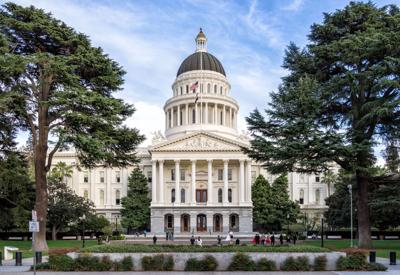


California State Capitol in Sacramento (Andre m / Wikimedia Commons)
The New Year has brought with it dozens of new laws, some that won’t change day-to-day life too much and some that likely will. Ranging from education to immigration, many of the laws are set to have a big impact on the state’s Latino population.
Education
The California State University (CSU) system will be required by a new law to establish a direct admissions process that involves notifying eligible high school seniors of their automatic admission to the 16 CSU campuses participating in the initiative. California community colleges will also be required to develop programs that facilitate a more seamless transition for community college students moving to a four-year university.
Senate Bill 640, introduced by Sen. Christopher Cabaldon, builds on the existing direct admissions pilot program CSU launched in 2024 in partnership with the Riverside County Office of Education.
Latino students are the CSU’s largest ethnic group, making up nearly 49% of the 23-campus system’s student population as of fall 2024.
Students who meet the grade and coursework requirements for CSU admission will automatically receive a letter of acceptance from the CSU chancellor, without needing to apply to any of the participating campuses.
Due to enrollment capacities, San Jose State, San Diego State, Cal Poly San Luis Obispo, Cal Poly Pomona, Cal State Fullerton and Cal State Long Beach are the campuses not participating in the initiative.
“We should make it as seamless for our students to go from 12th grade to the next stage of their education as it was for them to go sixth grade to seventh grade,” Cabaldon said when the bill advanced to the Governor’s desk in September. “Direct admission removes the application hurdle that stops some students from going to college, and relieves the fear that they won’t get in anywhere.”
Health
Even tortillas will change in 2026 due to AB 1830, a bill introduced by Assemblymember Joaquin Arambula that now requires manufacturers to add folic acid to tortillas and masa products in the state. The reason? Folic acid is a vital vitamin that supports infant health, but data shows Latinas consume less of the vitamin during early pregnancy than women in other demographics, leading to consistently higher birth defects rates among babies born to Latinas.
Folic acid has been shown to reduce the risk of neural tube defects, like spina bifida and anencephaly, by up to 70%. The new law requires manufacturers to add 0.7 milligrams of folic acid to every pound of masa and reflect the change on the nutrition label.
In the latest state data, from 2017 to 2019, around 28% of Latinas reported they consumed folic acid a month before they were pregnant. Since folic acid is not present in many foods, the idea is that by putting it in tortillas, a traditional food many Latinas are already used to eating, the rates of folic acid consumed will increase and the rate of birth defects will decrease.
Insulin was also a big topic of conversation during the legislative session.
As required by Senator Scott Wiener’s SB 40, health insurers will now cap insulin co-pays at $35 for a 20-day supply, significantly bringing the cost down for the consumer. The bill will prove significant for Latinos, whose diabetes rates trend higher than other ethnic groups.
According to the National Center for Health Statistics, Hispanic/Latino adults were diagnosed with diabetes in 2024 at a rate 13% higher than the overall adult population. Data from the American Diabetes Association indicates that about 11.7% of Hispanic adults have been diagnosed with diabetes, but the actual percentage of Hispanics/Latinos living with undiagnosed diabetes is likely significantly higher.
Immigration
Assemblymember Celeste Rodriguez’ AB 495 was championed by dozens of immigrant rights groups. The law will strengthen family’s rights, allowing parents to designate a temporary guardian for their children in ase of detainment or deportation. Previously, the list of who could be deemed a temporary guardian was very narrow, but now includes a wider range of family members and loved ones.
AB 495 also extends to daycares and child care facilities, barring them from collecting and sharing immigration-related information of students and their families. Schools under the new law are also required to distribute guidance to help families prepare for times of crises like family separations.
“By creating additional protections and tools that strengthen parental rights and community preparedness, we are ensuring that no child is left without a safety net and reinforcing California’s commitment to safety and compassion for all families,” said Rodriguez of the bill.








(0) comments
Welcome to the discussion.
Log In
Keep it Clean. Please avoid obscene, vulgar, lewd, racist or sexually-oriented language.
PLEASE TURN OFF YOUR CAPS LOCK.
Don't Threaten. Threats of harming another person will not be tolerated.
Be Truthful. Don't knowingly lie about anyone or anything.
Be Nice. No racism, sexism or any sort of -ism that is degrading to another person.
Be Proactive. Use the 'Report' link on each comment to let us know of abusive posts.
Share with Us. We'd love to hear eyewitness accounts, the history behind an article.