

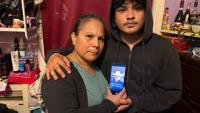

Patricia Martínez and her son Erick mourn the death of husband and father Alberto Gutiérrez Reyes. Credit: Paulina Herrera | Courtesy
When Patricia Martinez was asked by an employee of the Mexican Consulate in San Bernardino to sit down, she thought her husband had been deported.
She never imagined that she was about to receive the biggest blow of her life.
The staff person told Martinez that her husband, Alberto Gutiérrez Reyes, had died hours earlier in the hospital where he was transferred after losing consciousness at the Adelanto Detention Center.
“My husband died due to medical negligence. For days he was asking for help and they never paid any attention to him,” said Martinez, her voice breaking.
Gutiérrez was born in Veracruz, Mexico and emigrated to the United States in 2001, earning a living working in construction.
“We met here in Los Angeles [while I was] working in sewing,” said Martinez, originally from Nayarit, along Mexico’s west coast.
Gutiérrez was arrested by Immigration and Customs Enforcement (ICE) agents on January 9 in the predominantly Latino Echo Park neighborhood of central Los Angeles.
“It was around 10:44 in the morning when he went out for breakfast; and then the ICE agents passed by, saw him and got out to arrest him,” recalled Martinez. “My husband ran, trying to escape, but they caught him, threw him to the ground, and injured his arm, knee and part of his head.”
‘They ignored him’
After his arrest, Gutiérrez was transferred to Adelanto, about three hours east of Los Angeles. The facility is one of a growing number of privately-run immigrant detention centers across the country. It has been the subject of numerous complaints citing health, safety and human rights violations.
“We spoke daily via video call. At first, he was very depressed, but we encouraged him by telling him that he would soon be released on bail,” recounted Martinez, who said her husband began to feel unwell after Wednesday, February 18. That day, she explained, he and other detained immigrants were taken out by guards to the yard for an hour, despite the heavy rain and biting cold.
“The day turned very cold, and when they returned them to their cells, Alberto felt feverish. He started submitting papers requesting to be taken to the doctor. They ignored him, and since he didn’t get better and developed a cough, he continued asking for medical attention over the following days, without any response,” said Martinez.
On Tuesday, February 24, Gutiérrez was still unwell, but even in poor health he appeared at a bail hearing in court.
“That day we spoke four times, he told me that he hoped they would finally take him to the doctor, because he continued to feel unwell,” said Martinez.
But on Wednesday, February 25, she heard nothing more from her husband and received no calls from him. “It seemed strange to me,” she said.
It was Gutiérrez’ niece who received a call from a cellmate, who called to tell Martinez that her heusband had been taken to the emergency hospital after fainting.
“We were not notified that he was hospitalized; we found out through his cellmates, and I only received a call from the [Mexican] Consulate to tell me that he had died. ICE notified them of my husband’s death through an email sent around three in the morning.”
Martinez said her husband did not suffer from any illness or chronic condition. His only prior medical history was having had COVID-19 in September 2023.
“Covid landed him in the hospital and affected his thyroid, lungs and heart, but he recovered,” Martinez noted.
‘Medical negligence’
According to Martinez, immediately after his arrest and before being transferred to Adelanto, Gutiérrez was held briefly in a previously undisclosed holding cell known as B17 at the ICE federal building in downtown Los Angeles. It was here, she said, that he first developed a cough after being made to sleep on the floor in a cold room with only laminated paper sheets as blankets.
Officially, the information provided to the family indicates that Gutiérrez died on Friday, February 27 at 12:58 a.m. at the Victor Valley Global Medical Center in the city of Victorville; his wife was notified shortly before 8 a.m. that day.
Overcome with grief, Martinez said her husband was the financial backbone for their family and for his parents in Mexico.
“He was very optimistic about being released. He was trying hard not to get depressed. We were gathering the letters of good conduct needed for bail. We had so many plans,” she said, sobbing.
She added that Alberto’s death will not go unpunished. “We are going to do everything we can to get justice. My husband died due to medical negligence by ICE. If he had received medical attention in time, he would be alive today.”
Random kidnapping
Immigration lawyer Sergio Siderman, who took on Gutierrez’ defense after his arrest, said ICE agents targeted him because of the color of his skin. A Supreme Court ruling in September cleared the way for immigration agents to use race and ethnicity as factors when making stops.
“He had an I-589 asylum application and a possible 42B to cancel his deportation,” said Siderman. The latter allows eligible non-permanent residents in active deportation proceedings to apply to cancel their removal and apply for a green card.
Siderman also pointed out that immigrants who require medical assistance while in detention should receive timely and appropriate treatment. “Our clients [in detention] have informed us that they frequently need to make multiple requests to obtain medical care.”
But he also said that as a lawyer he faces difficulties in contacting his detained clients.
“It takes ICE a week to schedule a phone appointment with a client.”
Deaths in ICE Custody
Alberto is the second immigrant known to have died this year in California while in ICE custody.
On January 6, Luis Beltrán Yánez Cruz, a 68-year-old Honduran father and grandfather, died in a hospital in Indio where he had been taken by ICE officers. Beltrán had been detained since November at the Calexico immigration detention center, officially known as the Imperial Regional Detention Facility.
On September 29, an immigrant from China, Huabing Xie, died at El Centro Regional Medical Center after being transferred from the same Imperial Regional Detention Facility in Calexico where Luis Beltrán was held.
While in custody, Xie experienced a seizure and lost consciousness; he died in the hospital.
During the first year of Donald Trump’s second term, 32 people died in ICE detention centers, making 2025 the deadliest year in the last two decades for the federal agency, with the exception of the COVID-19 pandemic.
Los Angeles City Council member Eunisses Hernandez told one local news outlet that nine people are known to have died in ICE custody in 2026, most due to illness and alleged medical negligence.
ICE has not confirmed the number of deaths in their custody. La Opinión reached out to ICE for comment on Gutiérrez’ death. No response has been provided as of yet.
Deaths in ICE custody in 2026
- Luis Gustavo Núñez Cáceres, a 42-year-old Honduran son and brother, died on January 5 while being detained at the Joe Corley processing center in Conroe, Texas.
- Luis Beltrán Yáñez Cruz, a 68-year-old Honduran father who lived here for 26 years, died on January 6 while being detained at the Imperial Regional Detention Center in Calexico, California.
- Parady La, a 46-year-old Cambodian father who came to the United States at the age of two, died on January 9 while being held at the Federal Detention Center in Center City, Philadelphia.
- Heber Sanchez Dominguez, a 34-year-old Mexican husband and father, died on January 14 while being detained at the Robert A. Deyton Detention Center in Lovejoy, Georgia.
- Victor Manuel Diaz, a 36-year-old Nicaraguan father, died on January 14 at Camp East Montana in El Paso, Texas.
- Gerardo Lunas Campos, a 55-year-old Cuban immigrant and father of four, died at the ICE detention center Camp East Montana in El Paso, Texas. The autopsy revealed that he died by homicide.
- Alberto Gutierrez, 48, died on Friday, February 26 at 12:58 a.m. at the Victor Valley Global Medical Center in Victorville.
Source: American Immigration Council
Araceli Martínez is a reporter with La Opinión in Los Angeles, where this story was first published. This story is part of “Aquí Estamos/Here We Stand,” a collaborative reporting project of American Community Media and community news outlets statewide.








(0) comments
Welcome to the discussion.
Log In
Keep it Clean. Please avoid obscene, vulgar, lewd, racist or sexually-oriented language.
PLEASE TURN OFF YOUR CAPS LOCK.
Don't Threaten. Threats of harming another person will not be tolerated.
Be Truthful. Don't knowingly lie about anyone or anything.
Be Nice. No racism, sexism or any sort of -ism that is degrading to another person.
Be Proactive. Use the 'Report' link on each comment to let us know of abusive posts.
Share with Us. We'd love to hear eyewitness accounts, the history behind an article.