
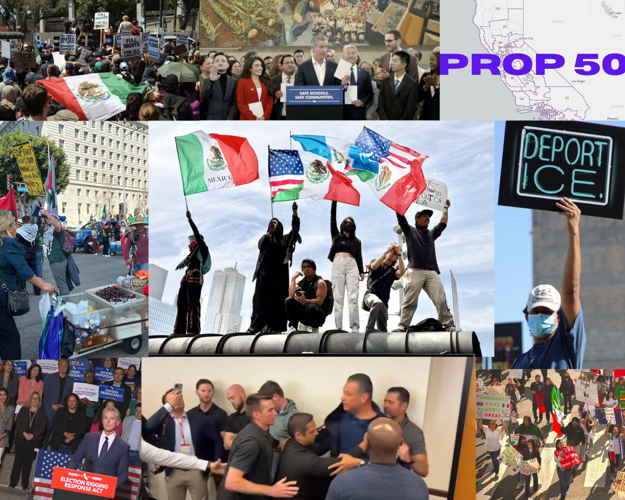


The top political moments for Latinos in California, from protests to new laws.
It has been a staggering year for Latinos in the United States and particularly in California. Undoubtedly marked by President Donald Trump’s second administration, the year’s struggles also highlighted the strength in the country’s and state's Latino communities.
Despite immigration being at the center of most headlines having to do with Latinos, it was the communities that stepped up - watching out for each other, delivering groceries for those scared to leave their homes, voting to strengthen their rights and generally advocating at every level.
As 2025 comes to an end, it’s important to remember what has happened in these past 12 months and how that will set the stage for the new year and beyond.
1. ICE raids terrorize Latino communities throughout the state
There were perhaps no moments this year that had a bigger impact on Latino communities than the Immigration and Customs Enforcement (ICE) raids that swept through California and the rest of the country.
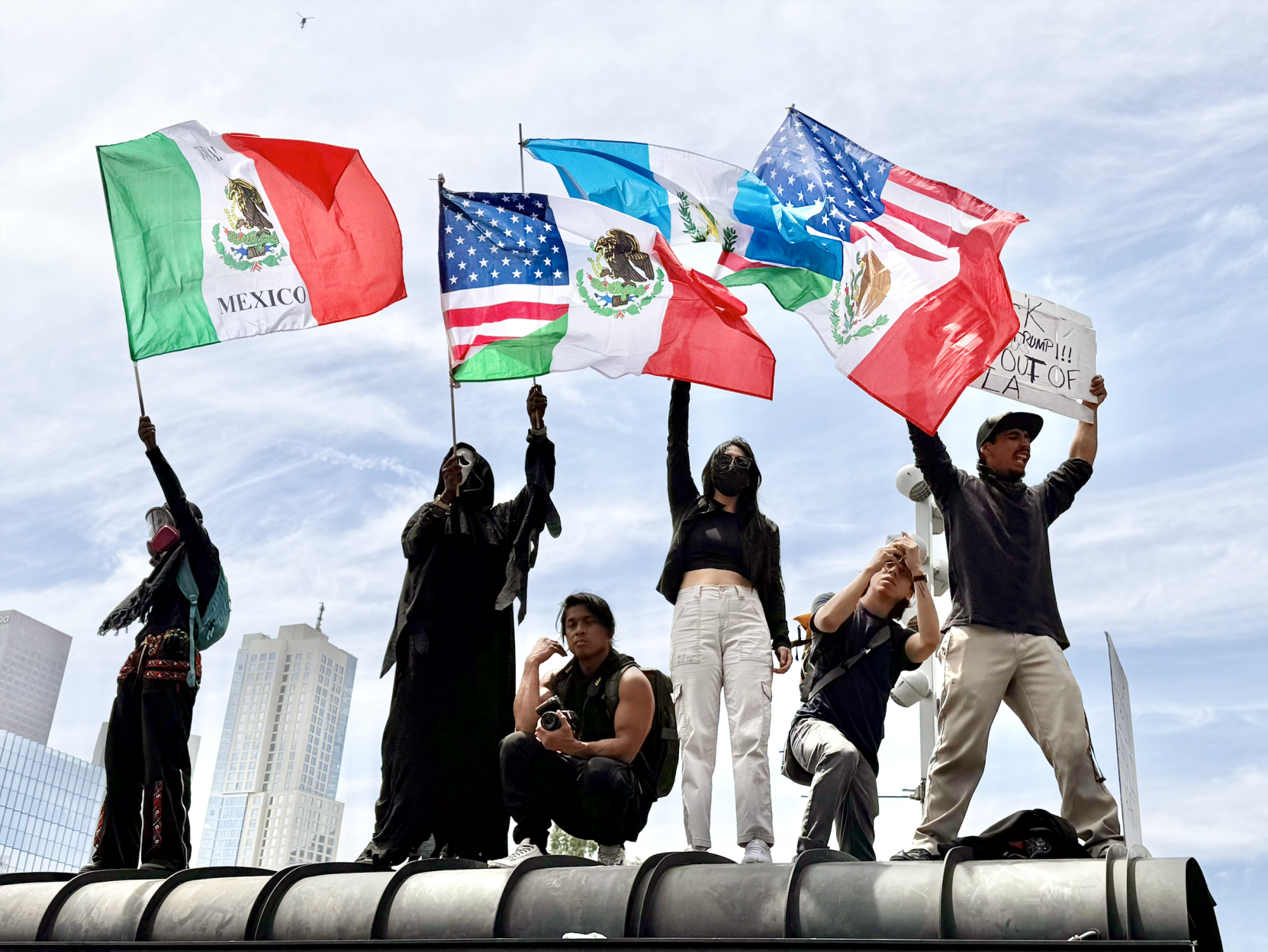
Demonstrators wave mixed heritage flags in front of LA City Hall (Image credit: Michelle Zacarias)
The second Trump administration promised a massive deportation agenda, and despite falling short of its goal to deport one million individuals per year, it has still carried out a steep increase in removals. Although the Department of Homeland Security (DHS) has claimed, without much evidence, that it has carried out over 500,000 deportations, the Migration Policy Institute estimates that around 340,000 deportations had been conducted as of September.
In June, ICE raids engulfed Los Angeles and resulted in thousands taking to the streets to protest the government’s actions. Law enforcement was quickly ramped up, with officers and police horses equipped with riot gear pushing back crowds of people.
The president quickly capitalized on the protests, calling them riots and deploying the National Guard to the state against Governor Gavin Newsom’s wishes. The move set the precedent for the administration to deploy National Guard troops to various Democratic states, one that is still being debated in the courts.
There were few places left untouched by ICE raids, with agents conducting raids near schools, Home Depot parking lots, car washes, churches, hospitals and legal court hearings.
2. Latinos showcase their voting strength in Prop 50
Despite a year where the Latino community was being systematically targeted, the same community came out in droves to pass the controversial Proposition 50, a measure that will undoubtedly have a huge effect on the 2026 Midterm Election.
71% of Latinos voted yes on Prop 50, cementing the group’s support for a redistricting measure that was campaigned as a direct response to Trump’s own gerrymandering push in Republican states.
As nearly a third of California’s voters, both sides of the aisle were vying for the Latino voting bloc. Spanish-speaking politicians, including Rep. Alexandria Ocasio-Cortez and Sen. Alex Padilla, were featured in "Yes on 50" campaign ads, asking voters to support the measure and "protect democracy.”
Prop 50 maps are now up for legal debate, as state Republicans immediately filed a lawsuit alleging the maps are race-based and favor Hispanic voters.
In Texas, Republicans are banking on Latino voters who voted for Trump to make their own redistricting measure worth it and continue electing Republican candidates.
No matter what state you’re looking at, Latinos have cemented themselves as a powerful group that’s needed to win elections.
3. State and L.A. City Council pass ICE accountability laws
Senate Bills 627 and 805 were some of the biggest steps the state has taken to fight back against the Trump administration’s deportation efforts.
The No Secret Police Act (SB 627) prohibits all law enforcement officers operating in California, including ICE and DHS, from covering their faces with masks. The No Vigilantes Act (SB 805) requires all law enforcement to visibly display identification. The bills were made in response to most ICE arrests being made by masked, armed men who could not be identified.
Last month, the Department of Justice filed a lawsuit against the two bills, claiming they violate the Constitution’s Supremacy Clause, which gives federal laws precedence over state laws.
Following in the legislature’s footsteps, on Dec. 9, the L.A. City Council voted to pass an ordinance that will ban law enforcement officers from wearing masks while on duty and require visible identification starting in January 2026. Supervisor Lindsey Horvath was absent from the vote and Supervisor Kathryn Barger abstained from the vote, questioning the legality of the measure.
4. Family Preparedness Act
Assemblymember Celeste Rodriguez (D-San Fernando) introduced a series of bills aimed at helping immigrant families, with AB 495, the Family Preparedness Act, poised to give families more power amidst ICE crackdowns.
The bill, signed into law in October, will allow for a broader range of relatives to be deemed as temporary legal guardians for children whose parents have faced detention or deportation. Many immigrant rights groups supported the bill, saying that by expanding current caregiver legislation, the Act gives parents peace of mind that their children will be protected if there’s an encounter with ICE.
The bill also requires schools and child care facilities to provide guidance for families to be prepared in times of crises like family separations.
“... By creating additional protections and tools that strengthen parental rights and community preparedness, we are ensuring that no child is left without a safety net and reinforcing California’s commitment to safety and compassion for all families,” said Rodriguez after the bill was signed.
5. Sen. Alex Padilla tackled by DHS
In June, in the midst of protests throughout L.A., Secretary of Homeland Security Kristi Noem held a press conference at the Wilshire Federal Building in L.A.. Sen. Alex Padilla, who grew up in Pacoima as a son to Mexican immigrants, was also in the building and decided to attend the conference to ask Noem about her agency’s “extreme” enforcement actions, he later said.
Padilla interrupted Noem to ask a question and was immediately grabbed by federal agents who began to push him out of the room. As he was being shoved, the senator told agents “I am Senator Alex Padilla. I have questions for the secretary.”
Agents shoved Padilla out of the room into the hallway, where they continued to push him and eventually muscled him to the ground and handcuffed him. The whole encounter was recorded and photographed.
Immediately following the incident and in the months since, Padilla has honed in on one message: if a U.S. senator can be treated in this way, in front of cameras, how is the administration treating detained immigrants and ordinary people on the street?
“You can only imagine what they're doing to farm workers, to cooks, to day laborers out in the Los Angeles community, and throughout California and throughout the country,” Padilla said to reporters after the incident. “We will hold this administration accountable.”






(0) comments
Welcome to the discussion.
Log In
Keep it Clean. Please avoid obscene, vulgar, lewd, racist or sexually-oriented language.
PLEASE TURN OFF YOUR CAPS LOCK.
Don't Threaten. Threats of harming another person will not be tolerated.
Be Truthful. Don't knowingly lie about anyone or anything.
Be Nice. No racism, sexism or any sort of -ism that is degrading to another person.
Be Proactive. Use the 'Report' link on each comment to let us know of abusive posts.
Share with Us. We'd love to hear eyewitness accounts, the history behind an article.