
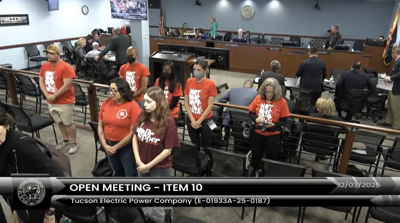

Tucson organizers opposing the Project Blue data center turn their backs on Arizona Corporation Commission members after they approve an energy plan for the project on Wednesday, Dec. 3. (Screenshot from the meeting.)
A state-level commission approved the energy request between a developer and Tucson Electric Power Wednesday, closing the loop on the final public vote before the massive data center slated for Pima County begins construction.
The vote by the Arizona Corporation Commission Wednesday evening, with four commissioners in favor and one against, was preceded by a lengthy public comment section with most speakers voicing their opposition to the agreement, as well as a sharp round of questions from several commissioners.
A core of activists with the No Desert Data Center coalition made the trip to Phoenix from Tucson for the nine-hour meeting. Wearing red shirts, they called for the commission to take a stand against the data center.
“Tucson said no, we said no over and over again,” said photographer and coalition member Kathleen Dreier. “We need to see elected officials walk their talk that they are supporting constituents.”
“This kind of sets the stage for future contracts, and I feel concerned,” said commissioner Rachel Walden, the only one of the five commissioners who voted against the contract. “At the end of the day, I have concerns about supporting this contract that could go further.”
The commissioners who voted in favor said they approved it to secure the best deal for regular utility customers. Without the contract, they said, the data center would enter the grid anyway under a specific rate for heavy users, but would not include any of the measures outlined in the contract.
“We don't get to say what they build, Beale can build what they want,” said commissioner Rene Lopez. “We negotiate how we get that power to them.”
The application approved Wednesday with Humphrey’s Peak Power LLC says TEP will begin providing service in 2027, and by 2028 provide 286 megawatts of capacity for the project. The agreement is in the public interest, the application argues, because it protects other local power users from cost or reliability impacts.
Commissioners raised several concerns about the contract in their discussion:
- The contract is a 10-year agreement that includes minimum monthly billing requirements, and the customer could only terminate it upon multi-year notice and with a termination payment. Walden, however, said that most of the contracts in other states she had seen were closer to 14 or 17 years in length, and the company would pay the entirety of the contract cost if they stepped out. "What I don't want is for Arizona to have the worst contract compared to other states," she said. In response, Erik Bakken, TEP senior vice president and chief administrative officer, said he felt that the energy infrastructure created to meet the data center's needs could be used for ongoing growth in the region.
- The contract does not include language requiring the data center to curtail its load during an energy emergency. In response to a question from commissioner Lea Márquez Peterson, TEP's Bakken said the company was confident they had the ability to meet peak load, and also the ability to curtail customer use. "Certainly we would be looking at that demand response capability, but it is not part of the contract today," he said.
- On Tuesday, the Arizona Daily Star cited three anonymous sources saying Amazon had dropped out of its deal with Project Blue, which would require Beale to find a new end user for the data center even as construction could start soon. Beale told commissioners Wednesday they were not concerned about finding a final user. “We feel confident that we will have a customer ready by the time this data center comes online,” said Sam Arons, the vice president of energy and sustainability at Beale. “The power will not be needed until sometime in 2027. We are doing what we need to to bring the customer forward.”
Separately, TEP is asking the commission to approve a rate hike that would raise residential bills an average of 14%. Attorney General Kris Mayes called the increase "blatant corporate greed" and said she intends to oppose it.
Organizers in Tucson have also been running a campaign to push the city council toward a public electricity utility that could remove TEP from operation.
The No Desert Data Center coalition lambasted the commission’s decision, saying they were failing to protect ratepayers from risk when there were serious concerns about the future of Project Blue amid news reports that Amazon had backed out of the deal.
“This decision allows foreign corporations to exploit and extract profit from the people and keeps Project Blue on life support,” the statement said. “There will be political consequences for those who side with Big Tech and corporate oligarchs."
They called on Pima County supervisors who had supported the project not to close on the land sale, expected to happen by Dec. 25, the last possible date allowed by the contract.
This article first appeared on AZ Luminaria and is republished here under a Creative Commons Attribution-NoDerivatives 4.0 International License.










(0) comments
Welcome to the discussion.
Log In
Keep it Clean. Please avoid obscene, vulgar, lewd, racist or sexually-oriented language.
PLEASE TURN OFF YOUR CAPS LOCK.
Don't Threaten. Threats of harming another person will not be tolerated.
Be Truthful. Don't knowingly lie about anyone or anything.
Be Nice. No racism, sexism or any sort of -ism that is degrading to another person.
Be Proactive. Use the 'Report' link on each comment to let us know of abusive posts.
Share with Us. We'd love to hear eyewitness accounts, the history behind an article.