
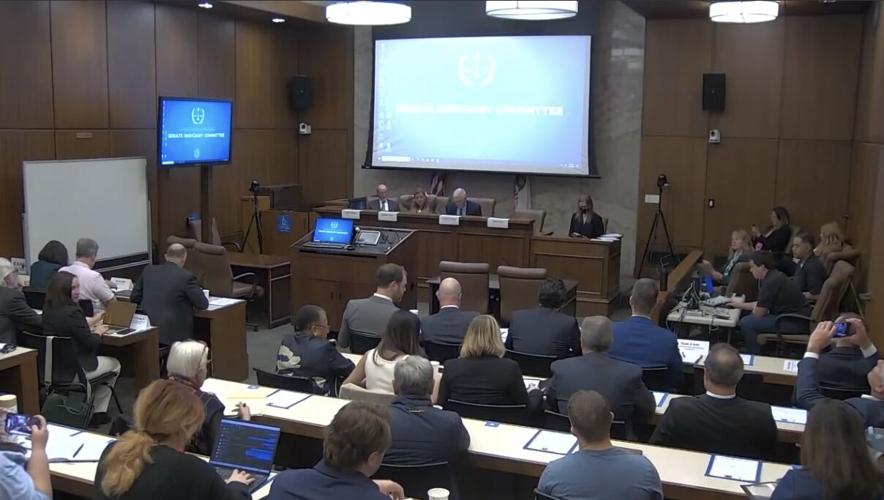





Last month, the Senate Judiciary Committee held an informational hearing on the importance of journalism and the challenges it faces today with news deserts, equity, disinformation, the risk of artificial intelligence and the decline in revenue in print media. The hearing took place at the UCLA School of Law in Los Angeles.
The committee which is in charge of overseeing and considering nominations also considers legislations and other matters provided in the Senate rules, heard about the experiences of a range of California publishers, as well as from members of academia, the tech industry, and measures taken by other countries to address some of the concerns raised by the news industry.
Participants in the hearing included Michael Karanicolas, executive director at the UCLA Institute for Technology, Richard Gingras, vice president of news, Google, Arturo Carmona, president of Latino Media Collaborative, Martha Diaz-Aszkenazy, publisher of San Fernando Valley Sun, Chris Argentieri, president and C.O.O. of Los Angeles Times and many more.
Matt Pearce, president of Media Guild of the West, spoke about the California Journalism Preservation act, which was a bill introduced by Assembly Mmeber Wicks. The bill would require big tech companies to pay publishers a fee for posting content. “We think the digital advertising market is broken and journalist will never be able to refectively bargain with publishers for pay that reflects our worth if big techs are captoring an ufair share value that our journalist create,” he said. Argentieri also stated that there is a need for legislation that will help news organizations gain revenue from tech companies like Google or Meta. “We have fallen behind other democracies of the world in supporting journalism.”

Chris Argentieri C.O.O. of Los Angeles Times.
Journalism is facing several other challenges today, including the loss of over 250 newspapers since 2005 and over 2,500 publications, according to the State of Local News report. Smaller communities are disproportionately affected by newspaper closures and, in most cases, they have no reliable source of local news in the digital or print era.
Also, Northwestern University’s Medill School of Journalism reports that more than one-fifth of the country’s population lives in a news desert or in communities at risk of becoming news deserts. In addition, local newspapers bought by private equity firms seem to decrease the quality of local news, in line with their desire to maximize profits by cutting costs, including labor force.
The staff of the Senate Committee on Judiciary created a background report that listed the pros and cons of news online. According to the report, journalism and the press have experienced mixed results from the digital revolution.
Online news has some positive outlooks, such as eliminating the need to wait for the newspaper every morning. By using our phones and digital devices, we can stay informed about breaking news with just a touch or click away. Additionally, digital media allows news and readers to network and discuss important topics together, which is not possible with local news broadcasts and local papers.
As digital journalism has grown and news sources have multiplied, some unintended negative effects have resulted in misinformation and disinformation. The rapid rise of online news has coincided with an increase of unreliable news sources that spread false information regularly or irresponsibly. Fake stories are often spread through social media platforms and have caused harm to public health and the state of California. For example, the intelligence interference with the 2016 U.S elections. Another negative effect is the decline of reporters. According to the Pew Research Center, newsroom employment in the United States has dropped 26% since 2008.
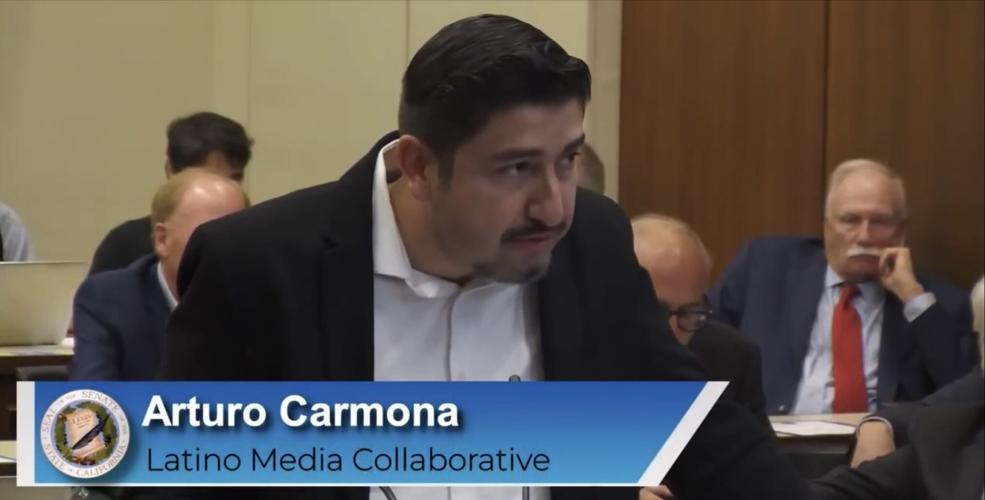
Carmona, spoke at the hearing and thanked the committee and assembly members for their support and for having these critical conversations about journalism in today's digital times.

Arturo Carmona, president of Latino Media Collaborative.
Carmona spoke about what LMC stands for and what it does for the Latino community. “The Latino Media Collaborative is an organization committed to advancing Latino journalism and media through advocacy, capacity building and content creation,” he said.
In addition, LMC is an emerging non-profit organization that develops high-impact media and outreach campaigns in partnership with the Latino media sector to advance an informed, highly engaged Latino community.
Carmona’s biggest message was the importance of equity in the state of California. He went on to discuss how, for decades, leaders in the Latino media community have complained about not being given a fair shake and about the lack of equity in the way the state advances its policies and communications operations.
“Latinos now account for 40% of California's population. California is the most diverse state in the nation. California is arguably the most nuanced state to communicate with a media ecosystem that’s geographically complex, rural, coastal, urban, suburbs and layered with multilingual and multicultural dynamics that are unique,” Carmona said.
Additionally, he discussed how the internet has severely impacted Latino media and our broader media ecosystem over the past two decades. “Thriving outlets have struggled to stay afloat and now operate with thin staffs and countless others such as eastside publications and servicing East Los Angeles and Southeast Los Angeles have had to close their doors,” he said.
Towards the end of his speech, Carmona emphasized the importance of integrating equity into discussions about journalism in the digital age. “Equity must be at the epicenter of any solution. We cannot repeat the mistakes of the past and develop a media ecosystem that excludes communities of color, particularly Latinos in California.” Carmona said.
To watch the hearing, click here.








(0) comments
Welcome to the discussion.
Log In
Keep it Clean. Please avoid obscene, vulgar, lewd, racist or sexually-oriented language.
PLEASE TURN OFF YOUR CAPS LOCK.
Don't Threaten. Threats of harming another person will not be tolerated.
Be Truthful. Don't knowingly lie about anyone or anything.
Be Nice. No racism, sexism or any sort of -ism that is degrading to another person.
Be Proactive. Use the 'Report' link on each comment to let us know of abusive posts.
Share with Us. We'd love to hear eyewitness accounts, the history behind an article.