


(Tom Hilton/Wikimedia Commons/Canva)
The recent allegations involving César Chávez have deeply disturbed me. They trouble me to my core. Like many organizers, I grew up hearing his name spoken with reverence. He was the example to admire, a moral force, a symbol of sacrifice and discipline in the struggle for farmworker dignity. To hear now the mounting allegations that he abused women and minors is disturbing. It alters not only how we remember a historical figure, but how we understand the movements that shaped us.
And yet, alongside my sadness and anger is another feeling: I am not surprised.
That is perhaps one of the hardest truths to admit. We live in a patriarchal society where men, especially powerful men, are often allowed to remain untouchable. Their charisma becomes a cover. Their achievements become a shielding armor. Their public image becomes more protected than that of the women and girls around them. Again and again, we see the same pattern: people refuse to believe women, minimize or dismiss harm, and protect institutional legacy over truth.
So while this news deeply saddens me, I also recognize it as part of a larger pattern many women already know too well.
What happens when the myth begins to crack? When do we face uncomfortable truths that require us to trust each other more deeply?
That question is not easy, but it is necessary.
A movement committed to justice cannot ask us to tell the truth about systems while lying to ourselves about our leaders. We cannot condemn abuse in one arena and excuse it in another because the person responsible helped build something important. Real justice demands moral consistency. It asks us to care about the farmworker, the immigrant, the poor, the marginalized and also the woman, the girl, the survivor whose suffering stayed hidden beneath the banner of the cause.
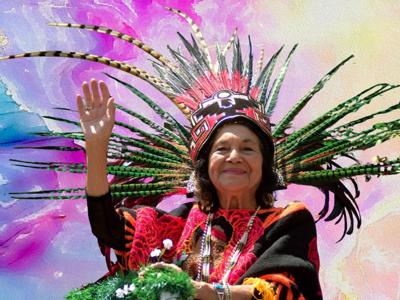
That is why I find myself thinking so much about Dolores Huerta.
I have long admired her, not only because of all she accomplished, but also because I know firsthand what it means for women to work in spaces shaped by men, ego, hierarchy and dismissal.
Leaders and institutions expect women to be brilliant but quiet, strong but accommodating, and sacrificial but unseen. Women carry strategy, labor, memory and emotional survival all at once.
And too often, we carry pain in silence so the movement can continue. Dolores Huerta’s public statement adds enormous weight to this moment and places the survivors, finally, where they should have been all along: at the center of the truth.
We can acknowledge that César Chávez played an important role in labor organizing while also recognizing that no contribution to justice cancels out violence against women and children. In fact, if we fail to name that violence, then we betray the very principles those movements claimed to uphold.
Our moral responsibility is not to protect the reputation of the powerful. It is to respond with humility, accountability, and care for those who have been harmed.
I am also thinking about the many women whose stories never become headlines. The ones who spoke and were ignored. The ones who were silenced and told not to ruin the work. To move on to the next job and not cause more problems. The ones who understood that movements, like families, churches and institutions, often know how to survive scandal better than they know how to protect women. Their silence was never consent. Often, it was survival.
We must stop teaching history in ways that demand devotion instead of discernment. Instead, we should ask: Whose voices are centered? Who remains silent? How have survivors been protected or silenced? These questions help us critically assess movement histories for gendered violence and prioritize justice over loyalty.
If our organizing is truly rooted in dignity, then that dignity must include women. It must include girls. It must include survivors. It must include the courage to confront painful truths even when they unsettle our deepest political and cultural narratives.
This moment is a reckoning, but it can also be an opening.
An opening to build movements that are more honest than the ones we inherited.
An opening that honors women whose labor and suffering others have erased.
An opening to teach the next generation that justice without accountability is not justice at all.
This news deeply saddens me. But I am not surprised.
And maybe that, too, is an indictment of the world we have lived in for far too long.








(0) comments
Welcome to the discussion.
Log In
Keep it Clean. Please avoid obscene, vulgar, lewd, racist or sexually-oriented language.
PLEASE TURN OFF YOUR CAPS LOCK.
Don't Threaten. Threats of harming another person will not be tolerated.
Be Truthful. Don't knowingly lie about anyone or anything.
Be Nice. No racism, sexism or any sort of -ism that is degrading to another person.
Be Proactive. Use the 'Report' link on each comment to let us know of abusive posts.
Share with Us. We'd love to hear eyewitness accounts, the history behind an article.