
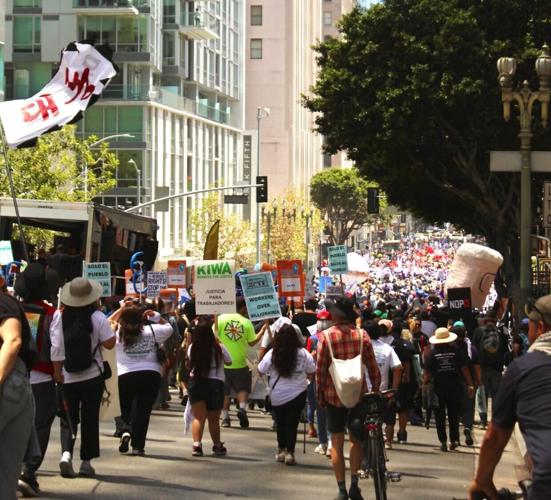


May Day march, 2026. (Photo: Brenda Verano/CALÓ News)
This year’s International Workers’ Day, we witnessed massive mobilizations as thousands took to the streets of Los Angeles, San Francisco, New York City, Chicago and many more cities across the nation. This year’s May 1 mobilization is a testament to the immigrant rights movement becoming part of a broader multi-racial and anti-war movement in defense of working-class people and immigrants in times of economic precarity, inequality and President Donald Trump’s imperial aspirations.
Trump started his war with Iran thinking it would be an easy military excursion that would be over quickly, much like his invasion of Venezuela. He also thought it would enable him to consolidate his power further and suppress opposition. Notably, however, the war has become extremely unpopular and it has generated much opposition, even among many in his conservative coalition.
Despite being weakened and increasingly unpopular, the Trump machine is ever more dangerous. He will employ anything, including the use of violence, intimidation and state terror, to keep majorities in the House and Senate. And after the election, regardless of the outcome, we will likely see a dramatic intensification of immigration raids and hostility against Trump’s enemies.
Steve Bannon, a prominent figure among white nationalists and the chief strategist behind Trump’s domestic policies still being implemented today, revealed to the Wall Street Journal that the administration aims to provoke a “constitutional crisis” and remove the writ of habeas corpus. Such actions could usher in one of the darkest chapters in this nation’s history.
This situation could enable Trump to effectively eliminate his opposition, leaving no avenue for challenge from Congress or the Judiciary. Such a development poses a significant threat to immigrants, anti-war activists and other dissenting voices, and to liberal democracy more broadly.

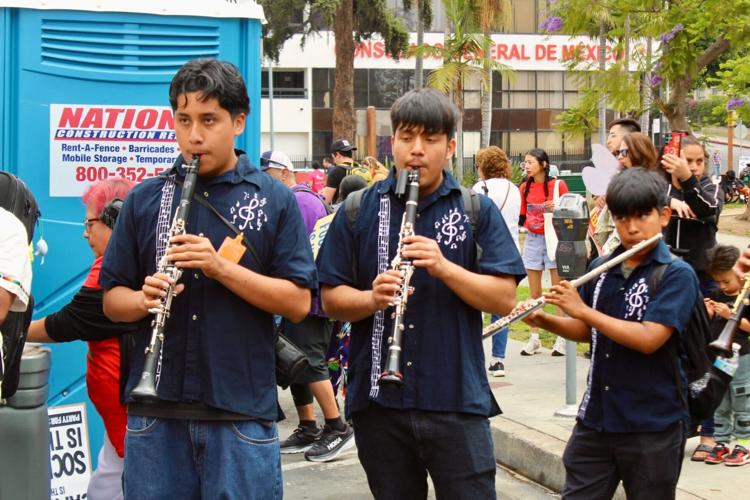
May Day 2026 (Photo: Brenda Verano / CALÓ News)
The administration is paying millions for government contracts with controversial software like Palantir to centralize private data. This could easily enable the labeling of dissenters as “enemies of the state." As the U.S. moves into its third month of war with Iran, this software isn’t just targeting immigrant and Latino activists, but all forms of dissent, including anti-war protesters, journalists, comedians — even some of Trump’s former allies and appointees.
This May 1 mobilization showed us that at the forefront of opposition to the President’s agenda is an organic, popular and peaceful multi-racial and ideologically diverse movement composed of immigrants, anti-war activists and defenders of the constitution. There are many lessons for this movement emerging from the 2006 immigrant mobilizations.
In 2003, then-President George W. Bush initiated the war in Iraq and established the Department of Homeland Security (DHS). This pivotal moment marked a shift in how both foreign policy and immigration policy were framed, as Bush and his neoconservative allies began to view these issues through the lens of the war on terror. It was in the early 2000s that we got the first dramatic Immigration and Customs Enforcement (ICE) raids. Across the nation, hundreds of thousands of people were rounded up, detained and put into deportation proceedings under the Bush administration. By 2005, the Republican controlled Congress had passed the nativist Sensenbrenner Bill, which would have made it a felony to be undocumented or “harbor” an undocumented person, among other provisions.
Opposition to the Sensenbrenner was the catalyst for the May 1 mobilization of 2006, when 1.5 million Latinos and their allies took to the streets of Los Angeles and millions more across the country stood up against this racist legislation. Latinos in Los Angeles and Southern California sparked a nationwide protest movement that spread to nearly every major city in the U.S.
Activists turned this political energy into an electoral movement that was able to punish anti-immigrant Republicans at the polls and get President Barack Obama elected, despite Obama also being a disappointment on immigration reform and deportation policies.
Nearly twenty years later, much has changed. Many Latinos have lost hope in the Democrats and the media landscape and mobilization structures have evolved significantly. In 2006, the vast majority of individuals received their news from relatively reputable journalists who addressed millions of Spanish-speaking Latinos during nightly broadcasts. The media reported on calls for mobilization in press releases issued by grassroots activists. Those activists belonged to actual base-building organizations and they were part of coalitions that met and planned in person.
Today, untrained social media influencers disseminate information in almost real-time, while traditional media outlets struggle to compete and keep pace with current events. If in 2006 there were two coalitions planning and organizing May 1 mobilizations, in 2026 there are several dozen individuals who do not necessarily belong to organizations calling for actions from Twitter and Instagram accounts. This movement is more fragmented and spontaneous. What remains, however, is the righteous indignation over overt racial profiling, the separation of families, precarity and imperial wars.
Given the significant threat posed by Trump’s police state, this cannot solely remain a Latino movement. To endure and be impactful, it must evolve beyond identity and transform into a movement that converges around universal values - class solidarity, anti-racism, anti-imperialism and democracy. Only such a movement could dismantle the police state, defend the last remnants of democracy and put an end to the imperialist war aimed at Iran, Venezuela, Cuba and other nations in the crosshairs of this administration.





(0) comments
Welcome to the discussion.
Log In
Keep it Clean. Please avoid obscene, vulgar, lewd, racist or sexually-oriented language.
PLEASE TURN OFF YOUR CAPS LOCK.
Don't Threaten. Threats of harming another person will not be tolerated.
Be Truthful. Don't knowingly lie about anyone or anything.
Be Nice. No racism, sexism or any sort of -ism that is degrading to another person.
Be Proactive. Use the 'Report' link on each comment to let us know of abusive posts.
Share with Us. We'd love to hear eyewitness accounts, the history behind an article.