

(Canva)
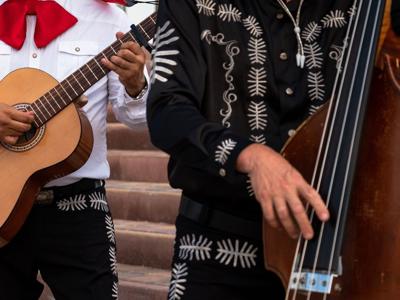
Mariachi is not just music. It is inheritance—history carried in harmony—an art form born from the lived experiences of working-class Mexicans and sustained in the United States by generations of Mexican Americans navigating identity, migration and belonging. For those of us within this tradition, mariachi is not separate from community. It is the community.
That is why moments of public controversy involving its most prominent figures resonate far beyond the stage.
José Hernández, founder and musical director of Mariachi Sol de México and a central architect of modern mariachi in the United States, has long been a cultural ambassador for Mexican American identity. For decades, he has helped elevate mariachi from backyard gatherings and community halls to symphony stages and international recognition. His contributions—to musicianship, to education, to the professionalization of the genre—are undeniable.
Following a high-profile performance by Mariachi Reyna de Los Ángeles at Coachella, controversy has emerged around Hernández and those associated with his musical institutions. That performance—on one of the world’s most visible stages—was, for many, a moment of cultural pride, which is precisely why the backlash that followed has felt so disorienting.
Online scrutiny has focused on political affiliations within his family and circle, including documented involvement in Republican political organizing. At the same time, public statements indicate that Hernández himself has not formally endorsed any political candidate. The result is a situation defined less by explicit declaration than by association, perception and proximity.
Recent reporting and interviews have only deepened that ambiguity. While public statements reject formal political endorsement, visible associations—including leadership roles in conservative political organizations and the management of public questioning—have done little to resolve the concerns being raised by audiences.
For many Mexican Americans, political alignment is not abstract. It is tied to lived experience: immigration policy, public rhetoric and questions of dignity and belonging. When a cultural figure whose legacy is built on representing that community becomes associated—directly or indirectly—with political movements perceived as antagonistic to it, the reaction is not simply disagreement. It is confusion and tension. For many, it feels like a betrayal.
This is not about denying anyone the right to hold personal beliefs. Mexican Americans, like any community, are not politically monolithic. There is diversity of thought and experience. But when one occupies a position as visible and symbolically charged as Hernández does, personal affiliations do not remain purely personal. They reverberate outward.
Public records and reporting show that individuals closely connected to these institutions have participated in conservative political organizing. While not all affiliations are formally declared, the visibility of these connections has fueled a growing perception—particularly among Mexican American audiences—that these institutions are aligned, at least indirectly, with political movements many view as antagonistic to their community.
What makes this moment difficult is that it is not defined by a single statement or endorsement. It is shaped by an accumulation of signals—organizational ties, public associations and the overlap between cultural institutions and political networks. Audiences interpret those signals through their own realities. For a community that has historically relied on mariachi as a form of cultural affirmation in the face of marginalization, those interpretations carry real emotional weight.
Mariachi in the United States did not rise in a vacuum. It grew in neighborhoods where immigrant families fought for stability, where schools struggled for cultural inclusion, where musicians had to justify their art as worthy of respect. The success of ensembles like Mariachi Sol de México and Mariachi Reyna de Los Ángeles is inseparable from that history. Their audiences, their students, their musicians, their supporters—many come from the very communities now grappling with these questions.
The issue is not simply political affiliation, but alignment.
Can a cultural ambassador remain representative of a community while being associated with political movements that many within that community experience as exclusionary?
For those of us who are both Mexican American and deeply rooted in mariachi, this moment forces a reckoning. It challenges us to think more critically about what it means to represent a culture—not just musically, but socially and politically. It asks whether artistic leadership can be separated from communal responsibility, or whether the two are, in practice, inseparable.
Mariachi has always been about more than performance. It is about who we are, where we come from and how we carry that forward. It is not about canceling individuals or policing beliefs. It is about coherence—about ensuring that the symbols we elevate remain in conversation with the people they are meant to represent.
The music deserves that honesty. And so does the community behind it.








(0) comments
Welcome to the discussion.
Log In
Keep it Clean. Please avoid obscene, vulgar, lewd, racist or sexually-oriented language.
PLEASE TURN OFF YOUR CAPS LOCK.
Don't Threaten. Threats of harming another person will not be tolerated.
Be Truthful. Don't knowingly lie about anyone or anything.
Be Nice. No racism, sexism or any sort of -ism that is degrading to another person.
Be Proactive. Use the 'Report' link on each comment to let us know of abusive posts.
Share with Us. We'd love to hear eyewitness accounts, the history behind an article.