
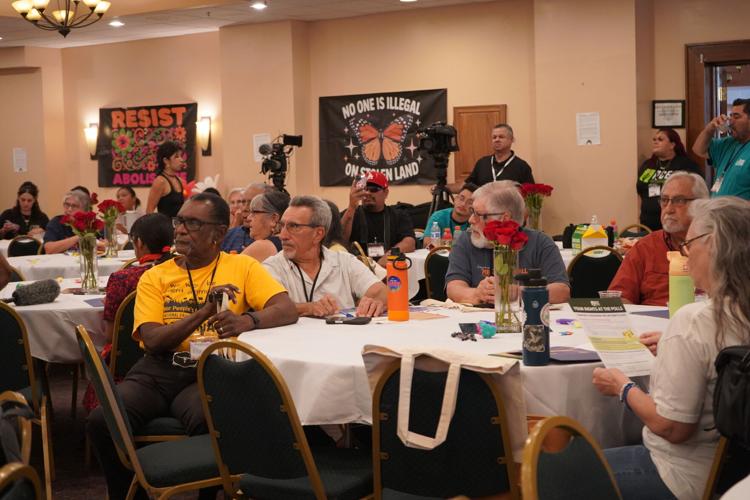
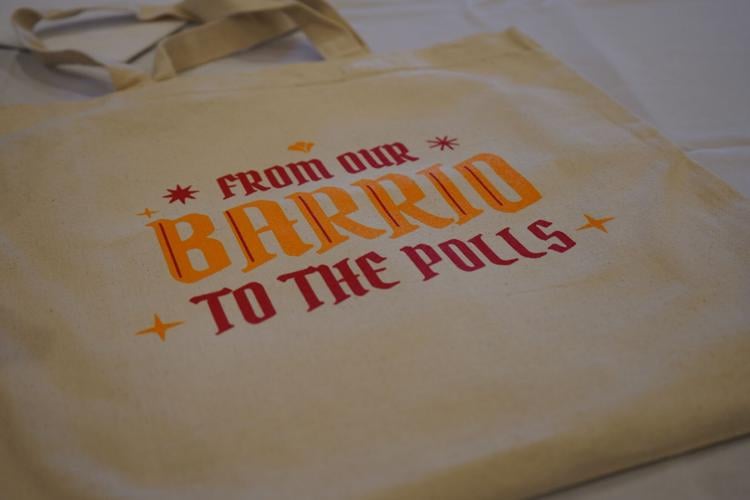
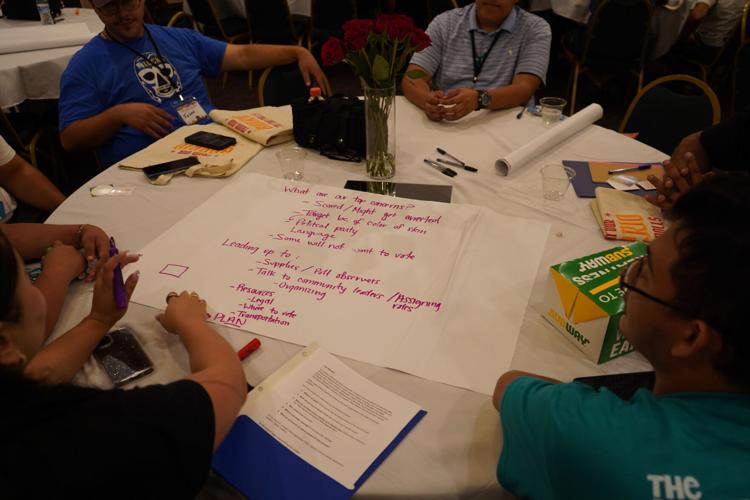

Participants learn to become constitutional observers at the polls ahead of the Arizona primary at the People's Congresso in Tucson, Arizona, on July 18, 2026. (Credit: Susan Barnett)
Maricopa and Pima County residents will have over 350 locations — 236 and 120, respectively — where to submit their ballot for Arizona’s July 21 primary election and Living United for Change in Arizona (LUCHA) is hoping that, at some of those voting locations, constitutional observers will make voting safer for their fellow neighbors.
The organization trained over 300 people to be nonpartisan constitutional observers in July events ahead of the primary and general elections amid fears of immigration enforcement agents near polling areas and unfounded claims of widespread election fraud made recently by President Donald Trump.
During the July 21 primary, Arizonans will have a chance to select their preferred party candidate for governor, treasurer, superintendent and more statewide executive offices. Voters will also set the general election matchups for competitive U.S. House seats as well as state legislative districts.
“The same forces terrorizing immigrant communities are the same forces this administration wants people to imagine showing up around our elections,” said Alejandra Gomez, LUCHA’s Executive Director. “These are not disconnected pieces. They are part of the same strategy to create fear, panic, confusion and make people question whether it is safe or worthy to participate in our democracy.”
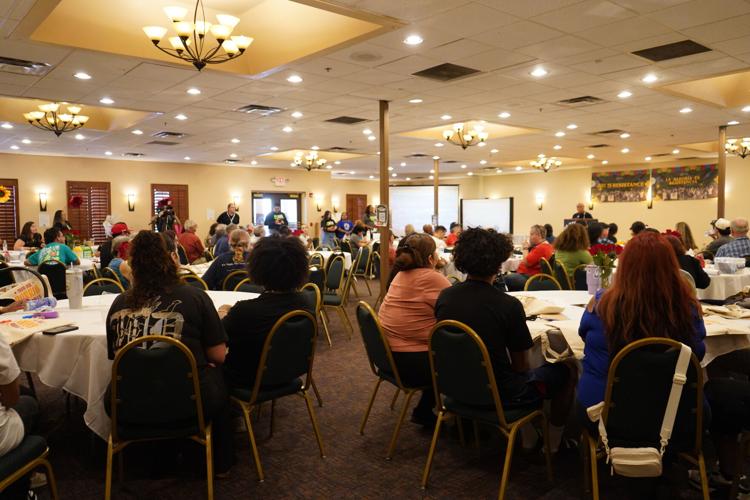
The Tucson Congresso, held on Saturday, was a two-hour training where 65 participants learned the importance of community protection, voter rights, polling place rules, documentation, reporting and scenario planning.

LUCHA hosts the People's Congresso in Tucson, Arizona, on July 18, 2026. (Susan Barnett/CALÓ News)
“We are not waiting until November; we are not waiting until there is a crisis,” Gomez said. “We are preparing today, training community members to become constitutional observers, defenders of democracy.”
Participants were given scenarios in which the federal administration sent agents to monitor polling locations across the nation and were tasked with how they would address the situation, then trained on the protocol for documenting and reporting. Their role will be to support voters, document problems, report concerns and make sure every eligible voter can cast their ballot safely and confidently, Gomez said.
“This training is about preparation, discipline and community power because when people are afraid, they need trusted messengers,” Gomez said. “When voters are confused, they need accurate information. When intimidation happens, it needs to be documented.”
Fighting for ‘a different reality’
A similar event was held in Phoenix a week prior, where they trained about 250 Phoenix residents to be constitutional observers and previewed a Maricopa County ICE heat map that detailed hot spots for Immigration and Customs Enforcement (ICE) presence, with data gathered through months of documenting federal agent activity.

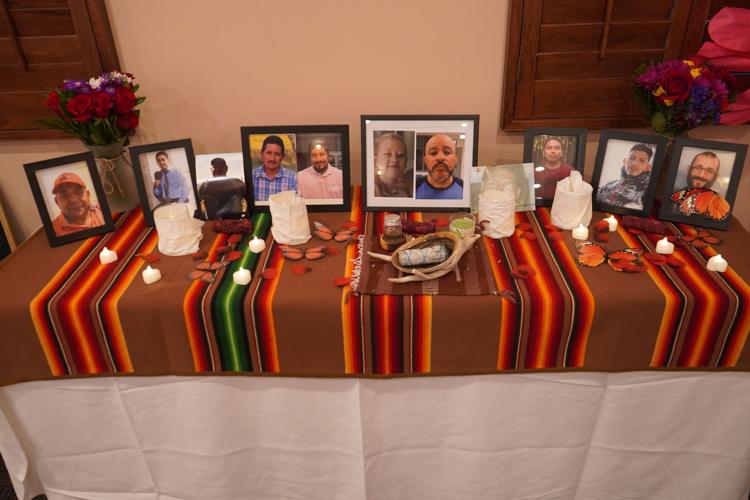
An altar honors those who have died at the hands of federal agents at the People's Congresso in Tucson, Arizona, on July 18, 2026. (Credit: Susan Barnett)
What they saw was that ICE enforcement, immigrant communities and polling locations were all concentrated in close proximity to one another.
“Polling locations are schools, they are churches, they are community centers and those are places where our people are all the time,” said Karime Rodriguez, an advocacy organizer with LUCHA. “That is concerning that there is such a close proximity to ICE enforcement and where people will show up to vote and we don't believe that is accidental. We know that there have been many scare tactics throughout the year of intimidation and this is just another example.”
Rodriguez, a Congresso facilitator, isn’t eligible to vote, but she’s doing everything in her power to ensure those who can exercise that right safely.
“Even though I can't vote, I know that I have an influence to make sure that others can and that people like myself still have my voice and my priorities heard,” she told CALÓ News during the Tucson event.
She was brought to the U.S. from Mazatlan, Sinaloa, Mexico, when she was two years old. A recipient of Deferred Action for Childhood Arrivals (DACA), she awaits becoming a naturalized citizen. She remembers being 14 years old when immigration agents “stormed” into her home and took her father away, completely uprooting her life.

Participants learn to become constitutional observers at the polls ahead of the Arizona primary at the People's Congresso in Tucson, Arizona, on July 18, 2026. (Credit: Susan Barnett)
“It was the single most scary thing I have ever lived through to date,” she said. “That was also the last night that I ever lived with my family as a full family again and that is a reality that many of my brothers and sisters across this country are living still.”
Afterward, she, her mother and her siblings battled instability, losing their home multiple times and going periods without water or electricity, all while 15-year-old Rodriguez worked a full-time job.
“I realized that if I wanted things to get better, I would have to fight for it. I fight now for a different reality,” she said. “That's exactly what I've done for the past 13 years, since that has happened, because I know that my family deserves better, every undocumented family in this country deserves better.”
While she dedicates her time now to motivate others to become civically engaged, she hopes it won’t be long before she gets her chance to participate democratically.
“I'm hoping that by the next elections, I'll be able to vote alongside all of you as well,” Rodriguez told Congresso attendees.
Shifting the 'voter fraud' narrative
The trainings come amid a national address from Trump where he made unsubstantiated claims of a stolen election in 2020 and mass voter fraud since. On his first day in office, the president pardoned Jan. 6 defendants.

Participants learn to become constitutional observers at the polls ahead of the Arizona primary at the People's Congresso in Tucson, Arizona, on July 18, 2026. (Credit: Susan Barnett)
“In truth, it was the Democrats who staged the real insurrection by certifying a fraud-ridden election, ignoring widespread irregularities, and weaponizing federal agencies to hunt down dissenters, all while Pelosi’s own security lapses invited the chaos they later exploited to seize and consolidate power,” said a White House statement.
Earlier this month, he refused to sign a rare bipartisan housing affordability bill into law if Congress didn’t pass the SAVE Act, which would require voters to provide documentary proof of citizenship at the time of voter registration and a photo ID at the time of voting — the latter already required in Arizona elections.
“There's already a lot of narratives that (Trump’s) putting out there, inaccurate narratives that are creating confusion around voting,” said Gina Mendez, the organizing director for Arizona Center for Empowerment. “We want to make sure that it's clear that people know that our elections are safe and accurate.”
LUCHA has been at the forefront of the fight against voter intimidation. Earlier this year, they were barred from the Arizona Senate building after filling up the room to oppose a bill that would require ICE agents at polling locations. The bill ultimately didn’t make it past committees, but served as a litmus test for how Arizona legislators view the idea of non-citizens voting in elections.
“We don't know what's going to happen; we don't know what (the federal government is) going to do. What we know is what we're going to do and what we have control to do,” Mendez said. “Our plan is to be out there… whether it's ICE, DHS, whoever, our plan is to be there to make sure that our communities are showing up to vote.”
LUCHA will hold another constitutional observer training in October ahead of the general election. To be informed about when the event will be held, follow them on Instagram or visit their website.
Susan Barnett is an independent journalist in southern Arizona covering the immigrant and Latine community. She is a recent graduate from the University of Arizona, where she received her Master of Arts in Bilingual Journalism. She previously worked at La Estrella de Tucson and co-founded Tucson Spotlight.




(0) comments
Welcome to the discussion.
Log In
Keep it Clean. Please avoid obscene, vulgar, lewd, racist or sexually-oriented language.
PLEASE TURN OFF YOUR CAPS LOCK.
Don't Threaten. Threats of harming another person will not be tolerated.
Be Truthful. Don't knowingly lie about anyone or anything.
Be Nice. No racism, sexism or any sort of -ism that is degrading to another person.
Be Proactive. Use the 'Report' link on each comment to let us know of abusive posts.
Share with Us. We'd love to hear eyewitness accounts, the history behind an article.