
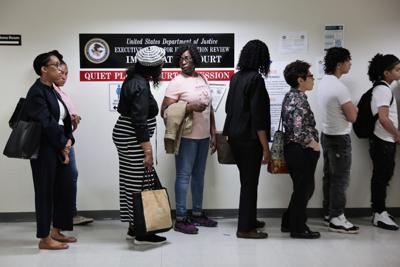


People line up for immigration court at the Jacob K. Javits Federal Building in New York. Photo: Michael M. Santiago/Getty Images.
This article was produced by Capital & Main. It is published here with permission.
The Trump administration has found a way for immigration judges to order dozens of immigrants deported at the same time.
Known widely as mega master hearings, the tactic involves rescheduling large numbers of immigration court cases from hearings months into the future to dates in just a matter of days or weeks. A single judge could have more than 100 cases on a given morning or afternoon during a mega master docket.
Attorneys around the country have said that many people do not get notice of the hearing date changes in time, and judges then order deported most, if not all, of the people who don’t show up for court.
Joseph Gunther and Brandon Marrow, data analysts who work with immigration court records, found that during one week at the end of May, about 40% of the people scheduled for mega master hearings did not show up. Gunther and Marrow wrote that on two occasions, a judge ordered every person scheduled for a mega master hearing deported because they did not appear for their hearing.
The researchers found that courts changed the hearing dates between nine and 35 days before the mega master date.
“People are not getting enough notice,” said Gracie Willis, a Rapid Response coordinating attorney with the National Immigration Project who observed mega master hearings in New Orleans.
“EOIR prioritizes the timely completion of all cases, including those of unaccompanied alien children, and makes scheduling adjustments as needed to ensure cases do not languish,” said an unnamed spokesperson for the Executive Office for Immigration Review, the immigration court agency, via email.
“Unnecessary delay hurts both aliens with meritorious claims and the American public who wish to see aliens with non-meritorious claims removed as quickly as possible,” the spokesperson wrote. “As it continues to add new immigration judges, EOIR will continue to make scheduling adjustments to ensure all cases are handled in a timely and lawful manner.”
While the mega in the tactic’s name alludes to the large number of people scheduled at a time, the master refers to master calendar hearings, which are usually short check-ins with an immigration judge to handle administrative aspects of a case. Judges typically hear a docket of master calendar hearings over a morning or afternoon. Cases often eventually move to individual hearings in which the judge schedules one person for a morning or afternoon hearing that is more like a trial over the facts of the case and the person’s request to stay in the country.
Vanessa Dojaquez-Torres, practice and policy counsel at the American Immigration Lawyers Association, said that her organization is hearing from lawyers across the country who are struggling to reopen cases of people who didn’t find out about their hearings until after judges had ordered them deported in absentia.
“It is physically impossible for a judge to get through 100 cases in one morning or afternoon slot and give every case the individual attention that it needs to ensure the correct due process guardrails have been followed, that proper notice was given,” said Dojaquez-Torres.
Courts in California, Connecticut, Georgia, Illinois, Indiana, Louisiana, Maryland, Massachusetts, New Jersey, New York, Oregon, Texas and Virginia have all had mega master hearings, Dojaquez-Torres said. A report from Mobile Pathways also found data to suggest mega master hearings are also happening in North Carolina and Tennessee.
The trend has continued to spread to more courts.
On June 12, the San Diego Immigration Court held its first mega master hearing.
Immigration Judge Catherine Halliday-Roberts ordered 50 people deported that day because they did not show up in court. She held a group hearing for 49 of them to give the deportation order. It took about eight minutes.
Most of those who did show up — about 20 people — received a group hearing as well. After advising the group of their rights and responsibilities through a Spanish interpreter, she gave them new court dates at the end of July and told them that they could leave.
One woman in the group did not speak English or Spanish. She spoke Indonesian and did not understand what had happened in her case.
Dojaquez-Torres said the large docket of cases makes more likely the possibility that judges will make those kinds of mistakes.
“People aren’t being given individual attention on their case, which would increase the chance of mistakes being made of someone not actually understanding what they’re agreeing to in their case,” Dojaquez-Torres said.
She and Willis, the Rapid Response attorney, both noted the strain that mega master hearings put on immigration courts.
Dojaquez-Torres said she is unaware of any immigration courtroom in the country that can accommodate 100 people. That has meant that some immigrants have to wait outside the courtroom for their turns before the judge. Dojaquez-Torres said her organization has received reports of people ordered deported in absentia because they were outside the courtroom because it was too full.
In San Diego, a court sign says that the maximum number of people allowed in a courtroom is 36.
Around the country, the large number of cases and relatively small courtrooms has meant court security staff haven’t allowed loved ones and legal observers to watch the hearings.
“If you are ensuring by your scheduling practices that every courtroom is completely packed, it could be seen as being an intentional tactic to exclude observers,” Dojaquez-Torres said.
An analysis from Mobile Pathways noted that the Chicago Immigration Court has seen a particularly high number of people scheduled for each mega master docket. It found that individual judges with mega master hearings had on average 122 cases on a given morning or afternoon.
“The Chicago Immigration Court is an in-absentia-removal-order factory right now,” said Ben Levey, senior attorney with the Asylum Project at the National Immigrant Justice Center.
He helps staff a legal help desk at the Chicago court.
He said many people there are not receiving notices about their hearings until after judges have already ordered them deported. One day, Levey said, a single judge ordered 78 people deported.
Adding to the issues, he said, some judges from other parts of the U.S. are appearing virtually via video to conduct the Chicago hearings. On a recent day, he said, the judge didn’t even turn on the video camera, and when the people present had questions about what was going on in their cases, the clerk was left to try to answer them in broken Spanish.
In one recent case, Levey said, a mother and child showed up together for court. The family thought their cases were grouped together. Court staff called the mother’s name for a group hearing, she received a new court date, and the family left, not knowing that the court hadn’t included the child in those proceedings. A judge later called the child’s name and ordered them deported because they had already left.
“It’s a mockery of due process,” Levey said.
Recently, he was trying to help a pregnant woman make a last-minute motion to change her hearing date because she is scheduled to be induced that same day, he said. He doesn’t know if the judge will rule on the request in time.
Meanwhile in Sacramento, Kamalpreet Chohan, an attorney with the California Immigration Project who similarly staffs an attorney-of-the-day program at the Sacramento Immigration Court, said that judges are telling people called in for mega master hearings that their applications for protection from deportation are incomplete but not explaining what those deficiencies are. The judges verbally give deadlines to the immigrants before them for fixing their applications and say they will order the people deported if they do not do so.
She said she’s heard judges say that because there are so many people present, they don’t have time to answer questions.
“Every time someone comes out, they’re very confused about what’s happening in their case,” Chohan said. “They’re in tears because they don’t know what’s happening.”
Chohan said that without written documentation showing the deadlines, it is difficult for attorneys to help later on.
She said the court scheduled mega master hearings with one judge but then fired the judge before the hearings happened and replaced him with a temporary judge who did not have any background in immigration law.
Willis, the attorney who has observed in New Orleans Immigration Court, said the process had looked a little different there. Many of the rescheduled cases already had pending individual hearing dates.
Mega master hearings started there at the beginning of June, she said. The fact that the cases already have trials scheduled makes the rescheduled master calendar hearings even more pretextual, she said.
“They’re being called in to be told, ‘You still have that hearing,’ and ‘Is your address correct?’” Willis said.
Willis pointed out that because the southern U.S. doesn’t have many immigration courts, many people have to travel from far away to make it to the New Orleans court for hearings. Short notice could make those trips impossible.
Willis said that the already understaffed New Orleans court is struggling to keep up with the daily caseload.
Back in San Diego, Immigration Judge Catherine Halliday-Roberts asked the group of people who did show up for the mega master hearing if any of them wanted to move ahead with their cases instead of taking more time to find lawyers to help them.
Several people raised their hands.
After the judge conducted one hearing for all of the people who wanted more time, she heard the handful of cases individually.
Among them, a woman in plaid pants and a black shirt asked to leave voluntarily to avoid a deportation order.
Halliday-Roberts asked if the woman was afraid to return to Mexico.
“Yes, but no,” the woman said in Spanish. “I don’t have family there or have a place to go, but it’s my country, and God will provide.”
She told the court she hoped that by leaving voluntarily, she would one day be able to get a visa to visit her grandchildren.
Next, the judge called up a man with dangling earrings and a white button-down shirt who said he had been in the U.S. for 14 years. The government had closed his case years ago but then suddenly reopened it last summer after President Donald Trump came back into office.
Halliday-Roberts asked if he wanted to proceed without an attorney.
“Yes, I prefer that to living in fear,” the man said in Spanish.
“What do you mean by living in fear?” the judge asked.
The man said that he’d lost everything in Mexico, that his family had rejected him because of his sexual orientation. He said he had made a life and friends here but that the current government didn’t seem to be giving him the chance to show he could contribute to the country.
The judge explained that the case would determine whether he could stay in the country and asked if he was sure that he didn’t want time to find an attorney.
The man thought for a moment and said he did want time after all. He said that he’d previously had an attorney, but the attorney quit after the man had a stroke and couldn’t keep up with the case.
“Now I’m restarting again,” the man said. “I don’t want to be a burden for the city or the government. I don’t receive any aid. I manage by myself as long as I have hands and feet. With these things I can move forward.”







(0) comments
Welcome to the discussion.
Log In
Keep it Clean. Please avoid obscene, vulgar, lewd, racist or sexually-oriented language.
PLEASE TURN OFF YOUR CAPS LOCK.
Don't Threaten. Threats of harming another person will not be tolerated.
Be Truthful. Don't knowingly lie about anyone or anything.
Be Nice. No racism, sexism or any sort of -ism that is degrading to another person.
Be Proactive. Use the 'Report' link on each comment to let us know of abusive posts.
Share with Us. We'd love to hear eyewitness accounts, the history behind an article.