
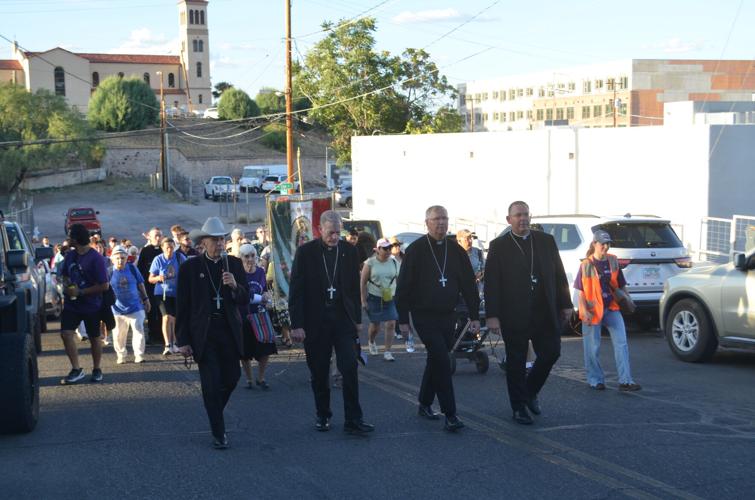
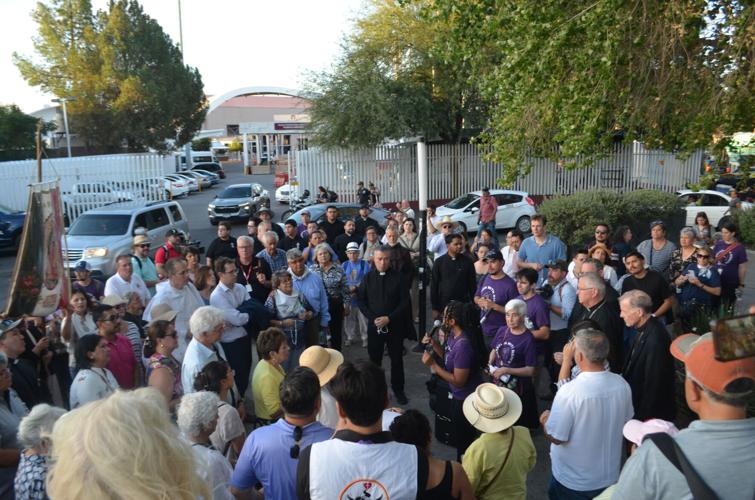
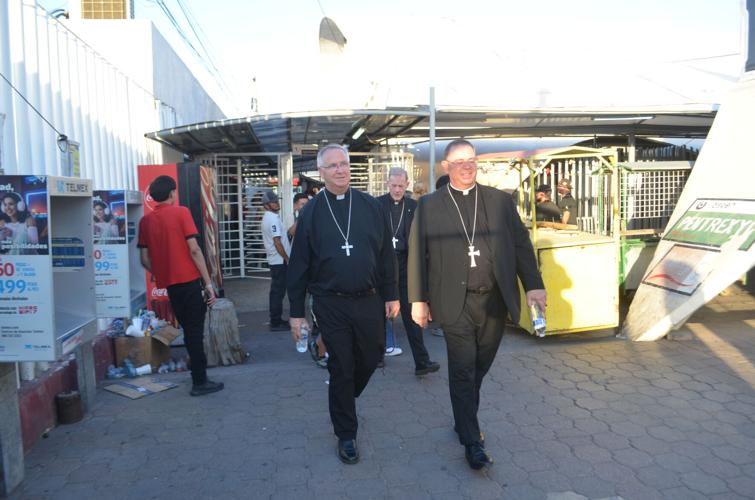
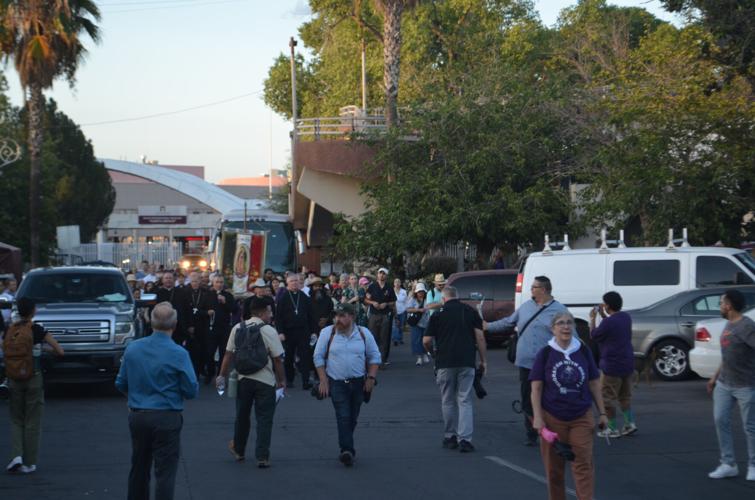

Bishops from Arizona, the Southwest and Mexico lead a procession from Nogales, Arizona, to Nogales, Sonora, in honor of 250 years of migrant contributions to the U.S., on June 26, 2026. (César Barrón/CALÓ News)
Nogales, Ariz. – Catholic bishops from Sonora and Arizona gathered to hold a pastoral dialogue, celebrate "The Border Mass 250" and conduct a procession from Nogales, Arizona, to Nogales, Sonora, honoring migrants in observance of the United States' 250th anniversary.
The June 26 event — held just days before the nationwide Fourth of July celebration — was organized by the dioceses of Tucson and Phoenix, in collaboration with the migrant support organization Kino Border Initiative, the Center for Migration Studies and the Hope Border Institute.
Catholic leaders from Arizona, parts of the Southwest and border Mexico cities participated, including Bishop John Dolan of Phoenix, Bishop Mark Seitz of El Paso, Texas, Bishop José Luis Cerra Luna of Nogales, Sonora, and Bishop Enrique Sánchez Martínez of Mexicali, Mexico.
Yohana Oviedo, media and narrative coordinator for Kino Border Initiative, noted that the idea behind the procession, rosary, and binational mass was to highlight migrants' contributions to the United States, specifically on the occasion of the nation's 250th anniversary.

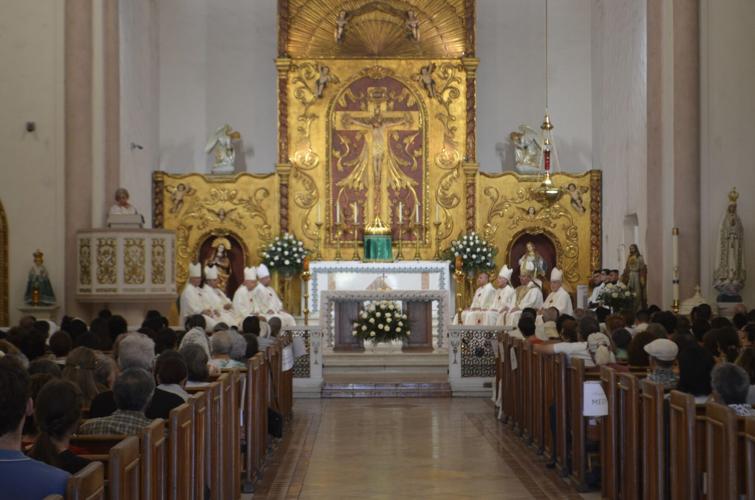
Bishops from Arizona, the Southwest and Mexico celebrate a mass at Sacred Heart of Jesus Church in Nogales, Arizona, in honor of 250 years of migrant contributions to the U.S., on June 26, 2026. (César Barrón/CALÓ News)
"What we want to emphasize is that we must never forget that migrants are part of this nation and have contributed — over the years and decades — to the nation's entire development," Oviedo said.
The observance began with a pastoral dialogue at Sacred Heart of Jesus Church, located on Grand Avenue in Nogales, Arizona — just two blocks from the border wall.
During the opening discussion, Archbishop John Wester of Santa Fe, New Mexico, stated bluntly that it was time to do justice to migrants who “have given so much to our country over the last 250 years,” specifically calling for “immigration reform that gives them the opportunity to become Americans and continue making our country great.”
For his part, Dolan noted that many migrants provide vital support to the region's agricultural sector and highlighted their contributions to the border community before the Mass began.

Bishops from Arizona, the Southwest and Mexico lead a procession from Nogales, Arizona, to Nogales, Sonora, in honor of 250 years of migrant contributions to the U.S., on June 26, 2026. (César Barrón/CALÓ News)
Afterward, a cross-border procession took place. Bishops led dozens of people from Sacred Heart to the Purísima Concepción parish in Nogales, Mexico — located on Adolfo López Mateos Avenue, two blocks from the Dennis DeConcini port of entry that divides the two cities of Nogales.
Before reaching their destination, upon crossing into Mexico on foot, the group was met near the border crossing by Sister María Engracia Robles, a co-founder of the Kino Border Initiative in Nogales. She spoke about the suffering endured by many displaced migrants.
“Migrants often carry an overwhelming sense of survivor’s guilt while their children, parents, and spouses die horrific deaths. Who can bear this alone? We pray for the grace to be present in their suffering and to help them carry their burden,” the sister said before leading the recitation of the rosary.
The procession then continued to Purísima Concepción Church. There, Cerra Luna acknowledged the visiting bishops and priests, noting, “We form a single pilgrim, a migrant pilgrim.”

Bishops from Arizona, the Southwest and Mexico lead a procession from Nogales, Arizona, to Nogales, Sonora, in honor of 250 years of migrant contributions to the U.S., on June 26, 2026. (César Barrón/CALÓ News)
In an interview with CALÓ News, Cerra Luna stated that part of the U.S. Independence Day celebration "must include the input, enrichment, and contributions of migrants. The United States cannot be understood without migrants," he said. "We must seek paths that lead to integration, dialogue, and unity, and overcome divisions."
José Israel Ibarra González, a research professor specializing in migration and human rights at El Colegio de la Frontera Norte (COLEF), Nogales Unit, told CALÓ News that such events represent a form of resistance to the new migratory reality.
"Human rights dictate that everyone has the right to migrate," the professor remarked. He explained that Mexico shifted from being a transit country to a destination country after the U.S. border was closed following President Donald Trump's return to the White House.
"There were many people who were in transit on January 20, 2025. Even though they had an appointment [with immigration authorities], they remained on the Mexican side and are still here. They cannot return to their places of origin because their lives would be at risk,” commented Ibarra González.

Bishops from Arizona, the Southwest and Mexico lead a procession from Nogales, Arizona, to Nogales, Sonora, in honor of 250 years of migrant contributions to the U.S., on June 26, 2026. (César Barrón/CALÓ News)
After the religious ceremonies, the bishops, priests, and other guests shared a meal with migrants in the dining hall of the Kino Border Initiative — a space where, far removed from speeches, solidarity is expressed every day at the table.








(0) comments
Welcome to the discussion.
Log In
Keep it Clean. Please avoid obscene, vulgar, lewd, racist or sexually-oriented language.
PLEASE TURN OFF YOUR CAPS LOCK.
Don't Threaten. Threats of harming another person will not be tolerated.
Be Truthful. Don't knowingly lie about anyone or anything.
Be Nice. No racism, sexism or any sort of -ism that is degrading to another person.
Be Proactive. Use the 'Report' link on each comment to let us know of abusive posts.
Share with Us. We'd love to hear eyewitness accounts, the history behind an article.