
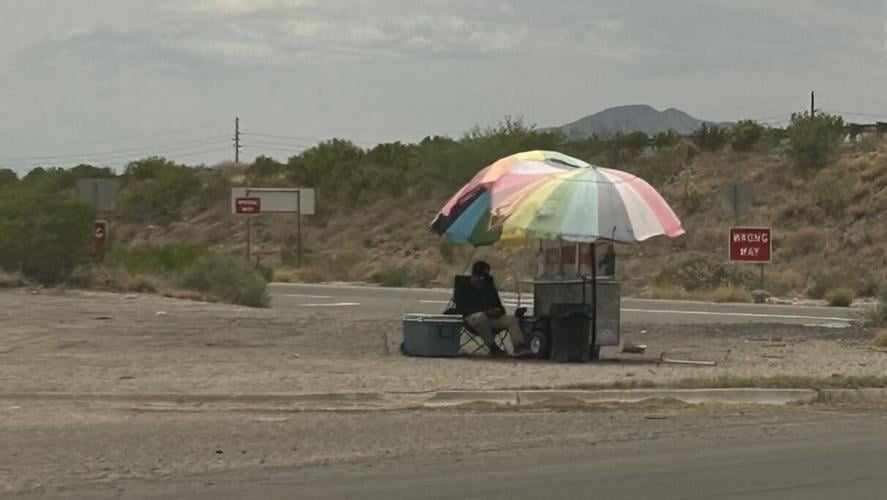


Fruteros are street vendors who set up along the roadside to sell fruit to passersby. (Susan Barnett/CALÓ News)
It’s an image that’s become all too familiar: a fruit stand left abandoned after the person working it is detained by Immigration and Customs Enforcement (ICE) agents. Photos of abandoned cars are posted to community Facebook groups and pages in the hopes that someone may recognize them and know that their loved one has been taken.
That’s exactly what happened on Saturday, June 27, 2026, when the fruit stand of a local family business that sets up on the corner of Santa Cruz Road and Drexel Road in Tucson was found abandoned.
A photo circulated on social media and in rapid response group chats and eventually made its way to Valentina, the cousin of the person who’d been arrested — whose name has been changed and omitted to protect their identity.
In an interview with CALÓ News, she said that since January, nine family members have been taken, all of them fruteros — street vendors who sell fruit on busy street corners — while on the job. It’s not the first time she’s been left all alone after her family members were detained and deported.
Since his re-election, President Donald Trump’s immigration agenda has focused on mass deportation, sealing the southern border and conducting sweeping raids, regardless of protected immigration status. The New York Times reported that federal immigration officials detained more than 10,000 people last week stemming from an internal push to increase arrest quotas.
In Arizona, ICE arrests tripled in the last fiscal year as street operations surged, according to a joint investigation by CALÓ News and Arizona Luminaria. Fruteros have become easy targets for ICE amid that surge.
“They took my three sisters, my three brothers-in-law, my cousins — everyone, really — but on different occasions,” Valentina said. “I’m the only one left.”
On the Saturday her cousin was taken, Valentina followed the protocol she has in place to make sure her family is safe while on the job. The system, which started shortly after her sister was detained earlier this year, entails calling her family members who are out vending every hour to make sure they’re okay.
“When they don’t answer if I call them — the second time they don’t answer — it means something has happened,” she said. “That’s how we stay in touch.”
Who and what gets left behind
One of the major fallouts Valentina has dealt with after a family member is detained is the property left behind: cars, fruit vending stands and personal belongings are just some of the things Valentina has had stolen after not being able to move the stand to another vending spot quickly enough.
ICE has also made it difficult to retrieve property, either by taking the keys so cars are harder to move, according to Valentina, or by staking out the area and waiting for someone to come pick up the property. She’s thankful to the passersby and Rapid Response volunteers who, on occasion, will stand by and observe while she retrieves her property, but she hasn’t always been as lucky.
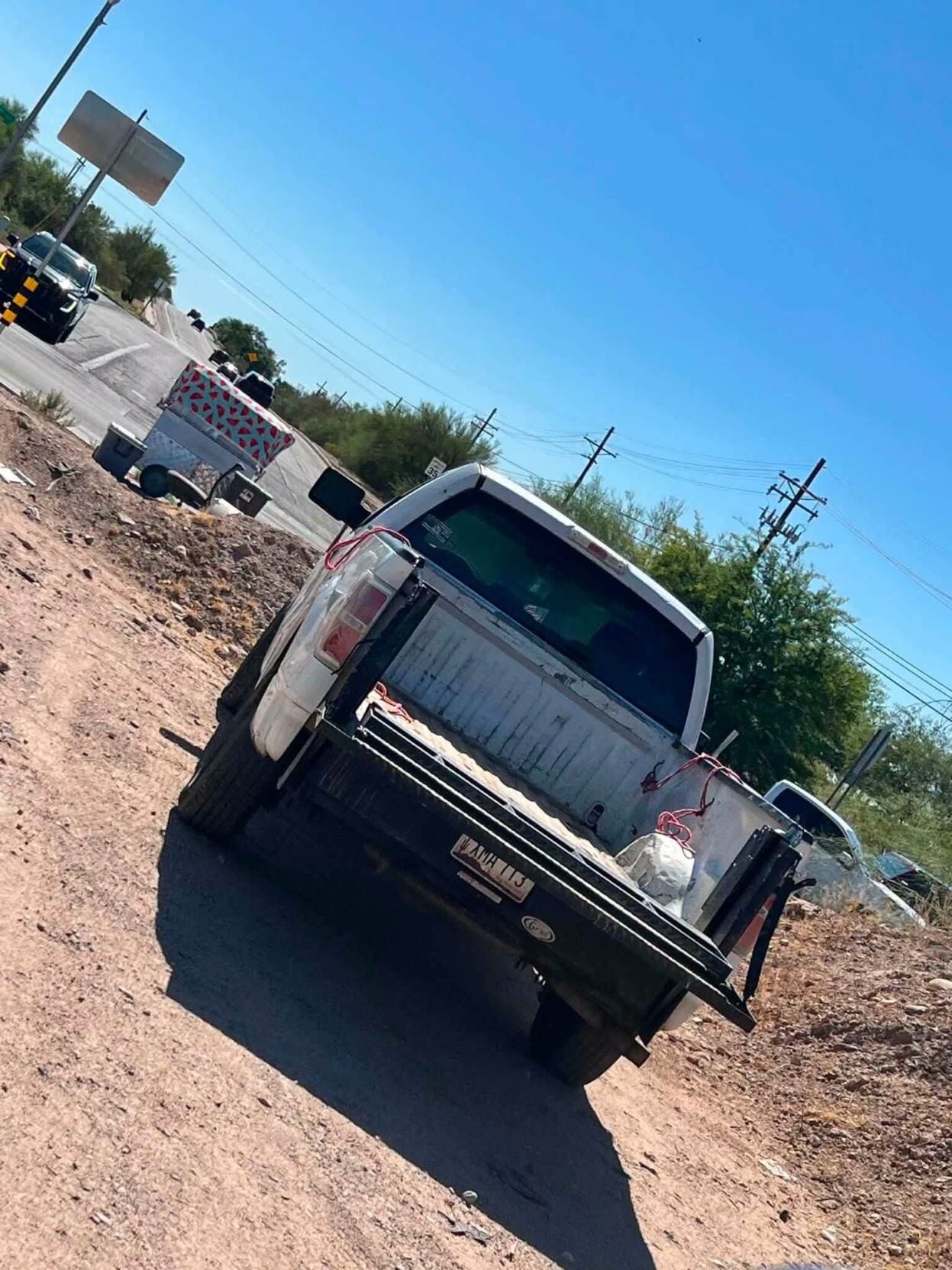
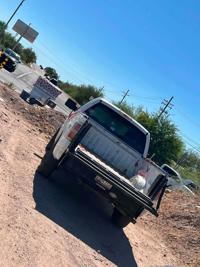
The photo that circulated on Facebook and in rapid-response group chats, which eventually reached Valentina. (Facebook)
She’s had to call a locksmith on occasion and has had to leave property behind after noticing it being watched by unidentified vehicles. In total, her family has lost three trucks to ICE activity. In one instance, someone — she’s unsure whether it was ICE or a passerby — stole a truck carrying five fruit-vendor stands. Each cost around $3,000, she said.
ICE’s personnel take the necessary steps to “secure vehicles left behind after an arrest and ensure they do not impede traffic,” according to Fernando X. Burgos, a DHS spokesperson. “The detained individual may arrange for someone to pick up the vehicle. If that is not possible, ICE contacts the local police department to arrange for towing.”
In a statement to CALÓ News, the Tucson Police Department said it is not involved in federal immigration enforcement operations.
“As a local law enforcement agency, our primary responsibility is the safety of community members and visitors, regardless of race, ethnicity, national origin or any other characteristic,” said Public Information Officer Frank Magos. “That means all community members, regardless of immigration status. In all our activities, the Tucson Police Department will continue to protect people's constitutional and statutory civil rights and liberties..”
He added that vehicles parked illegally or blocking roadways are towed by the city’s contracted tow company, Gary’s Towing & Salvage.
Florence Johnson, a community activist with the Coalición de Derechos Humanos in southern Arizona, sat in on a June 24 meeting between community organizers and Tucson police, where they discussed property left behind and surveillance technology used, such as Automatic License Plate Readers.
“(TPD) doesn’t know when ICE is abducting people so they don’t know where these things are happening,” she said. “It’s up to us to find a way to let people know because we can have Rapid Response on the scene. (TPD basically said) it's not their problem because they’re not collaborating knowingly.”
The coalition is hoping to approach members of the Tucson City Council, the Pima Board of Supervisors and other officials to “make them aware of all the different ways the community has been targeted and abducted.” Their next meeting is with Ward 6 Councilmember Miranda Schubert on July 23.
Johnson also called on Rapid Response observers to stay and monitor the area after someone has been detained, as it’s likely ICE would be targeting multiple locations nearby, she said.
Tucson was ‘calmer’
According to Valentina, almost every incident in which a family member was taken by ICE, the threat has started with a random person telling them to “go back to Mexico,” she said. “And a little while later, about four immigration patrol cars showed up and took [them] away.”
On another occasion, her cousin was on his way to work at a fruit stand when he called her to say he was being stopped. “‘Guess what? (ICE) turned their lights on behind me. I’m done for.’ That’s what he told me,” she said.
Valentina estimates about eight family members were detained and deported last year, including her four sisters and their husbands. Many clients supported her through that time, buying her fruit, bringing her food and giving her the encouragement she needed to continue working. Then, more of her family in California moved down to Tucson and one by one, she saw them also disappear into the immigration system again before being deported to Mexico months later.
Valentina and her family, all in the business of picking and selling fruit on Tucson’s busy street corners, moved from California to Tucson in 2023. Originally from Puebla, Mexico, she moved to the U.S. with her family in 2018 to send money back to her elderly parents, both of whom are sick.Her family settled in the Los Angeles area but experienced their trucks being robbed and even set on fire.
On a trip to Safford, she and her family passed through Tucson and noticed the city's calm. She and her siblings decided to make the move to Arizona. But since moving to Tucson, she’s seen most of her family be taken by ICE.
In total, Valentina has had over a dozen family members and at least seven friends detained, and many of them have already been deported back to Mexico.
“It’s more about the emotional exhaustion than going out to work in the heat,” she said.
According to Valentina, other fruteros have also experienced an increase in their families being targeted while at work. It is not just a fear but a daily reality: uncertainty in providing for their families.
“We’ve always tried to find a way to get ahead. We try not to get mixed up in anything, but unfortunately, there are bad people, selfish people,” she said. “God sees everything, and, well, there’s nothing left to do but keep moving forward.”
Susan Barnett is an independent journalist in southern Arizona covering the immigrant and Latine community. She is a recent graduate from the University of Arizona, where she received her Master of Arts in Bilingual Journalism. She previously worked at La Estrella de Tucson and co-founded Tucson Spotlight.









(0) comments
Welcome to the discussion.
Log In
Keep it Clean. Please avoid obscene, vulgar, lewd, racist or sexually-oriented language.
PLEASE TURN OFF YOUR CAPS LOCK.
Don't Threaten. Threats of harming another person will not be tolerated.
Be Truthful. Don't knowingly lie about anyone or anything.
Be Nice. No racism, sexism or any sort of -ism that is degrading to another person.
Be Proactive. Use the 'Report' link on each comment to let us know of abusive posts.
Share with Us. We'd love to hear eyewitness accounts, the history behind an article.