
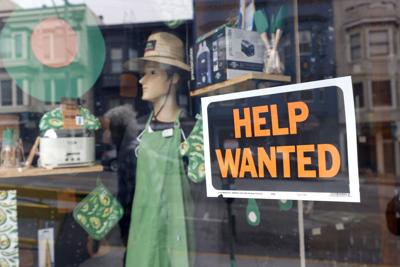


SAN FRANCISCO, CALIFORNIA - SEPTEMBER 16: A help wanted sign is posted in the window of hardware store on September 16, 2021 in San Francisco, California. Unemployment claims inched up to 332,000 from a pandemic low of 312,000 a week before. (Photo by Justin Sullivan/Getty Images)
This article was produced by Capital & Main. It is published here with permission.
The flip of the calendar to July brought a scrap of relief to workers scattered from California to New York, as a series of minimum wage adjustments kicked in. Alaska, Oregon and the District of Columbia all made broad-scale adjustments — in Alaska’s case, by $1 an hour — that will increase the earnings of more than 361,000 workers by roughly $221 million, according to research by the Washington, D.C.-based Economic Policy Institute.
Combined with minimum wage hikes in 19 other states that took effect on Jan. 1, 2026, it’s a testament to the ability of the states to schedule raises that increase pay for some of their lowest-wage workers.
In California specifically, though, something different is happening. Despite the fact that the Golden State has one of the highest minimum wages in the country, local cities and counties are increasingly coming to the realization that even as a wage “floor,” that minimum won’t give workers a shot at a decent life — and may lead them to look elsewhere for jobs.
As a result, 42 cities and counties now post minimums that are higher than the state standard — in some cases, approaching or exceeding $20 an hour.
Even those higher rates don’t cover the cost of living in the areas where they’re implemented, but that’s not to say they don’t matter. As those wages rise, they cover a large swath of workers — and turn up the volume on the conversation about what it takes to actually make it in California.
* * *
The minimum wage is hardly a trivial matter. According to estimates published by the California State Library, about 3 million residents of the state earn the minimum or very close to it — nearly 16% of the workforce.
Those ranks no longer include fast food workers at major chains, whose minimum wage was raised to $20 an hour in 2024, nor many health care workers, whose pay rose thanks to statewide legislation. But they do include legions of workers in restaurant, hospitality, retail and other jobs.
In 2016, then-Gov. Jerry Brown signed a landmark law that not only raised California’s statewide minimum wage from $10 to $15 an hour by 2022, but also scheduled future increases tied to inflation. This year, that inflation adjustment pushed the wage to $16.90, a 40-cent raise.
But while indexing to inflation is a “commonsense policy” that many cities around the U.S. have adopted, “It is not the strongest way to protect the value of the minimum wage,” write Economic Policy Institute researchers Sebastian Martinez Hickey and Emma Cohn in a recent blog post.
Instead, the EPI advocates tying the minimum to the median wage growth in a city or state — or that of the nation itself.
A rising national minimum has been a nonstarter for 17 years. Stuck at $7.25 an hour since 2009 by successions of reticent lawmakers in Washington, D.C., the wage is close to useless — miles away from even approaching the cost of living in most of the country.
Worse, the federal minimum gives the stingiest states and employers cover to continue using wage scales from another time. Twenty states either default to the mandatory $7.25 figure or actually have minimum wages set lower than that and are thus required to move “up” to the federal number. Of the 10 states with the highest poverty rates in the U.S., seven are stuck at $7.25 an hour.
The EPI estimates that the federal minimum has lost 30% of its purchasing power since its last adjustment and sits at its lowest real value in 77 years. Roughly 840,000 workers in the U.S., many of them tipped workers or students, are paid either the federal minimum or less.
But a minimum wage does more than raise living standards for the lowest-paid workers. When municipalities or states raise the minimum, motivated employers, including those who already pay more than the minimum to experienced workers, often follow with their own upward adjustments — their way of staying above that floor, so that they can attract and retain the workforce they need in order to thrive.
Studies have repeatedly shown that it’s more cost effective to retain your workers than it is to recruit and train a new workforce, even if retaining them means instituting a pay increase to stay ahead of the new minimum.
A rising minimum wage thus has a ripple effect, one of its many benefits. But in California, even an aggressively paced statewide minimum is no match for the skyrocketing costs of housing, food, transportation and health care. To the extent that they can, municipalities are now stepping into that breach.
* * *
San Francisco was the first municipality in California to adopt a minimum wage higher than the state standard. That was in 2003, and it was not until 2015 that any other city or county followed suit.
But the last decade has seen major growth. Dozens of cities, plus Los Angeles County and San Mateo County, now mandate minimums that are above — sometimes well above — the state’s $16.90 figure. Additionally, the so-called Olympic Wage law for many hotel and airport workers in Los Angeles reached $25 an hour this summer, although its full rollout has been delayed.
The stakes are certainly high enough. The links between financial struggle and health and poor health outcomes for both adults and children have been well documented, as well as learning problems and barriers to education access among kids from low-income backgrounds.
In Los Angeles, a working family would need to earn $38.61 an hour to afford a decent standard of living anywhere within an hour’s commute of the city, according to the advocacy group Living Wage For Us.
The state minimum only makes a dent in that math, and the federal minimum is of no use. Increasingly, cities and counties in California are trying to help workers themselves. Millions of residents have a stake in the outcome of those efforts.








(0) comments
Welcome to the discussion.
Log In
Keep it Clean. Please avoid obscene, vulgar, lewd, racist or sexually-oriented language.
PLEASE TURN OFF YOUR CAPS LOCK.
Don't Threaten. Threats of harming another person will not be tolerated.
Be Truthful. Don't knowingly lie about anyone or anything.
Be Nice. No racism, sexism or any sort of -ism that is degrading to another person.
Be Proactive. Use the 'Report' link on each comment to let us know of abusive posts.
Share with Us. We'd love to hear eyewitness accounts, the history behind an article.