
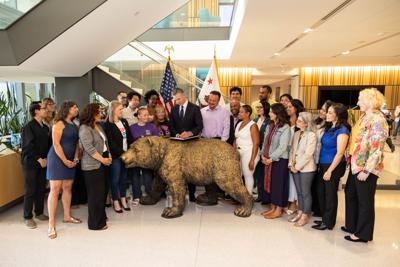


Members of SEIU and Health Access gather as SB 177 is signed by Governor Gavin Newsom. (Governor's Press Office)
The California Legislature has taken a first step in its mission to make big corporations in the state pay into Medi-Cal if their own employees rely on it, relieving some of the burden on taxpayers.
Gov. Gavin Newsom signed into law on Wednesday a bill that will require the next governor and his Department of Finance to come up with reasonable avenues for California’s biggest corporations to offset the taxpayer costs of their employees who rely on public benefits. Originally, legislators wanted Newsom to take up this task, though private negotiations ended in Senate Bill 177 leaving the charge up to the next governor.
“The Senate was proud to champion the Fair Share from Big Corporation Act to ensure taxpayers no longer pay a public subsidy to meet a corporation’s responsibility for employee healthcare,” said Senate President pro Tempore Monique Limón. “Requiring corporations to pay their fair share will help ease the burden the state faces due to federal healthcare cuts.”
The final iteration of SB 177, the Fair Share from Big Corporations Act, requires the Department of Finance to present at least one option for “holding the state’s largest corporations accountable” to the Joint Legislative Budget Committee by March 1, 2027.
The bill states that if the billions of dollars in healthcare cuts to California through HR. 1, the “Big, Beautiful Bill,” are repealed by the March deadline, SB 177 would no longer be in play.
The bill has a $10,000 General Fund allocation for the Department of Finance to implement. SB 177 is only a small first step in the process, as subsequent legislation and budget allocations would need to be passed and signed to actually begin requiring payments from these corporations.
“SB 177 is rooted in a simple principle: those who have benefited the most from California's economy should contribute their fair share to sustaining the communities that make that success possible,” said Sen. Lola Smallwood-Cuevas (D-Los Angeles) during a June 29 Senate floor session.
Essentially promising to study the issue before implementing a future policy is a similar playbook as other changes to Medi-Cal the legislature chose to postpone for now. Not wanting to immediately implement deep healthcare cuts proposed by Newsom for undocumented immigrants and others temporarily in California, Democrats chose instead to punt these cuts to the next governor.
In a prepared statement, Newsom said California believes “the biggest and most profitable companies should do their fair share—not shift the cost of employee health care onto taxpayers.”
While he did eventually sign the bill, Newsom did not budge on his opposition to implementing the large corporation tax during his final few months in office. The governor, who has also long opposed an in-state billionaire’s tax, has resisted the Fair Share tax as well as other state tax proposals.
Democratic leaders in the Legislature ultimately agreed to having SB 177 and any other similar legislation up to the next governor to deal with.
Some good news for Democrats is that Xavier Becerra, who has a strong shot at becoming the state’s next governor, has said he will support the Fair Share Tax and will work with the Legislature to implement it, as reported by POLITICO.











(0) comments
Welcome to the discussion.
Log In
Keep it Clean. Please avoid obscene, vulgar, lewd, racist or sexually-oriented language.
PLEASE TURN OFF YOUR CAPS LOCK.
Don't Threaten. Threats of harming another person will not be tolerated.
Be Truthful. Don't knowingly lie about anyone or anything.
Be Nice. No racism, sexism or any sort of -ism that is degrading to another person.
Be Proactive. Use the 'Report' link on each comment to let us know of abusive posts.
Share with Us. We'd love to hear eyewitness accounts, the history behind an article.