
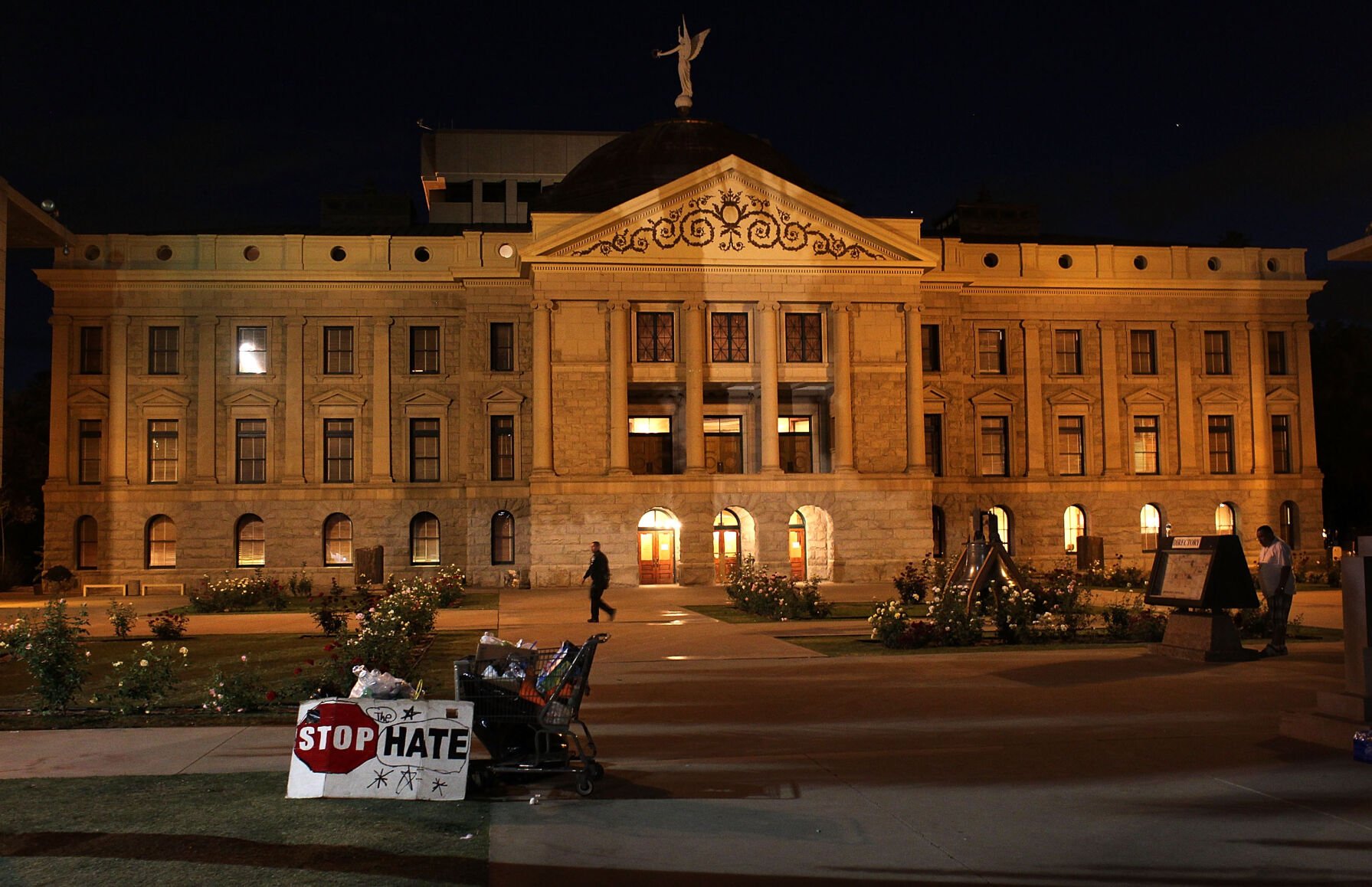
A policeman passes by Arizona's state capitol building following a demonstration protesting the state's new immigration law on April 23, 2010 in Phoenix, Arizona. (John Moore/Getty Images)
Nearly two months into Arizona’s record-setting legislative session, the Republican majority has yet to hear an immigration-related bill introduced by Democrats. The deadline to hear them in the originating chamber’s committee was Feb. 20, meaning they are effectively dead for the remainder of the session.
Last month, CALÓ News published a breakdown of the anti-immigration bills moving through the Arizona Legislature. While those bills continue to be monitored, it is also worth recognizing legislation attempting to aid immigrant communities, including proposals meant to keep immigration enforcement out of everyday public spaces like courthouses, hospitals and schools.
Rep. Mariana Sandoval (D-Goodyear) told CALÓ News that lawmakers on her side of the aisle are “still trying to protect immigrant communities,” regardless of pressure from the other side.
“People shouldn’t feel afraid to go seek medical help,” Sandoval said. “Parents shouldn’t feel afraid of sending their kids to school.”
Pro-immigrant organizations like Living United for Change in Arizona (LUCHA) said they will continue pushing their priorities despite the bills failing to advance.
“We want to create the Arizona we deserve,” said LUCHA Communications Director César Fierros. “We still want to build a legislature that is responsive to the needs of its constituents.”
They pointed to several bills that are about community trust and protecting civil rights, especially in a state where over one million people are foreign-born, according to the U.S. Census Bureau.
Although those bills will not move forward during this session, which is scheduled to adjourn on April 25, here is a look at what those bills could have done for Arizona’s immigrant communities.
Senate Bill 1375
Introduced by Sen. Catherine Miranda (D-Phoenix), the bill would place limits on immigration enforcement in “sensitive locations,” including courts, hospitals, schools and childcare facilities.
It comes as a response to criticism over enforcement activity in these areas that discourage families from seeking essential services.
House Bill 2881
In a similar vein, this bill, named the Immigration Safe Zones Act, would require the Arizona Attorney General to create statewide policies limiting how government agencies assist with immigration enforcement.
The bill, introduced by Sandoval, aims to ensure places like public schools, colleges, libraries, courts and hospitals remain accessible to residents regardless of immigration status. It would also require agencies to remove questions about citizenship or immigration status from applications for public services within 60 days.
Senate Bill 1708
Also introduced by Sandoval, this bill would prohibit state, county or city property from being used for civil immigration enforcement unless a judicial warrant requires it.
It would prevent public spaces such as government facilities from being used to detain or process people for immigration enforcement, including parking lots, garages or vacant land. The proposal would also require public signage stating that immigration enforcement cannot take place on those properties without a warrant.
The bill is partly in response to incidents last year in which people were detained outside immigration court hearings. Some counties and cities have begun to take similar action, like Pima County and the cities of Tucson and Phoenix, working on putting together ordinances that prohibit federal agency use of county and city-run properties.
House Bill 4111
Sponsored by Rep. Lydia Hernandez (D-Phoenix) and several Democratic co-sponsors, the bill would require U.S. Immigration and Customs Enforcement (ICE) officers to use body-worn cameras during interactions with the public. The text outlines requirements for when cameras must be activated and sets standards for storing and handling recordings.
It comes after ICE agents fatally shot two American citizens, Nicole Renee Good and Alex Pretti, during confrontations in Minneapolis. Supporters say it could increase accountability, while others worry it will be another avenue for mass surveillance.
Senate Bill 1342
Known as the Immigrant Trust Act, this bill, sponsored by Sen. Analise Ortiz (D-Phoenix), would restrict ways in which state and local agencies share information related to immigration status.
The bill would prohibit state, county and local law enforcement from stopping, questioning or detaining someone simply because of their suspected immigration status. It would also limit how agencies cooperate with federal immigration enforcement.
Local agencies would not be required to assist with immigration enforcement or share personal information unless there is a judicial warrant or federal law requires it. The proposal would also require annual reports on interactions between local law enforcement and immigration authorities and place limits on how immigration-related information collected through public services can be shared.
House Bill 2657
This bill from Rep. Seth Blattman (D-Mesa) would clarify the boundaries of how Arizona law enforcement agencies interact with federal immigration authorities.
It would prevent law enforcement agencies in Arizona from entering into agreements with federal immigration authorities to carry out federal immigration enforcement. It would also prohibit local agencies from detaining or housing people for federal immigration violations.
Other notable bills
HB 2474: Replaces the term “alien” in Arizona law with “noncitizen,” aligning state language with terminology that studies show are associated with more positive outcomes for immigration court cases.
HB 2879: Prevents healthcare providers from sharing medical records or allowing immigration enforcement access to private areas of medical facilities without patient consent, a subpoena or a valid search warrant.
HB 4093: Authorizes the Arizona Attorney General to prosecute ICE officers for criminal violations committed while operating in the state.
HB 2572: Allows students without lawful immigration status to qualify for in-state tuition at Arizona public universities and community colleges if they attended and graduated from an Arizona high school.
HB 2465: Prohibits Arizona licensing agencies from requiring proof of citizenship or immigration status and would allow applicants to use a federal tax identification number instead of a Social Security number when applying for professional licenses, similar to policies in states like California and New Mexico.
As other bills continue moving through the Legislature, Fierros said their focus remains on showing up, keeping the conversation alive and pushing for policies that respond to the needs of their communities.
“We’re fighting every day so that all people can thrive in our state,” Fierros said, “We will never abandon this fight.”
To track and monitor bills yourself, visit https://apps.azleg.gov/BillStatus/BillOverview. The site provides updates on votes, fact sheets and original bill texts.
Lorenzo Gomez is a multimedia journalist based in Phoenix, Arizona. He reports on politics, borderlands, culture and minority communities. He obtained a Master of Mass Communication from the Walter Cronkite School of Journalism and Mass Communication. His work has been featured in the Associated Press, CALÓ News, LOOKOUT, Phoenix New Times and Cronkite News.








(0) comments
Welcome to the discussion.
Log In
Keep it Clean. Please avoid obscene, vulgar, lewd, racist or sexually-oriented language.
PLEASE TURN OFF YOUR CAPS LOCK.
Don't Threaten. Threats of harming another person will not be tolerated.
Be Truthful. Don't knowingly lie about anyone or anything.
Be Nice. No racism, sexism or any sort of -ism that is degrading to another person.
Be Proactive. Use the 'Report' link on each comment to let us know of abusive posts.
Share with Us. We'd love to hear eyewitness accounts, the history behind an article.