
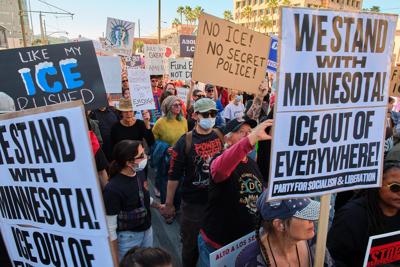

Thousands of people showed up to protest ICE violence in downtown Tucson on Jan. 30, 2026.
This story is published in partnership with Arizona Luminaria, a nonprofit newsroom dedicated to community-centered reporting
Clarification: An earlier version of this story misstated the definitions of custodial and non-custodial arrests. The story has been updated to reflect the correct definitions.
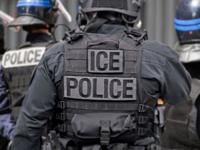
Immigration arrests in Arizona more than tripled in Fiscal Year 2025 as street-level operations have become a growing presence in neighborhoods and workplaces during the second Trump administration.
Fear of immigration enforcement has been a shadow over immigrant communities for decades, but under the Obama administration, street raids moved to a strategy of more targeted enforcement. Under the second Trump administration, a policy leaving few places of public or private life protected from enforcement has quickly become the norm.
More than 6,000 arrests were recorded by U.S. Immigration and Customs Enforcement (ICE) in Arizona — the bulk of which occurred soon after Trump returned to office.
The numbers show a dramatic mid-year shift after Donald Trump took office.
In the first three months of the fiscal year, from October to December 2024, monthly arrests in Arizona held steady at roughly 175 to 190, in line with the prior year's pace.
It was only after the inauguration that numbers began climbing sharply, reaching 364 in February, the first full month of the second Trump administration, and more than 800 by June. In September, federal immigration agents arrested more people than in any other month since Trump’s second term: a record high of 997 arrests.
CALÓ News and Arizona Luminaria analyzed internal arrest records from ICE obtained by the Deportation Data Project, a research initiative that acquires and releases government enforcement data through Freedom of Information Act requests. The data covers Fiscal Year 2024 (Oct. 1, 2023 – Sept. 30, 2024) and Fiscal Year 2025.
The data analysis looks at two groups: custodial and non-custodial arrests.
Non-custodial arrests refer to people arrested in street-level operations in neighborhoods or workplaces. Custodial arrests are people arrested by ICE who were already in law enforcement custody at a local jail or state prison, or, in some cases, in federal custody in Arizona.
ICE’s reported data shows that custodial arrests in Arizona more than tripled — rising from at least 1,249 last year to 3,821 in Fiscal Year 2025.
Non-custodial arrests saw the most explosive growth.
These kinds of arrests were nearly non-existent at the start of the fiscal year, with just 18 recorded in October 2024.
Following Trump’s inauguration, the number increased from 63 people arrested by immigration authorities in street-level operations in January to 124 in February, reaching a peak of 421 non-custodial arrests in August 2025. This represents a nearly seven-fold increase in just seven months.
Since the Trump administration took office, street-level arrests have become increasingly visible through videos shared online of neighborhoods inundated by federal agents.
Nearly seven out of every ten people arrested during these street-level operations had no prior criminal convictions. Even among custodial arrests, fewer than half had prior criminal convictions.
In Arizona, most arrests happen out of the public eye in jails and prisons run by local and state law enforcement, as well as at federal facilities.
About 38% of all arrests in the past fiscal year involved agents taking custody of individuals already being held by local law enforcement through the Criminal Alien Program, which allows ICE to detain immigrants in federal, state or local law enforcement agency custody.
The custodial arrests are also only possible because of the way local law enforcement works with the federal government, according to Yvette Borja, an attorney who works with Tucson-based immigrant defense network Red de DefensAZ to support Southern Arizona immigrant communities. “Without them, ICE would simply be unable to detain and deport people at the scale that it does,” Borja said.
Organizers say the immigration arrests show the ways that immigration enforcement —historically as well as under the second Trump presidency — worked to exclude Latinx and other groups of color from the country.
“This administration's cruel and harsh zero-tolerance policy … uses racial profiling to indiscriminately target anyone with a precarious immigration status for detention and removal, even at times disregarding prior grants of legal relief or orders of supervised release,” Borja said.
Federal officials dispute that characterization and say enforcement efforts are focused on public safety.
"Every day, DHS is conducting law enforcement activities across the country to keep Americans safe. It should not come as news that ICE will be making arrests in states across the U.S. and is actively working to expand detention space,” an unnamed ICE spokesperson said in an email to Arizona Luminaria. “Thanks to the One Big Beautiful Bill, ICE has new funding to expand detention space to keep these criminals off American streets before they are removed for good from our communities.”
That enforcement has impacted immigrant communities in Tucson, Phoenix and other parts of Arizona.
A Venezuelan mother of two was detained by Border Patrol on Tucson’s south side in February and then deported to México, a series of events that pushed the family into an uncertain and frightening future as migrants in Mexico.
In Phoenix, advocates at Trans Queer Pueblo continue to fight for the release of one of their own from immigration detention. Arbella “Yari” Rodríguez Márquez, a Phoenix resident with leukemia, has been in custody since February 2025, and loved ones say her health has continued to deteriorate due to a lack of adequate medical care.
Those realities have echoed across Southern Arizona: immigrant families have been arrested at their homes,heading to doctor’s appointments in Tucson or outside their local grocery stores during operations that have included windows being smashed by federal agents.
At least 46 people were arrested, many of them workers, in a series of coordinated raids at Taco Giro restaurants across the city. Rep. Adelita Grijalva was pepper-sprayed by federal agents who turned on protesters protesting the raids in December 2025.
In January, a similar operation resulted in the arrest of 38 employees of Zipps Sports Gill locations across the Phoenix area. Rapid response volunteers, government officials and local residents poured out in protest during and after the Homeland Security Investigation raids took place.
On the ground, Arizona residents, including American citizens, are carrying documents with them to prove their immigration status amid ongoing reports of immigration authorities having detained more than 170 citizens.
Local rapid response groups and mutual aid organizers have stepped up their efforts to support impacted communities and build systems to show up to raids as they happen.
Meanwhile, Tucson and Pima County officials are implementing policies to restrict how federal immigration authorities can use local government property for enforcement operations.
How we analyzed the ICE arrest data
The Source
CALÓ News and Arizona Luminaria analyzed internal U.S. Immigration and Customs Enforcement (ICE) records obtained by the Deportation Data Project. These records, released in response to a Freedom of Information Act request, cover Fiscal Years 2024 and 2025.
Cleaning the Data
To ensure the numbers specifically reflected Arizona, we cross-referenced two different location fields in the ICE system: the state designation and the “Phoenix Area of Responsibility.” When these fields disagreed due to data-entry errors, we counted only records in which both matched.
We also filtered the list to ensure each person was only counted once per year. If an individual was arrested multiple times in a single fiscal year, we retained only the most recent record to prevent double-counting.
Defining “Street-Level” vs. “Jail” Arrests
We used ICE’s internal “apprehension method” field to categorize how people were taken into custody:
Street-level arrests (Non-custodial): These are recorded by ICE as “Non-Custodial” or “Located” arrests. These typically occur in neighborhoods, transit hubs or workplaces.
Jail and prison transfers (Custodial): These occur when people already in the custody of local jails, state prisons or federal facilities are transferred to ICE through programs such as the Criminal Alien Program and the 287(g) Program.
Categorizing Criminal History
ICE classifies individuals as having a prior conviction, pending charges or as “other immigration violator” with no criminal record. In this story, when we refer to people with “no criminal conviction,” that includes both those with no record at all and those with only pending charges. This ensures we are not labeling people as “criminals” who had not actually been convicted of a crime at the time of their arrest.
Demographics and Limitations
Nationality and age figures are based on the citizenship and birth year fields provided by ICE. While this data is the most comprehensive look at federal enforcement in Arizona, it only reflects what ICE officially recorded and may not capture every enforcement action that took place during this period.
Raphael Romero Ruiz is a journalist and a graduate fellow at the Howard Center for Investigative Journalism and now lives in Baltimore. Born and raised on the southside of Tucson, Arizona, he formerly covered the border beat for The Arizona Republic, reporting on immigration issues and communities across the Arizona-Mexico borderlands.







(0) comments
Welcome to the discussion.
Log In
Keep it Clean. Please avoid obscene, vulgar, lewd, racist or sexually-oriented language.
PLEASE TURN OFF YOUR CAPS LOCK.
Don't Threaten. Threats of harming another person will not be tolerated.
Be Truthful. Don't knowingly lie about anyone or anything.
Be Nice. No racism, sexism or any sort of -ism that is degrading to another person.
Be Proactive. Use the 'Report' link on each comment to let us know of abusive posts.
Share with Us. We'd love to hear eyewitness accounts, the history behind an article.