
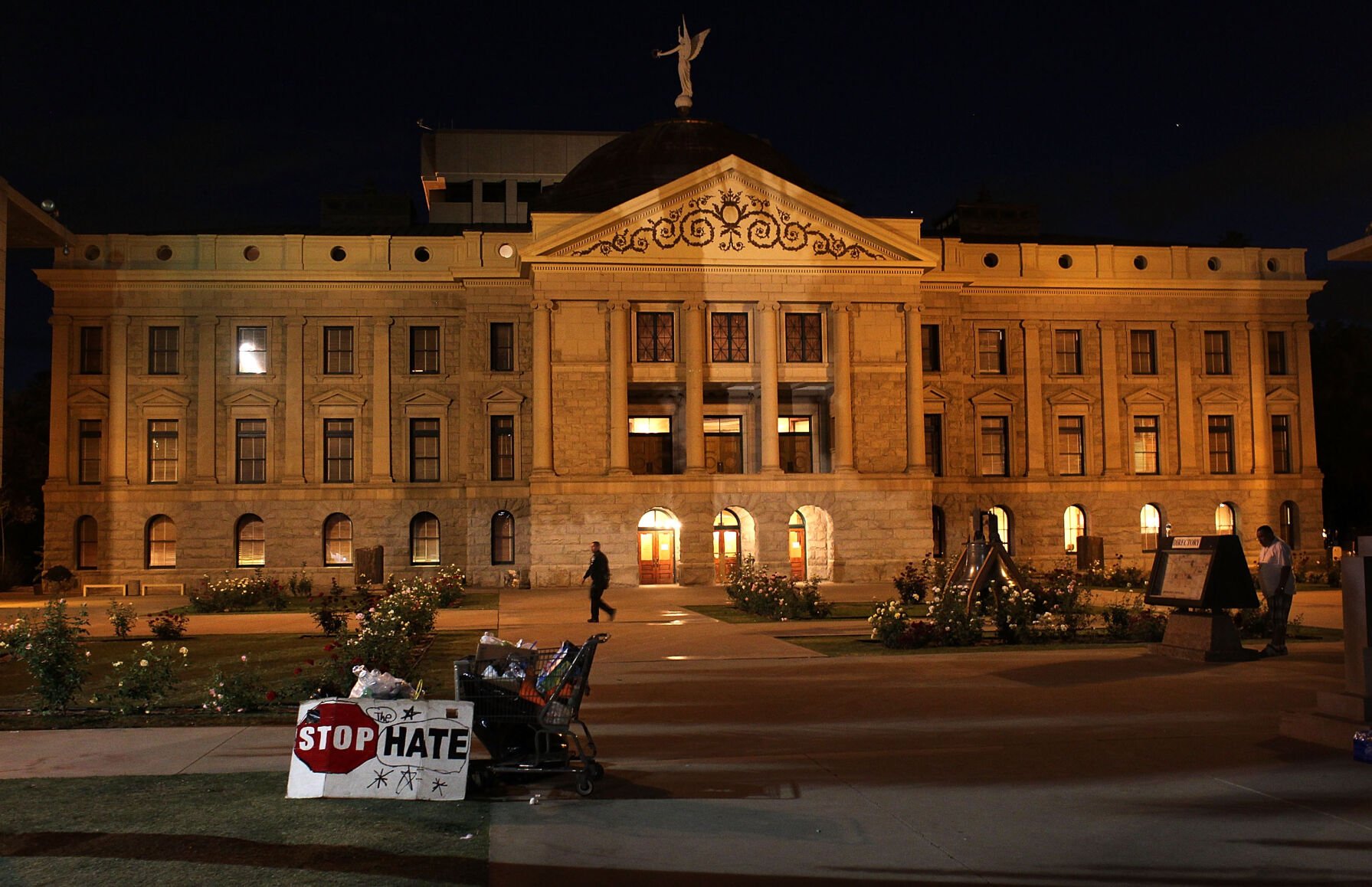
A policeman passes by Arizona's state capitol building following a demonstration protesting the state's new immigration law on April 23, 2010 in Phoenix, Arizona. (John Moore/Getty Images)
Arizona’s 2026 legislative session is set to break records for the most bills introduced in the state’s history and it comes as no surprise that immigration has been one of the hottest topics.
Lawmakers on both sides of the aisle have introduced numerous bills related to immigration enforcement, border security, protesting and documenting law enforcement activity.
“What I’m seeing is duplicative federal bills,” said Rep. Mariana Sandoval (D-Goodyear). “[Republicans] want to codify whatever the federal government is doing at the state level.”
In an interview with CALÓ News, she said state and local governments should not be in the business of enforcing federal immigration laws, saying it undermines community trust, public safety and local control.
With so many passing, dying and stalling, here are some of the anti-immigration bills CALÓ News is tracking and what they could mean for the community.
Senate Bill 1520
Introduced by Sen. Wendy Rogers (R-Flagstaff) and Sen. Mark Finchem (R-Prescott), the bill would require Arizona state agencies to share information upon request with the federal government about people who are in the country without legal status or who have overstayed a visa. The law would expire in 2028 unless renewed.
Wayne Wauneka, a Diné behavioral health worker, said the bill, “creates a system built on fear and surveillance instead of care and community.” He said it would prevent people from reaching out and receiving necessary mental and behavioral health services.
The bill passed through the Senate Military Affairs and Border Security committee along party lines and now heads to the Senate Rules Committee.
Senate Bill 1570
The bill, sponsored by Sen. Wendy Rogers (R-Flagstaff), would require the state's 15 county recorders and board of supervisors to enter into a written agreement with ICE "to provide for the presence of such law enforcement personnel at all locations in Arizona in which voting is conducted or ballots are deposited," the fact sheet reads.
Bill language states it would only be in effect during the 2026 general election.
SB 1570 was originally introduced by Sen. Jake Hoffman (R-Queen Creek) regarding DEI practices at workplaces. Rogers re-introduced this strike-all bill instead, altering it entirely to focus on the upcoming elections — a move that advocates denounce as voter intimidation.
The bill was scheduled for a read at the Senate Judiciary and Elections committee on Feb. 20.
Senate Bill 1635
This bill, sponsored by Sen. John Kavanagh (R-Fountain Hills) would make it a misdemeanor offense for “unlawful alerting,” making it a crime to knowingly warn someone about law enforcement activity in their area if the intent is to “hinder, delay or prevent” an arrest.
The bill applies to electronic messages, verbal statements, gestures or other forms of intentional signaling. Violations would be prosecuted by the attorney general or county attorneys and classified as a Class 1 misdemeanor.
Organizations like Puente Movement for Migrant Justice and legislators like Sen. Analise Ortiz (D-Phoenix) have become known for alerting the community of Immigration and Customs Enforcement (ICE) activity in their area. The bill does not directly mention ICE monitoring, but advocates say it is meant to stop exactly that.
It is currently held in the Senate Judiciary Committee, as its initial hearing was postponed.
House Bill 2904
Sponsored by Rep. Steve Montenegro (R-Goodyear), the bill declares fentanyl trafficking a public health crisis and directs the Arizona Department of Health Services to address it, stopping fentanyl overdoses by beefing up border security and addressing public health.
“Thank God we have a president that has focused on having a secure border,” Montenegro said during a committee hearing. “But that doesn't always happen, and in those instances, we as a state have a responsibility to our citizens to make sure that we are protecting them.”
Noah Schramm, a policy strategist with the ACLU of Arizona, argued that the bill uses ambiguous language, like “unlawful invasion,” that does not exist in state law, and could lead to “even higher incarceration rates for low-level offenders,” without addressing the opioid epidemic.
The bill passed along party lines and now heads to the House Rules Committee for a vote.
Senate Bill 1055
Introduced by Sen. Wendy Rogers (R-Flagstaff), the bill would require local authorities to alert ICE when someone without legal status is arrested, intending to enforce established laws and protect ICE agents.
“When this is not carried out, it puts an undue burden on the safety and the well-being of law enforcement,” she said. “Then ICE does not have to go looking and put themselves in danger in neighborhoods.”
ACLU’s Schramm said the bill “is a way of strong-arming state and local law enforcement into using their limited resources to help ICE.” He also said the current statute does not obligate law enforcement to prolong arrests solely for determining immigration status.
The bill passed through committee and now heads to the Senate floor for a vote.
Other bills to watch
HB 2689: Requires hospitals receiving certain state funds to ask patients to self-report their citizenship or immigration status (without affecting care or sharing personal identities) and submit aggregate quarterly and annual reports to the state, analyzing totals and the financial impact of uncompensated care for those without legal status.
SB 1421: Bars banks and check cashers from accepting certain IDs issued to undocumented immigrants and prohibits loans that rely on an Individual Taxpayer Identification Number for identification. It also requires proof of lawful presence before sending money abroad, with oversight and penalties enforced by the state — a potential setback for those relying on remittances.
HB 2416; SB 1707; SB 1157: Appropriations bills providing millions of dollars for security along the southern border.
HB 2811: Expands the crime of obstructing governmental operations to include using or threatening violence to hinder a lawful arrest and makes that conduct a Class 5 felony instead of a misdemeanor.
SB 1152: Requires state and local agencies to verify immigration status before providing certain public benefits and to report suspected immigration violations to federal authorities. It also makes people with pending asylum applications ineligible for those benefits.
SB 1474: Requires state and local law enforcement agencies to train officers on immigration enforcement and bans policies that limit cooperation with federal immigration authorities. It also empowers the Attorney General to take legal action against local governments that restrict that cooperation.
SB 1457: Allows state funds to be used for advanced air mobility and purchasing aircraft for border security purposes, with priority given to counties along the international border.
Sandoval said the surge in immigration-related bills reflects sharply different approaches at the Capitol. Some lawmakers seek to mirror federal enforcement efforts, while others focus on retaining local control.
She said the debate ultimately comes down to community voice and participation, arguing that influence comes from collective action and that residents who are able should engage in the process and make their priorities known.
To track and monitor bills yourself, visit https://apps.azleg.gov/BillStatus/BillOverview. The site provides updates on votes, fact sheets and original and amended bill texts.
Lorenzo Gomez is a multimedia journalist based in Phoenix, Arizona. He reports on politics, borderlands, culture and minority communities. He obtained a Master of Mass Communication from the Walter Cronkite School of Journalism and Mass Communication. His work has been featured in the Associated Press, CALÓ News, LOOKOUT, Phoenix New Times and Cronkite News.







(0) comments
Welcome to the discussion.
Log In
Keep it Clean. Please avoid obscene, vulgar, lewd, racist or sexually-oriented language.
PLEASE TURN OFF YOUR CAPS LOCK.
Don't Threaten. Threats of harming another person will not be tolerated.
Be Truthful. Don't knowingly lie about anyone or anything.
Be Nice. No racism, sexism or any sort of -ism that is degrading to another person.
Be Proactive. Use the 'Report' link on each comment to let us know of abusive posts.
Share with Us. We'd love to hear eyewitness accounts, the history behind an article.