
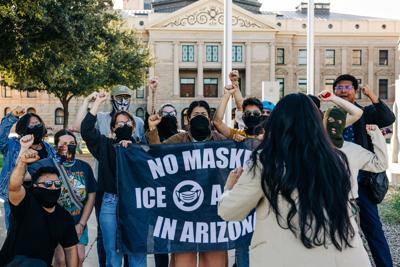

RAZA advocates protest outside the Arizona State Capitol on March 2, 2026. (Courtesy of Rural Arizona Action)
Activists and community members remain steadfast and committed to sounding the alarm against anti-immigration proposals at the Arizona Legislature, even as they face increased obstacles during the 2026 legislative session, including scheduling delays, greater security presence and threats of legal charges.
As numerous bills targeting immigrant communities in Arizona progress through the state Senate and House of Representatives, advocacy groups across the state have rallied to raise awareness and build resistance.
Among those most active are Living United for Change in Arizona (LUCHA), Progress Arizona and Rural Arizona Action (RAZA), an advocacy organization focused on supporting and amplifying civic engagement and voter rights efforts across rural Arizona. Their initiatives include voter registration drives, leadership training events and advocacy on political issues, among others.
Members of rural communities often cannot attend legislative sessions and events due to travel and time burdens, Kassandra Alvarez, communications director at RAZA, told CALÓ News. That’s where the organization’s work comes in, representing their interests by raising awareness and creating visibility at the Arizona State Capitol.
Their actions — as well as those of other advocacy groups — have been accompanied by heightened security at the Capitol.
During a February reading of SB 1570, which would have required Immigration and Customs Enforcement (ICE) agents at polling places, community members were issued trespassing notices and barred from entering the Senate chambers. Leaders and activists categorized the action as “blatant discrimination and racial profiling.” Due to ongoing protests, however, the bill was held in committee, preventing it from being heard and voted on for the time being.
Those notices were delivered after protesters were removed from a committee session days before, as testimony for SB 1635 — which would criminalize sharing information about ICE activity — was underway.
“They are intimidated by the community and how we are responding. So, whenever there is a bill that is controversial… they increase security or they limit testimony,” Alvarez said. “There are things that they do strategy-wise to get people tired, to get people anxious, to just get people uncomfortable, or to make them wait until another day.”
On March 3, RAZA partnered with other advocacy groups to host a demonstration against the Senate’s passing of SB 1635. Throughout the demonstration, RAZA had legal teams and bail funds on call, according to Alvarez. Demonstrators were also briefed on the potential for trespassing or other charges before entering the Senate building after the events related to the ICE at polls bill.
“This was actually one of the few bills where we had the opportunity to do this demonstration,” Alvarez said. “We wanted to keep it and hold it there because of the nature of what that specific bill was trying to criminalize: our alerts and what we believed was public safety with being able to identify an agent.”
Inside, security personnel warned demonstrators that blowing the plastic whistles some had brought in would result in a felony charge.
During that same Senate floor session, Arizona State Sen. Catherine Miranda (D-Laveen) introduced an amendment to SB 1635 that would prohibit facial coverings for ICE agents and require them to visually display their name and badge number.
When the amendment failed to pass, protestors in the gallery stood, chanting “Unmask ICE! No more fear!” Security escorted the protestors out of the building and trespassed them, but no charges were issued for blowing whistles.
“The security really, really increased [since last time],” Alvarez said. “The team from the Democratic representatives tried to figure out exactly what was going on behind the scenes — what was different, why were they acting in that specific way — but we couldn't get a lead of who had been the one that had requested security to act in that manner.”
CALÓ News reached out to the Arizona Senate Republican Caucus for comment regarding the presence of increased security throughout this legislative session, but did not receive a response at the time of publication.
In a statement emailed to CALÓ News following the trespassing notices delivered in February, Arizona Senate Republican Caucus spokesperson Kim Quintero said that Senate staff "positively identified" community members in violation of the ARS statute after reviewing video from previous committee hearings.
"These actions were not directed at any organization or viewpoint. They were based solely on documented conduct that violated established law and rules that apply equally to everyone in the Capitol," Quintero said.
Other political advocacy groups have faced similar challenges to those encountered during previous appearances at the Capitol. Kassie Black, a Phoenix commander with the Brown Beret Organization and attendee of the Senate demonstration on March 3, told CALÓ News that Capitol security informed her that tabling on the Senate lawn was prohibited without permits and insurance, and instructed her to take down her setup.
“That's never been a problem for the entire five years I've been out here, but all of a sudden, for the first time in my life, it is now a problem,” Black said.
The Brown Beret Organization has tabled at the Arizona State Capitol regularly throughout the current Trump administration to promote pro-immigrant resistance and encourage voting for progressive change.
LUCHA’s recent efforts have included “Pack the Room” calls to action, in which they invite community members to join them as they witness readings and votes on certain bills, often organizing testimony in opposition.
On March 9, LUCHA organized an event against SB 1055, which would require state law enforcement to determine the immigration status of anyone “reasonably suspected” of being in the country illegally during an arrest, detention or legal stop. During the session, legislators heard from community members like East Valley resident Lisa Castellanos, who spoke on behalf of disabled individuals like her son, and Tempe public educator Gail LaGrander, about prioritizing housing, healthcare and education needs of Arizona families over the needs of federal law enforcement.
“Those are the challenges families across the state expect you to address. Instead, this legislature continues to fail us,” LaGrander said. “Time is being wasted advancing policies like SB 1055 that endanger communities and distract from the real issues families are facing.”
While the bill was ultimately passed and returned to the House floor for a later vote, Republicans would still need Gov. Katie Hobbs’ support to sign the bill into law. Hobbs has vetoed numerous immigration enforcement bills this session, including SB 1164, which would have required state and local agencies to cooperate with immigration enforcement operations, and SB 1051, which would have required public hospitals to ask patients about their immigration status upon admission.
While additional vetoes may be possible, groups plan to continue showing up to the publicly accessible stages of the legislative process. Local organizations like LUCHA and RAZA are regularly hosting events ranging from legislative advocacy to community education.
Future events include:
ICE out of Mesa - Mesa City Council Meeting (March 23 at 5:30 p.m.)
Barrio Dinner - Tax Education Event (March 24 at 5 p.m.)
NO KINGS Central Phoenix - Rally (March 28 at 2 p.m.)
The People’s Assembly - Town Hall (April 25 at 9 a.m.)
Primary Election Ballot Party - Community Education (July 14 at 6 p.m.)
“[The Capitol] is where everything is happening. This is where you want to be. They're trying to kick people out selectively, booting them into other areas, making it less visible and less known,” Black said. “The whole idea of being here is just to be able to get the Senate members [to see us].”
When asked what the public can do to get involved, Alvarez said, “Stay attentive to the legislature and request to speak, request to share your testimony. Ask your legislators directly to vote yes or no on certain things. I think that's a really good first step.”
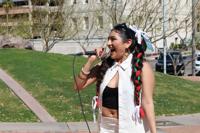
River Graziano is a freelance journalist for CALÓ News. They grew up in the Ahwatukee area of Phoenix and later attended ASU in Tempe, where they spent two years as an editor at The State Press. Their reporting with CALÓ News covers advocacy efforts impacting Latine communities across the Valley.







(0) comments
Welcome to the discussion.
Log In
Keep it Clean. Please avoid obscene, vulgar, lewd, racist or sexually-oriented language.
PLEASE TURN OFF YOUR CAPS LOCK.
Don't Threaten. Threats of harming another person will not be tolerated.
Be Truthful. Don't knowingly lie about anyone or anything.
Be Nice. No racism, sexism or any sort of -ism that is degrading to another person.
Be Proactive. Use the 'Report' link on each comment to let us know of abusive posts.
Share with Us. We'd love to hear eyewitness accounts, the history behind an article.