
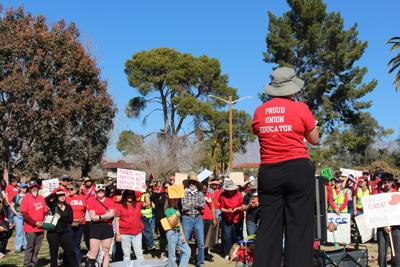


A local teacher speaks before the crowd at an educators' rally on Friday, Jan. 30, 2026, at Catalina Park on Fourth Avenue in Tucson.
TUCSON – Ruben Lopez rolled the school-zone signs one-by-one out onto 1oth Avenue Monday morning.
In a crisp 49-degrees, he wore a royal blue Air Force knit cap under his hoodie and waved as cars passed. He then trekked into the Drachman Montessori Magnet School parking lot.
“Our crossing guard called in today, so I need to put the signs out cause I’m making sure we have what we need for our children,” he said. “Now, I’m headed back to monitor.”
Lopez, 55, is a father of 10 and a Tucson Unified School District campus monitor is one of hundreds on the front lines of TUSD campuses at 88 schools across the city. As district staff met last week on a personal development day, Lopez and others attended mandatory training for how to deal with Immigration and Customs Enforcement — should the federal agency arrive at campuses across Southern Arizona’s largest school district.
“We understand exactly what ICE is allowed to do and what it cannot do,” he said, pointing to the intersection of 22nd Street and 10th Avenue, steps away from where last month ICE agents stopped a car and arrested occupants just outside the Drachman playground fence.
“So my biggest thing is making sure my students are all safe,” he said. “As long as they are safe, I’m safe. That’s all that matters to me.”
Student, staff and family protection prompted staff to ask the TUSD Governing Board last month to review guidelines and offer training on how to deal with potential ICE presence on campus.
As of Monday, TUSD says ICE has not been on a campus this school year. Yet, the training and preparation is imperative in a district where about 65% of its 35,000 students identify as Hispanic.
The board will hear from Superintendent Gabriel Trujillo at Tuesday’s meeting with an update.
More than 50 schools have expressed interest in the training, said Jim Byrne, president of the Tucson Education Association, the union representing teachers and staff.
Distributing Know Your Rights cards and circulating district resource lists — both available in the front office — are the baseline, no matter who comes to campus or how, Byrne said.
“We are building out and up our immigrant support teams at the sites that have expressed interest. We are collecting questions to bring to TUSD legal and asking what signage would feel helpful and comforting at each school,” he said.
How to protect students’ identities, identifying judicial warrants and ways to approach officers arriving on campus are included in the training, which is derived from TUSD immigration enforcement guidelines.
Board President Dr. Ravi Shah agreed the instruction is vital and he identified with families who may be targeted by ICE.
“As an American with brown skin, with an immigrant parent, and a parent of TUSD children, including one with very brown skin, like my own, my family, like a majority of families in our community, are very truly aware of the othering and the scapegoating perpetuated by our federal government right now,” Shah said at the board meeting. “I feel for all our members and our community who are not just feeling targeted, but are targeted.”
At Catalina High School, where the population of about 600, includes 86% students of color and 36 different nationalities, staff and teachers looked to Chicago Public Schools as a preparation example. Chicago was one of the first cities to deal with a stepped-up ICE presence last year.
The Catalina plan is evolving and the Trojans’ staff is examining what to do specifically before or after school. The district is unified in that “we want our schools to be safe for our students,” said Catalina teacher Becky Graseck.
Across town at White Elementary on the southwest side, first-grade teacher Yessica Acosta said her training takeaway was looking at how warrants can differ and what to look for, who can come onto campus, how to keep the children safe and “what-if scenarios, especially on field trips.”
“The students don’t really know what’s going on. They are just doing their own thing,” Acosta, a first-year teacher, said. “I like being up-to-date with everything that’s happening. And here, we have a community, parents that are involved, administration that’s involved. You can count on them.”
Leaning into community relationships is key, Byrne said, because families and volunteers can be the eyes and ears of a school.
“The more organized and prepared, the campus is much more integrated to what’s going on,” Byrne said. “We are looking at more than what district guidelines say: What if they come to the gate? Building? Tool kits for the front-line staff — whether that’s front office, monitors, food service, community liaison.”
Reiterating the district policy, including an updated superintendent email from last year were some asks from teachers and staff. And they implored administrators and the board to hear their urgency.
“So what I would ask is that yes, we have policies and procedures in place. But it seems that our administrators are afraid to talk about it,” speech pathologist Gina Santos told the board.
“Teachers that we talk to don’t seem to really know what the plan and procedures are. What is different than the status quo? Because we are not living in the status quo,” Santos said. “People are being disappeared, citizens are being murdered. What is different? This year has been wild. It’s been scary. We all feel like we’re in danger.”
That plea and others came three days before thousands of TUSD employees called out sick, prompting 21 TUSD schools to close for the day due to lack of staff. Many took part in a rally and protest downtown. Staff took cues from thousands of TUSD high school students who walked out of their final class period on Jan. 20.
Shah echoed that passion.
“My three kids now have copies of their passports and birth certificates in their backpacks,” Shah said to groans from the board meeting crowd. “And I know my second grader still doesn’t know exactly why this is happening and what’s going on.”
That lack of awareness was OK with Lopez, the Drachman monitor, on Monday morning.
“The kids just need to be kids,” Lopez said. “It’s pretty simple: You’re not alone. We are all trying to do the same thing. Keep the children safe.”
This article first appeared on AZ Luminaria and is republished here under a Creative Commons Attribution-NoDerivatives 4.0 International License.








(0) comments
Welcome to the discussion.
Log In
Keep it Clean. Please avoid obscene, vulgar, lewd, racist or sexually-oriented language.
PLEASE TURN OFF YOUR CAPS LOCK.
Don't Threaten. Threats of harming another person will not be tolerated.
Be Truthful. Don't knowingly lie about anyone or anything.
Be Nice. No racism, sexism or any sort of -ism that is degrading to another person.
Be Proactive. Use the 'Report' link on each comment to let us know of abusive posts.
Share with Us. We'd love to hear eyewitness accounts, the history behind an article.