
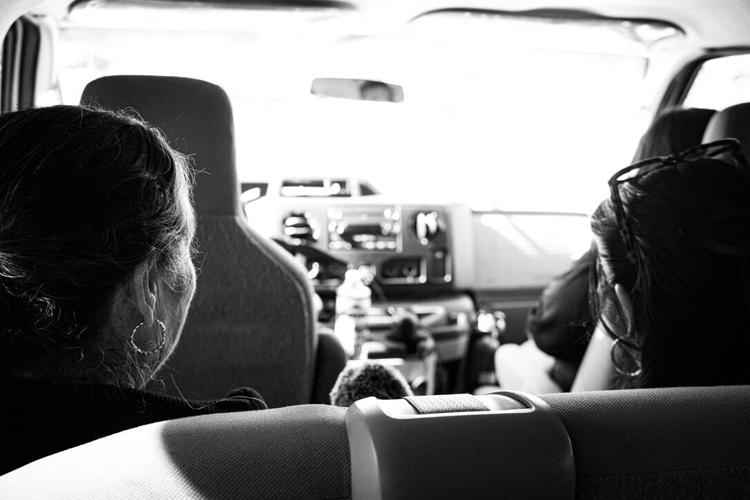





Passengers ride a shuttle from Phoenix to Nogales on May 23, 2026. Poet Anna Flores is collecting stories from riders along the route for a poetry chapbook and audio archive. (Photo by El Lopez, courtesy of Anna Flores)
For poet Anna Flores, the shuttle between Phoenix and Nogales has never just been about transportation.
She rode it as a child with her mother, traveling south to reunite with her brothers, who could not make the same journey north. They boarded a shuttle service near 27th Avenue and McDowell Road in west Phoenix, crossing the desert between the Valley and the border again and again.
“My family is very much at the mercy of the distance between us,” Flores said. “It’s always been about, ‘how do we keep each other as a family without being able to be together?’ And it’s almost, frankly, it’s impossible — at least in what the American sense of family is, where you can sit across the table from each other and share a meal.”
Now, Flores is returning to these routes as a poet.
A 2026 recipient of the Phoenix Office of Arts and Culture’s Artists to Work grant, she is creating a poetic inquiry project centered on people traveling the long-standing shuttle routes connecting Phoenix, Tucson and Nogales. Her project will weave passenger conversations with original poetry, eventually forming a chapbook and audio archive. The city selected Flores as one of 10 literary and performing artists in the 2026 cohort.
One of the central questions of her project is “How do we, as mixed-status communities, maintain relationships and care networks amidst heightened violence and enforcement?”
Flores, an Arizona State University MFA graduate and 2025 Frontier OPEN Poetry Award recipient, teaches at Estrella Mountain Community College. Her work has appeared in The Nation, Columbia Journal and Huizache.

Anna Flores, a Phoenix poet and recipient of the 2026 Artists to Work grant, is exploring how mixed-status families stay connected across the border. (Photo by Nader Abushhab, courtesy of Anna Flores)
For Flores, the shuttles are part of what she calls “care networks.” Riders carry money, clothing, even washing machines to relatives across the border.
“The shuttle services have always operated as a form of maintaining relationships across the border, and after the mass deportations of the Arpaio years, I started to see that they were also pivotal in returning us to one another,” Flores said.
Joe Arpaio, Maricopa County’s sheriff from 1993 to 2017, drew national attention for immigration sweeps and workplace raids.
Some of the people Flores has spoken with have spent the past 12 years traveling back and forth to visit a deported loved one, she said. Now, riders also ask whether it’s safe to take the shuttle at all.
“That fear is only something I realized as I talked to people,” Flores said.
The corridor also crosses the traditional homeland of the O’odham, whose communities have moved across the Sonoran Desert for thousands of years. Flores said the migrant, Indigenous and land struggles along the route “are so interconnected.”
“We’re crossing back and forth on this land that has been crossed back and forth forever,” she said. “To me, it’s poetic and it’s very unsettling too.”
So far, Flores has taken one recorded ride, where she met five people willing to talk, and chose to go deeper with them rather than immediately seek new voices. She credits much of that work to a collaborator who helps schedule rides for a local shuttle service.
“None of this would be possible without her,” Flores said.
Others who don’t ride the shuttle sought Flores out on their own, including women who crossed through the desert and, she said, cannot make the trip back because of their immigration status.
Together, Flores said, their stories complicate the familiar narrative of immigration as a straightforward path to opportunity, pointing instead to its often unseen costs: exploitation, vulnerability and strain on families.
Domestic violence emerged repeatedly in the stories of immigrant women, she said. Newly arrived, they were “just so vulnerable to predators and predatory relationships of all kinds.”
She also found a grief she had underestimated, especially among women between 40 and 60 who crossed about 20 years ago.
“There’s not as much space as I thought there was to grieve,” she said.

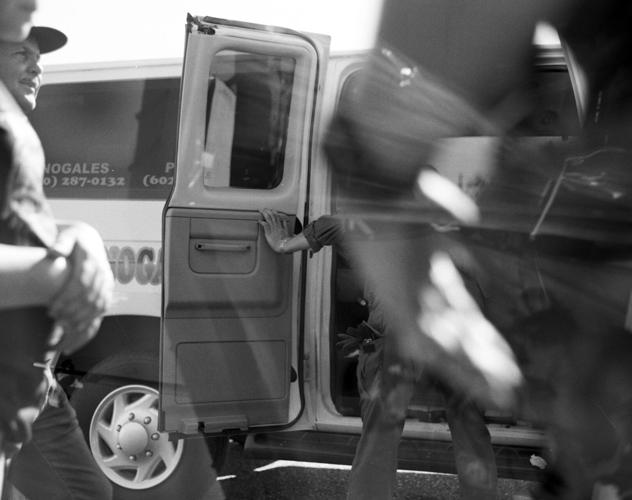
Passengers board a shuttle traveling between Phoenix and Nogales on May 23, 2026. For many riders, the route is a lifeline to family on the other side of the border. (Photo by Michelle Villareal, courtesy of Anna Flores)
Others described a different kind of disillusionment, Flores said. Some recalled people from their pueblos who came to the U.S. decades ago and returned home with a picture of success. The reality they later found — grueling work, exploitation, hunger — looked nothing like it.
“They say, ‘I wish those people would have told us what the truth of the American dream is,’” Flores said. Those who had “the privilege of coming back home,” as she put it, made it seem as though everything was fine.
“The question of ‘was it worth it’ is really a lot more difficult than I think we might want to admit to ourselves,” she said. “Was it worth it to do this to the family? And if it was, how worth it was it actually?”
Some stories remain out of reach. Many men rode the shuttle too, but they seemed warier or simply worn out and less willing to talk, leaving Flores with questions about labor: “Where are these men working, and how are they coming back home? Why are they coming back home, too?”
Flores will share the work in an individual exhibition at The Sagrado Galleria in December, followed by a group exhibition with her cohort in January. More of her writing is on her Substack and Instagram.
Her own family remains the project’s starting point.
“Accepting that we’re an estranged family, and that there’s still a love that we’re very stubborn about, is the sole inspiration for the whole project,” Flores said.
For Flores, poetry offers a way to preserve something she believes can be lost when people’s experiences are filtered through news or politics.
“I think poetry is sometimes more true because of the heart in it,” she said. For a topic this sensitive, she added, it can be “a safer way of telling a story that could be dangerous.”
During emotional conversations, she has cried while interviewing participants and told them the project is art. Looking back, she said, what she was really telling them was that it was safe to share.
“I’m not interested in just recording what you’re saying,” Flores said. “I need your story just as much as I hope you would need mine.”
Jamie Montoya is a Phoenix-based journalist and writer covering community, culture and accountability. She earned a master’s degree in investigative journalism from Arizona State University’s Walter Cronkite School of Journalism and Mass Communication and has a background in investigative reporting and private investigation. Her work focuses on the people, communities and systems shaping Arizona.








(0) comments
Welcome to the discussion.
Log In
Keep it Clean. Please avoid obscene, vulgar, lewd, racist or sexually-oriented language.
PLEASE TURN OFF YOUR CAPS LOCK.
Don't Threaten. Threats of harming another person will not be tolerated.
Be Truthful. Don't knowingly lie about anyone or anything.
Be Nice. No racism, sexism or any sort of -ism that is degrading to another person.
Be Proactive. Use the 'Report' link on each comment to let us know of abusive posts.
Share with Us. We'd love to hear eyewitness accounts, the history behind an article.