
Texas turning blue in 2026 is a defining moment in American politics. The factors that gave rise to that political shift and its long-term consequences will be studied extensively by political scientists, media pundits and campaign consultants. Comparisons will be made between California and Texas, as the former became a deep blue state at the end of the 1990s.
I’ve spent my career as a political scientist and pollster studying Latino voting patterns in California and the state’s blue-ward shift. I was also born and raised in Texas, so my expertise and cultural roots lead me to conclude that Texas will be blue for the foreseeable future. The dust of the election has yet to settle, but the emerging evidence suggests my conclusion is correct.
Why did California turn blue before Texas?
In 2001, Gary Segura, Ricardo Ramirez and I published a seminal article comparing Latino voting behavior in California and Texas in the mid-1990s and provided compelling statistical evidence that anti-immigration candidates and policies in California caused Latino voters to vote in record numbers and transform the Golden State into a Democratic Party stronghold. In contrast, the absence of a hostile political climate in Texas during the same period allowed the state to remain red. In California, the Republican Party became a permanently damaged brand to a generation of Latino voters that entered the political process in the mid-90s. This political generation would dedicate their lives to ensuring that similar anti-immigration and anti-Latino attacks would never again happen in California.
A similar phenomenon is taking place in Texas today. MAGA Republicans have become a damaged brand among a new political generation of Latino voters in the Lone Star State.
My conclusion is based, in part, on recent pre-election polling data from BSP Research, UnidosUS and the Latino Community Foundation on Latino voters in Texas. The political views of Latinos ages 18 to 29 provide a window into the state’s blue-ward shift. This generation became voters during the second half of the MAGA years, a period of intense hostility toward immigrants and Latinos, and they will remain politically active to defeat candidates and parties they perceive as hostile.
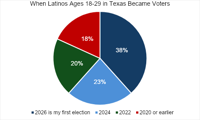
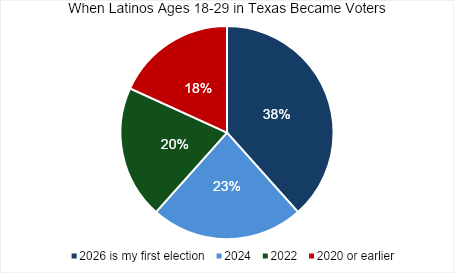
Over 800,000 Latinos turn 18 each year in the United States. The Latino electorate is young, dynamic and — as we saw on Election Day 2026 — politically energized. Data from the Texas polls show that among young Latinos in the state, 61 percent cast their first vote during the second half of the MAGA years. What are the political attitudes of these young Latinos and how did they vote?
They strongly dislike MAGA Republicans.
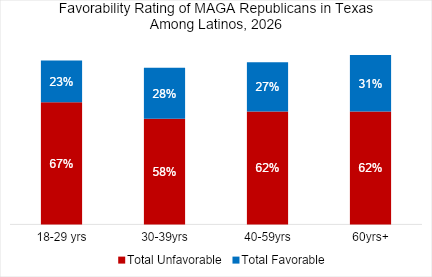
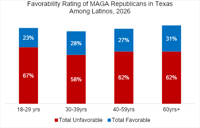
Latino evaluations of MAGA Republicans are overwhelmingly unfavorable. Among the different age cohorts, young Latinos have the greatest dislike for MAGA Republicans. The initial inroads Trump and MAGA Republicans made with young Latinos in 2024 have dramatically eroded. The polling data provides insights into the policies that led this age cohort to turn against MAGA: anger over abusive and cruel immigration policies tops the list. In the poll, 63 percent of young Latinos agreed with the statement, “I am angry at the aggressive and violent actions of ICE and the lack of accountability. They need to be stopped.”
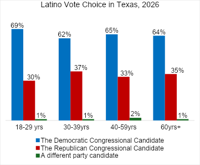
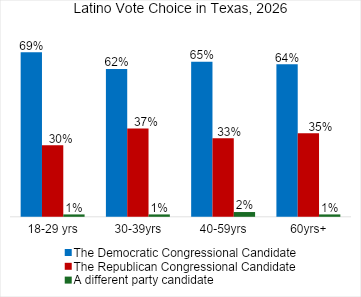
The turn against Trump and MAGA Republicans created a blue tsunami throughout the Lone Star State. In the survey, respondents were asked whether, in a generic congressional race, they would vote for the Democratic or Republican candidate; young Latinos, relative to other age cohorts, were the most pro-Democratic and anti-Republican in the group. A similar pattern emerges when asked about the Senate and Governor’s race.
On Election Day, they put their words into action. This generation of voters not only defined Texas politics in 2026 but will do so for the foreseeable future, just as we have seen in California. The trauma of the Trump presidency will serve as a springboard for their political engagement throughout their lives.
For those of us who have dedicated our lives to analyzing Latino politics, Texas turning blue has never been a question of if, but when. On Nov. 3, 2026, we got our answer.
This was a defining moment in American politics as Latinos in the Lone Star State heeded the call of “no te dejes.” The victories of Gina Hinojosa, the state’s first elected Latina governor, along with other Latino/a candidates across the state, are both inspiring and remarkable. Emerging evidence suggests this blue-ward shift is permanent and, if California offers a political blueprint for what's to come, you haven’t seen anything yet.
Adrian D. Pantoja, Ph.D., is a professor of Political Studies and Chicano Studies at Pitzer College, a member of the Claremont Colleges.









(0) comments
Welcome to the discussion.
Log In
Keep it Clean. Please avoid obscene, vulgar, lewd, racist or sexually-oriented language.
PLEASE TURN OFF YOUR CAPS LOCK.
Don't Threaten. Threats of harming another person will not be tolerated.
Be Truthful. Don't knowingly lie about anyone or anything.
Be Nice. No racism, sexism or any sort of -ism that is degrading to another person.
Be Proactive. Use the 'Report' link on each comment to let us know of abusive posts.
Share with Us. We'd love to hear eyewitness accounts, the history behind an article.