
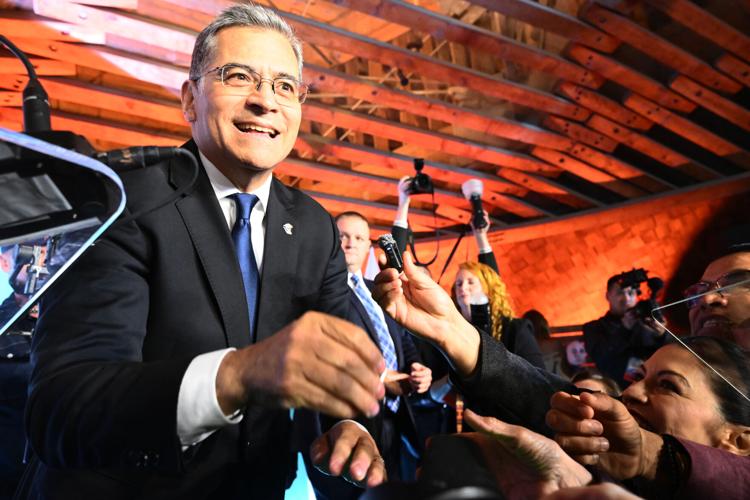



California Democratic gubernatorial candidate Xavier Becerra smiles as he greets supporters at an election night event Tuesday, Nov. 3, 2026, in Sacramento, Calif. (AP Photo/Noah Berger)
Gov.-elect Xavier Becerra will represent 39 million Californians when he steps into office in January. Of those Californians, 15 million Latinos will — for the first time — see someone who looks like them leading the state.
Becerra ran his campaign on both his 35-year political record and his identity as a first-generation Latino with immigrant parents. His background positioned him uniquely in a crowded race and, once he eventually broke through, Becerra leaned into his “Tío Xavier” persona.
But being elected is only the first step; now Becerra has to prove to California that he will be a governor for Latinos and for all Californians — a promise he made in his victory speech.
Latinos, who represent 32% of the state’s voters, got Becerra to the governor’s office. What do they expect in return? Less words and more action, according to Jarred Cuellar, an assistant professor of political science at Cal Poly Pomona and a Ph.D. candidate focused on Latino political attitudes.
The number one ask: affordability
While the Latino electorate felt “obvious excitement” over the possibility of a Latino governor, Cuellar said there was also a sense of “anxiety over what kind of governor [Becerra] would be once he actually got in.”
Becerra said throughout his campaign he wanted to avoid making “inflated promises” to voters before he knew exactly what he was dealing with. This approach positioned Becerra as a steady, reliable choice who often said he wouldn’t need “training wheels” on the job.
He campaigned on affordability, healthcare, pushing back against the Trump administration and other key issues most Californians, not just Latinos, care about. The fact that Becerra, proudly Latino, was running as a Democrat in California all but ensured he would win the governorship.
A Public Policy Institute of California poll released the week before Election Day showed Becerra leading with 61% of the vote. As the ballots have been counted over the past week, Becerra has exceeded estimates; at the time of publication, with 83% of ballots counted, he had received 65% of the vote.
While his election to the governor’s office is historic, Cuellar advised the governor-elect to be careful with how much he continues to lean into that message.
“Latino voters tend to respond negatively to pandering,” Cuellar said, adding that Becerra will also receive pushback if he is seen “doing too much” for Latino causes.
Latino voters historically tend to vote with the economy as their top issue, which was no different this year, despite ongoing immigration threats.
Nationwide, Latino voters showed up to the polls with cost of living and the economy as their top issues, according to a recent National Immigration Law Center (NILC) poll. Immigration reform and enforcement ranked sixth.
In California, where voters have been calling on lawmakers to address affordability for years, the priorities are no different.

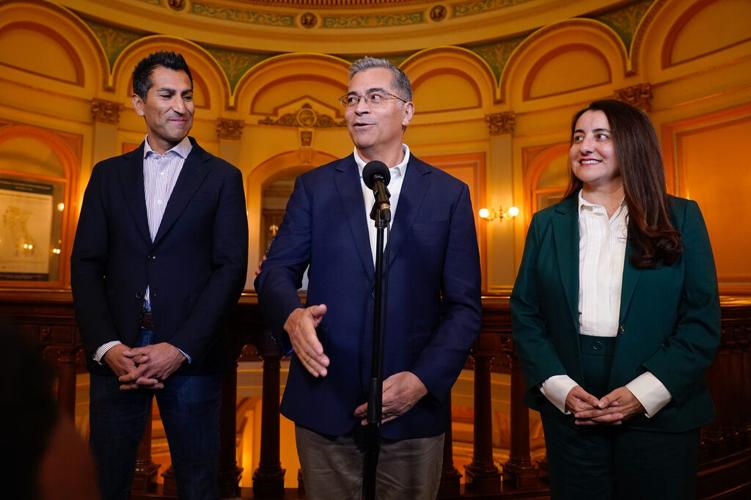
California Gov.-elect Xavier Becerra, center, accompanied by Assembly Speaker Robert Rivas and Senate President pro Tempore Monique Limon meets with reporters at the Capitol in Thursday, Nov. 5, 2026, in Sacramento, Calif. (AP Photo/Rich Pedroncelli)
On affordability, Becerra has also been somewhat vague. He told reporters last week that cost of living is his top priority and his campaign website says that he will take on price gouging and utilize “the power of the state to lower prices where the market has failed.”
Becerra, California’s former attorney general, often points back to his record of suing to block corporate interests that raised prices for consumers. The governor-elect also often highlights his time as the U.S. Secretary for Health and Human Services under the Biden administration, where he worked to lower drug prices and continued his decades-long fight to expand healthcare access.
While Becerra has Latinos’ support now, Cuellar theorized that support hinges on the economy, home prices, wage growth, grocery prices and pretty much everything else dealing with the pocketbook.
“It will get old fast for Latinos if the economy doesn't keep up and they don't feel the benefits of having this governor,” Cuellar said.
Further looming in voters' minds is that they still don’t have much idea of what to expect from Becerra, beyond general priorities – cost of living, healthcare and housing, to name a few. Two months before he is sworn in, the governor-elect is still choosing to hang back on policy commitments until he is in office.
Becerra is already facing heat from his future constituents after declining to commit last week to reversing Medi-Cal cuts for undocumented immigrants. While the governor-elect said he is committed to expanding healthcare, he said he won’t make any concrete promises before he is in office and understands what the budget will look like and how the Democratic-led Legislature will vote.
“It's probably realistic that he needs to see the budget and kind of see things from the governor's chair first, but politically, it can hurt him,” Cuellar said. “Public opinion… it's not rational, it's emotional. But at the same time, politics isn't really rational either.”
How can Latinos shape policy?
Democrats won big throughout the country last week, coming out on top with several firsts — the first Latino elected governor of California and the first Latina governor of Texas, to name a few. Latino voters in particular were pivotal in creating what politicians and analysts have been calling a “blue tsunami.”
Latinos also exercised their power as swing votes. In 2024, when President Donald Trump promised economic strength, an issue that is consistently top of mind for Latinos, the group shifted to the right.
On Election Day, after two years of a worsening economy on top of targeted attacks on the Latino community, Latinos shifted 28 points to the left, according to New York Times exit polling.
“The notion has always been Latinos could be very powerful, but we don't show up to vote,” Cuellar said. “We don't participate politically. But more and more, we're seeing that number grow when it comes to political participation.”
Immigrant communities in California had record-high turnout in the midterm election, according to Matt Barreto, president of BSP Research, which partnered with NILC’s Immigrant Justice Fund to poll voters' views on immigration and the current administration.
Overwhelmingly, voters appeared to favor more progressive policies to address immigration enforcement, and their votes on Tuesday reflected that sentiment.
“If you take immigrant voters out… Democrats would not have had the day that they had on Tuesday,” Barreto said last week during a live stream of the poll findings.
Polling showed that majorities of every demographic — white, Latino, Black, Asian American and Pacific Islander and Indigenous voters — were open to progressive immigration reform. Each group also supports — with anywhere between 70-79% — Congress establishing a substantive pathway to citizenship for long-residing immigrants.
“This administration's cruelty has opened the door for a once in a generation change, and we must seize it,” said Kica Matos, president of the NILC Immigrant Justice Fund.
Matos said the data is clear: most voters, particularly Latino voters, want “bold, progressive policies.”
“It really does show that it might have taken a second, but the power that we have in the Latino community … it's not secluded to California or Texas,” Cuellar said. “It’s growing, and our voice is going to be heard, and it needs to be heard because we are the second largest group in this country.”






(0) comments
Welcome to the discussion.
Log In
Keep it Clean. Please avoid obscene, vulgar, lewd, racist or sexually-oriented language.
PLEASE TURN OFF YOUR CAPS LOCK.
Don't Threaten. Threats of harming another person will not be tolerated.
Be Truthful. Don't knowingly lie about anyone or anything.
Be Nice. No racism, sexism or any sort of -ism that is degrading to another person.
Be Proactive. Use the 'Report' link on each comment to let us know of abusive posts.
Share with Us. We'd love to hear eyewitness accounts, the history behind an article.