
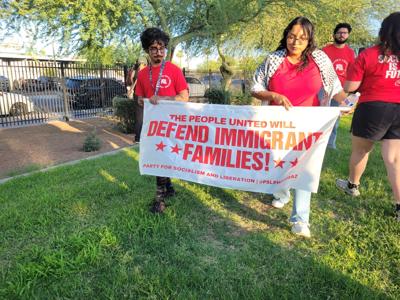


Phoenix activists and residents call for the release of Joel Gutierrez and others detained in immigration raids during a protest in downtown Phoenix on Sunday, June 8, 2025.
It’s been over two weeks since the midterm election results brought Arizona both historic wins and devastating blows for migrant communities, like the passing of Proposition 317.
The bill — which designates drug cartels as “terrorist organizations” and authorizes the Arizona Department of Homeland Security, a grant management office and not a law enforcement agency, to do everything in its power to address the threat they pose — has prompted critics to ask: what does this actually do and who does it affect?
“Lawmakers showed they would rather villainize vulnerable groups than defend our rights when they sent bad policies to the ballot, and unfortunately, some of those measures passed,” Victoria López, executive director of the American Civil Liberties Union (ACLU) Arizona, said in a statement released after the election results.
Sponsored by Republican lawmakers, the ballot measure was brought forth to address the transportation and sale of illegal drugs and attempt to halt human trafficking in the United States.
It is one of several recent state bills that aim to target cartels at the state level following President Donald Trump’s executive order designating those groups as a threat to national security, granting his administration power to infiltrate foreign governments across the Western Hemisphere to neutralize threats.
The opposition, however, argues that these broad, generalized laws hurt more than they help.
“It just seems more like a political move to make it look like something is being done without actually addressing the bigger issue and the harm that these cartels are causing in our communities. I feel like, instead of focusing on real solutions, [legislators] are just trying to change the labels,” Alyssa Estavillo, the executive director of Voices for Change Arizona, said to CALÓ News. “The reason why [Voices for Change] voted against it was because we were thinking, like, ‘how are they going to stop drugs from entering our communities? How are they going to prevent human trafficking, violence [and] the recruitment of vulnerable individuals into these organizations?’”
As defined by the bill, a cartel “terrorist” would be anyone with a former or ongoing association with members that actively engage in human smuggling or drug trafficking. Additionally, the U.S. Code Title 8 on "inadmissible aliens” legally defines a terrorist as someone who is believed to “associate with a terrorist organization and intends while in the United States to engage solely, principally, or incidentally in activities that could endanger the welfare, safety, or security of the United States” and classifies these individuals — explicitly referred to in the statute as an “alien” — engaged in these activities as “inadmissible.”
Prior to the Nov. 3 election, ACLU indicated that the proposition would directly impact asylum seekers and migrants seeking to reach the U.S., falsely categorizing them as terrorists.
“Prop. 317 conflates low-level drug offenses committed by American citizens with the serious threat of organized crime. [It] does not meaningfully impact human smuggling. Instead, people lawfully seeking asylum who are compelled to pay guides for safe passage through Mexico could be unjustly categorized as members or associates of a drug cartel, with serious legal repercussions,” ACLU Arizona stated in its 2026 ballot guide, strongly urging Arizonans not to vote for this controversial ballot measure. “Prop. 317 transforms participants in activity compelled by substance abuse or survival into terrorists.”
Legislation opens the door to being ‘unfairly’ targeted
The language in Prop. 317 says the legislation is necessary to address the public health crisis at the border.
While overdose deaths dropped nearly 14% nationwide — falling from 81,300 deaths in 2024 to just under 70,000 in 2025 — Arizona’s estimated overdose deaths increased by 18%, rising from 2,531 in 2024 to 2,988 in 2025, according to research from the Arizona Public Health Association (AZPHA). AZPHA states that while opioid lawsuit settlement money may help communities expand on prevention and treatment services, the number of deaths caused by synthetic opioids, mainly fentanyl, increased by nearly 33% last year despite a national decrease in seized amounts of the illegal substance.
In 2020, U.S. Customs and Border Protection (CBP) in collaboration with Border Patrol and the Office of Field Operations (OFO) seized a combined total of nearly 4,800 pounds of fentanyl nationwide. That amount peaked at nearly 27,000 pounds of fentanyl seized in 2023, but has since dropped drastically to only 11,200 pounds of fentanyl seized this year by the agencies.
Despite the existence of the Drug Enforcement Agency, whose sole purpose is preventing drug smuggling into the country, the Trump administration has vowed to take these efforts to the next level.
By labeling Latin American cartels and criminal enterprises as terrorist organizations, the administration created conditions through which the executive branch can “invoke broader authorities, including inherent Article II powers, claims of self-defense against non-state actors, the ‘unwilling or unable’ doctrine for cross-border force, or military assistance to law enforcement operations,” as stated in Lawfare media’s publication about what the legal implications of these designations mean.
Since Executive Order 14157 was implemented at the federal level, there have been at least 240 confirmed deaths as a result of the 69 strikes made against alleged drug vessels that the U.S. military carried out in their year-long operation in international waters. In February of 2025, 250 Venezuelan men were accused of being affiliated with the Tren de Aragua gang, deported from the U.S. and sent to the mega-prison Cecot in El Salvador without any kind of due process or trial. A little over 100 of these deportees were allowed to return to the U.S. and receive the due process they were initially denied.
The legal implications of granting any branch of government that kind of power and authority — to be able to deport people to countries they aren’t from or the ability to bomb boats in international waters without so much as a trial under the guise of protecting national security — now hang over the state of Arizona as the passing of Proposition 317 leaves many unsure of what dangers it could bring at the state level.
“My biggest concern is how this is going to affect our undocumented neighbors, who are just here trying to live their lives, work, raise their families [and] contribute to our communities,” Estavillo said. “Just because someone is not from here, someone's from Mexico or another country, doesn't mean that they have ties to the cartel. And we do worry that this could open up the door for innocent people to be unfairly targeted, questioned, labeled as terrorist supporters simply because of who they are, or who they're related to or where they come from. And I think right now the biggest issue is that we already have families in our community that are living in fear of being detained, separated from their children, racially profiled, targeted. They're afraid of being followed, and so my concern is that something like this could create even more opportunities for that to happen.”
Organizations prepare to defend migrant families
The proposition comes amid record-breaking numbers of deportations and detainments made by ICE, with some instances even turning lethal, resulting in an estimated 56 people who have died in ICE custody and 13 who died during arrests and raids, according to L.A. TACO media’s ICE tracker.
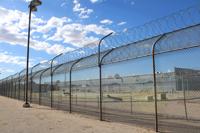
Voices for Change Arizona was established in the West Valley community shortly after the Department of Homeland Security (DHS) purchased a warehouse just outside the Surprise suburbs earlier this year, intending to convert it into one of Immigration and Customs Enforcement’s (ICE) detention centers nationwide.
The proposed facility — which has been greenlit despite the ongoing legal battle brought forth by Arizona’s Attorney General Kris Mayes and outspoken residents — will hold over a thousand detained migrants as part of the Trump administration’s immigration crackdown that has now overseen the detainment of over 491,000 migrants and the deportation of 483,000 migrants within the last year, according to data reported by DHS.
“There are people and families who have been threatened and intimidated already. They’ve been exploited or forced into situations they’ve never wanted to really be a part of,” Estavillo said. “There are even people who have fled their homes from countries to escape the cartel violence. They’ve come here because of that, and I feel like now [state officials] are going to put some of those people at risk of being treated like criminals just because of how they look or who they are or where they came from.”
There may not be any guarantees on what the implementation of Proposition 317 might look like across the state, but there’s no shortage of organizations in Arizona stepping up to prepare themselves and others for what is to come.
“We have an important opportunity to make our communities stronger and ensure Arizona is a state where all people can prosper, thrive and live in liberation with dignity and freedom,” López stated. “The ACLU of Arizona is preparing to build on the momentum of last week’s election to defend and advance civil rights and liberties for all.”
Having already set up info sessions and response plans for arrests made by local police enforcing federal immigration laws, as permitted by Proposition 314 that passed in 2024 and went into effect this past summer, the ACLU of Arizona, Voices for Change Arizona and additional advocacy groups are planning to continue their fight against any unconstitutional practices and violations made against the migrant communities of Arizona.
“We need to be asking whether these policies are actually going to make our communities safer, or whether they're just going to create more fear and put vulnerable people at risk… We should be investing more in prevention, addiction treatment, mental health services, resources for victims of trafficking and efforts that actually target the people responsible for organizing and profiting from these criminal operations, and we also need to understand that immigration status does not automatically make someone a criminal,” Estavillo said. “At the end of the day, I just want our communities to be safe, just like everyone else. But safety shouldn't come at the expense of innocent families.”
Analisa Valdez (she/her) is a freelance journalist based in Phoenix. Her reporting includes community & culture, social justice, arts, business, and politics.








(0) comments
Welcome to the discussion.
Log In
Keep it Clean. Please avoid obscene, vulgar, lewd, racist or sexually-oriented language.
PLEASE TURN OFF YOUR CAPS LOCK.
Don't Threaten. Threats of harming another person will not be tolerated.
Be Truthful. Don't knowingly lie about anyone or anything.
Be Nice. No racism, sexism or any sort of -ism that is degrading to another person.
Be Proactive. Use the 'Report' link on each comment to let us know of abusive posts.
Share with Us. We'd love to hear eyewitness accounts, the history behind an article.