
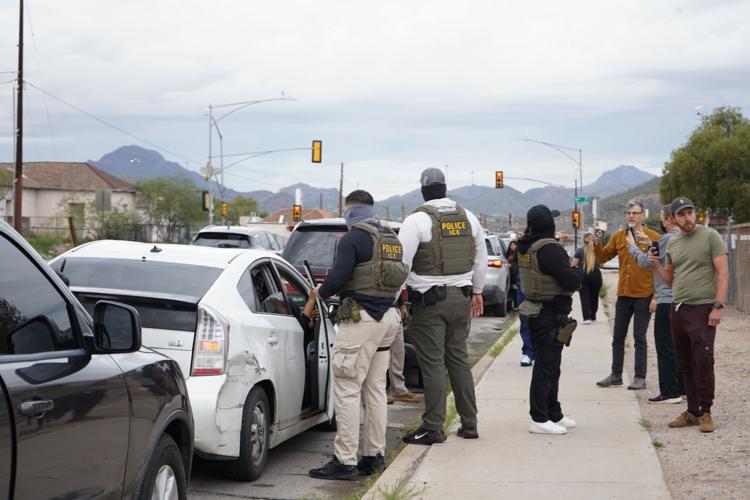

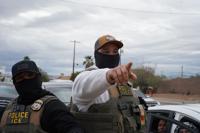
Immigration and Customs Enforcement (ICE) agents detain several people during a traffic stop on Friday, Jan. 23, 2026, in Tucson, Arizona.
With Proposition 314 having gone into effect this summer — against the background of ongoing Immigration and Customs Enforcement (ICE) operations across the country — the American Civil Liberties Union (ACLU) of Arizona, the Florence Immigrant & Refugee Rights Project and Arizona civil rights groups have started to host informative town halls to prepare residents.
The ACLU may have dropped its lawsuit challenging the 2024 Arizona law approved by voters that would allow local police to enforce federal immigration laws, among other things, but that hasn’t stopped the civil rights organization from taking proactive measures to protect and inform communities.
These new informative sessions — hosted in partnership with local non-profits such as Poder in Action, Puente Human Rights Movement, America’s Future Project, Living United for Change in Arizona (LUCHA), National Day Laborer Organizing Network (NDLON) Arizona, Borderlands Resource Initiative, Rural Arizona Engagement (RAZE) and Proyecto Progreso Arizona — aim to keep Arizonans informed and gather evidence.
“It started out as HCR 2060. That's how it started. It faced a lot of scrutiny at the legislature, not just from immigrants' rights advocates, but from business leaders and law enforcement and even the Department of Corrections,” ACLU Arizona’s Legal Director, Tara DeGeorge, said.

More people were arrested by immigration authorities in Arizona in July 2026 than any time in the previous four years, new data shows.
Prop. 314, also known as the “Secure the Border Act” approved by voters in November 2024, includes three main sections that target immigration status verification for public benefits, the sale of foreign-made fentanyl and, most importantly, unauthorized immigration, converting the federal crime into a state offense and therefore enforceable by local law enforcement and courts.
According to DeGeorge, the ACLU has been monitoring this latter section of the law, which indicates that it cannot go into effect until a similar law in Texas, SB 4, cleared legal hurdles and was in effect for at least 60 days. The law became enforceable in Arizona in July.
“Once [the ACLU] saw that trigger, they started immediately mobilizing the community, informing the community because it’s been a while since 314 passed, and so we haven’t had time to think about it for a minute,” the executive director at Borderlands Resource Initiative, Beth Strano, said.
In August, the ACLU dropped a lawsuit challenging the constitutionality of Prop. 314, but vowed to monitor how the law is being enforced.
“Right now, we have no information about enforcement at all in the state of Arizona. We are reaching out to community partners all over the state so that we can monitor, aggressively monitor whether or not enforcement is happening. And as soon as we hear about enforcement, we at the ACLU of Arizona will take swift action to ensure that our community is protected [from] this unconstitutional law,” DeGeorge said.

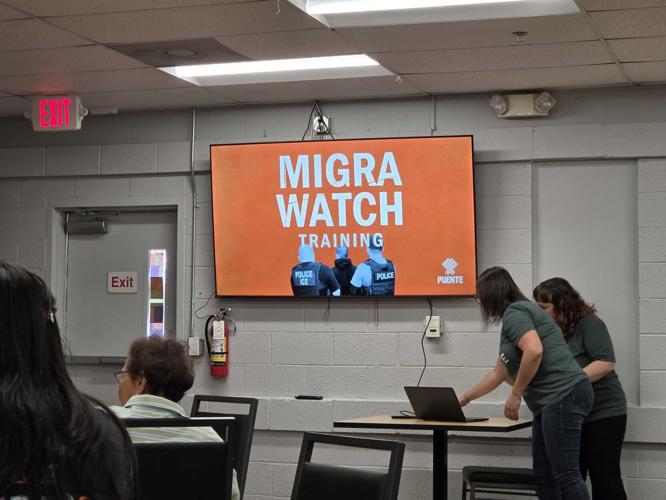
Volunteers with Puente Human Rights Movement facilitate an immigration enforcement know-your-rights training in Surprise, Ariz. (Analisa Valdez/CALÓ News)
ACLU Arizona activated an intake form for online submissions or emailed complaints (intake@ACLU.org) to track potential civil rights violations.
“We want to know if people are being asked by state or local police questions about how they entered the United States, and any state or local court case with any mention of return to Mexico or return to a foreign country,” DeGeorge said.
Uncertainty looms as groups prepare their communities
At the ACLU’s town hall held on Aug. 15, representatives and organizers went over Know Your Rights training for individuals who might be questioned, arrested or charged for anything to do with their immigration status in the country.
The town hall also offered attendees the opportunity to ask questions and voice concerns about the future of migrants’ safety now that local law enforcement has the authority to willfully aid the Trump administration’s ongoing mass deportation efforts. In Arizona alone, 2,171 people were detained by ICE in July — the highest number to date, according to figures made available by the Deportation Data Project.
Surprise and metro Phoenix residents continue organizing in opposition to the proposed ICE facility set to open this year in the Valley suburb.
“Based on the wording of the proposition, we’re expecting law enforcement agencies across the state to start more actively engaging in enforcement activity. But because there’s been such a large pushback from the public, we hope that that doesn’t happen as much as the proposition gives them the apparent freedom to do these things,” Jerica T., a community organizer with Puente, told CALÓ News following the group’s first Migra Watch training in the West Valley.
During that August session, Prop. 314 was also mentioned in correlation to the expected start of operations at the recently purchased ICE detention center in Surprise.
“We’re not entirely sure [what to expect] because the gist of this section of 314 is that it makes it so that it is a state crime to cross the border into the United States without permission, and that’s never been the state’s role. That’s always been the federal government’s role. So, it’s a little confusing what that infrastructure might look like,” Strano said. “But the main thing that we’re watching for would be that some of these police departments or sheriff’s departments that are local to Arizona would start to build out that kind of system. That would look like charging people, specifically with that charge of entering the state from a foreign country without permission.”
Learning from SB 1070
This isn’t the first time civil rights groups in Arizona have gone through legal proceedings to fight against a state-backed immigration law that would subject people to racial profiling and potential arrest in questioning their legal status in the country.
SB 1070, known as the “show me your papers” law, was a piece of legislation that also aimed to criminalize unauthorized entry into the country, made failure to carry documentation or unauthorized individuals seeking work a state misdemeanor and required law enforcement officers to determine immigration status during lawful traffic stops if given reasonable suspicion.
Civil rights groups and the U.S. Department of Justice (DOJ) legally challenged the 2010 law over its constitutionality, and the U.S. Supreme Court later ruled to strike down three of the four main provisions as violations of the U.S. Constitution’s Supremacy Clause.
“I think one of the things we learned too from SB 1070 is that laws like that, that are really dependent on law enforcement somehow assessing somebody's lawful status, are very fraught… it's going to rely heavily on racial profiling and so those kinds of racial profiling interactions can cause all sorts of harm,” Strano said. “It's the broken-window policing. It's pulling somebody over for having a brake light out, and because you suspect they're in the country unlawfully. But now you're giving them other criminal charges on top of that, where they might not have gotten pulled over if they didn't maybe match the description of who you think you would put this charge on.”
Broken-window policing stems from the 1980s theory used by law enforcement officers that argues that policing low-level offenses can curb chaos and prevent more serious crimes. It is notoriously attributed to the “aggressive over-policing of minority communities,” as reported by Frontline.
“It's the whole can of worms that comes with local law enforcement trying to suss out somebody's immigration status. There's a reason that this is handled, in the best-case scenario, through a legal process that is much better informed,” Strano said. “It's been a rough couple of years for that, but I think we know from SB 1070 how bad it can look with all of these different policing entities engaging in this kind of guesswork.”


After some of Arizona’s major cities took steps to manage and limit collaboration with ICE, some immigrant-rights advocacy groups are voicing concerns regarding the confidentiality behind government-sponsored reporting forms
ACLU Arizona, Borderlands Resource Initiative, Puente and more grassroots groups across the Valley will continue to host events that assist their community in taking proactive, preventative measures.
Earlier this week, Puente held its first Brake Light Clinic, providing free vehicle light checks and bulb installations to avoid potential police interactions. Other organizations have provided packets containing important power of attorney paperwork that they encourage people to complete, along with access to free notaries to process them. At its informative town hall, ACLU Arizona also stressed the importance of memorizing at least one phone number of a trusted contact in the case of sudden detainment.
“We’re really leaning on partners to notify us or get out the word that if anyone in their community is experiencing any of this, we want to hear from them,” DeGeorge said, citing their website and social media platforms as a source for people to stay tuned in for future town halls, events and news. “We really urge [the] community to be on the lookout for any sort of enforcement and to let us know so that we can make sure that our community is protected.”
Analisa Valdez (she/her) is a freelance journalist based in Phoenix. Her reporting includes community & culture, social justice, arts, business, and politics.










(0) comments
Welcome to the discussion.
Log In
Keep it Clean. Please avoid obscene, vulgar, lewd, racist or sexually-oriented language.
PLEASE TURN OFF YOUR CAPS LOCK.
Don't Threaten. Threats of harming another person will not be tolerated.
Be Truthful. Don't knowingly lie about anyone or anything.
Be Nice. No racism, sexism or any sort of -ism that is degrading to another person.
Be Proactive. Use the 'Report' link on each comment to let us know of abusive posts.
Share with Us. We'd love to hear eyewitness accounts, the history behind an article.