
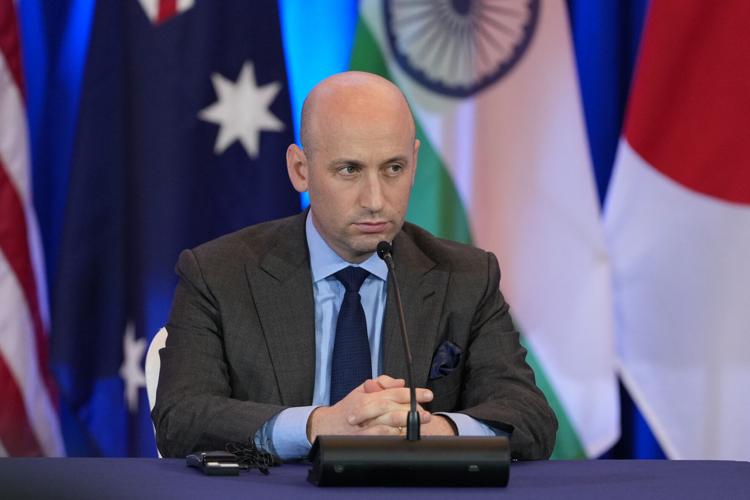



White House Chief of Staff Stephen Miller attends the meeting of the leaders of the Quad in Manila, Philippines, Tuesday, Nov. 17, 2026. (AP Photo/Mark Schiefelbein)
MEXICO CITY – Following Republicans’ crushing defeat in the U.S. midterm elections, many expected President Donald Trump to soften his attacks on Mexico. Instead, his administration has taken a more confrontational turn. The appointment of Stephen Miller as the new White House chief of staff has been followed by renewed pressure on President Claudia Sheinbaum’s government over two recurring issues: immigration and security.
According to several reports, Mexican officials are increasingly concerned that Miller’s influence could push Trump to authorize a military strike on Mexican territory, an unprecedented escalation in relations between the neighboring countries.
However, political analyst and expert on U.S. Mexico relations Lorenzo Meyer believes such an attack is unlikely.
“The United States is not going to invade Mexico. It is not in its interest to have a bad relationship. It attacks Mexico verbally and accuses it, but that is as far as it goes. There is hope for Mexico. Not everything is lost,” Meyer told CALÓ News. “At this moment, the United States has many open fronts, while Mexico has only one, with the United States. We are distrustful of the United States.”
Ongoing U.S. political influence, especially in the upcoming 2027 elections, will remain, he said.
“I do not believe Morena will lose the 2027 elections in Mexico. There may be interference, I do not deny it, and the right has U.S. support. But the Mexican right has no leader and no platform,” Meyer said.
Meyer on U.S. interference ahead of Mexican elections
Meyer examines these threats with the calm and perspective of someone who has spent decades studying the political history between the two countries.
“It is logical that the United States has an interest in Mexico. Trump is far right while Mexico is a dissenter, but an important one, and that bothers the United States. That is why there is interference ahead of the 2027 elections, accusations that Mexico is a narco government and claims about uncontrolled violence and corruption, which sounds ironic.
“Look at all the corruption under the Trump administration and yet they accuse us of being corrupt. In Trumpist rhetoric, that does not figure. They do not talk about arms trafficking or drug consumption in their own country. Everything that happens in Mexico cannot be explained without the United States,” the political scientist said.
More recently, political scientist Carlos Pérez Ricart, who studies the illicit arms trade between the U.S. and Mexico, has highlighted U.S. authorities' responsibility for the flow of weapons. He argues that, rather than making accusations, the Trump administration should focus on stopping the trafficking of firearms.
Meyer also downplays the political significance of Trump’s midterm defeat, at least when it comes to the relationship with Mexico. He expects some changes in the administration’s approach, but not a fundamental shift.
“The tone will change, but not the substance. Mexico has always held a position of weakness in relation to the United States. We have to understand that there is an international structure and Mexico is inside it, with the great imperial power as its neighbor. Mexico is the weaker party. It has its sovereignty, but with limits,” Meyer said.

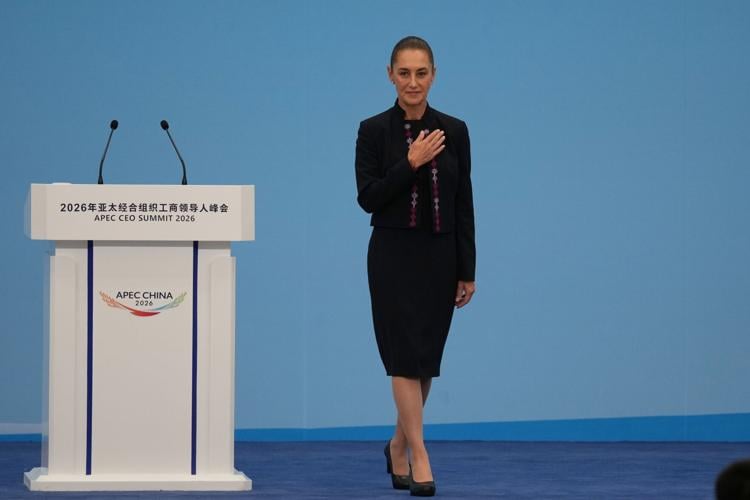
Mexico's President Claudia Sheinbaum gestures after delivering her speech at the 2026 APEC CEO Summit held ahead of the APEC China 2026 summit in Shenzhen in southern China's Guangdong province on Tuesday, Nov 17, 2026. (AP Photo/Ng Han Guan)
Political analysts warn of Stephen Miller
Last week, Mexican political commentator Leo Zuckermann published a column in Excélsior warning about Miller’s appointment, describing him as a danger to Mexico.
“Let’s be clear,” Zuckermann wrote. “The new chief of staff is a racist who does not look favorably upon our country. At any moment, he could revive plans to attack Mexico and convince Trump of their necessity.”
Zuckermann also cited reporting by New York Times journalists Maggie Haberman and Jonathan Swan, who have documented how Miller previously advocated military strikes against suspected drug cartels on Mexican soil.
Meyer — professor emeritus at El Colegio de México, who has written extensively about political power, authoritarianism and the influence of the U.S. on Mexican sovereignty and foreign policy — takes a less alarmist approach.
He highlights the dramatic situation unfolding under Trump, whom he describes as "a despotic leader." Although there is widespread belief that little can be done to counter the U.S. leader’s attacks on Mexico, he argues it is important to understand that these actions are driven less by substantive or material objectives and more by Trump's desire to appease his supporters, many of whom hold negative views toward immigration.
“We have had to face Trump in a second term, a ruler with an unworthy, insolent and racist discourse who made Mexico his enemy from the moment he came to power. It is easy to explain. He seeks to please his base, white, middle and lower middle class people who do not sympathize with immigrants,” Meyer said.
He sees Trump’s latest attacks as part of an effort to compensate for the political weakness exposed by the midterm results.
Meyer also considers a military intervention in Mexico highly unlikely. He points to the country’s long history of resisting attempts to be placed under the influence of the United States, including a military history that distinguishes Mexico from other countries across the continent.
Sheinbaum ‘will not give in’
One of Mexico’s greatest strengths, Meyer argues, is its president, who has so far defended the country’s position in the bilateral relationship through diplomacy rather than confrontation.
“We have a president with a very rational personality. She is the embodiment of integrity. She has done very well. She has not bent. Sometimes I think about everything she faces and the toll it must take on her. She has responded to Trump on her own terms. Claudia Sheinbaum will not give in,” Meyer said.
Despite the difficult political climate and the growing influence of conservative movements in parts of Latin America, Meyer does not believe Mexico is without options.
“We have the opportunity to build a good scenario, with an effective government that is not corrupt, that has the support of Mexican society and defends the interests of Mexicans.
“I repeat, we are not Iran, nor do we control the Strait of Hormuz. We have only ourselves. We must be very clear about what the United States can and cannot do to us,” he concluded.
Reynaldo Mena is a Mexican journalist and editor with more than 30 years of experience in Spanish-language media in the United States and Mexico. He has held editorial positions at the Fort Worth Star-Telegram, San Jose Mercury News, Orange County Register, Los Angeles Times' Hoy Los Angeles and La Opinión, where he was named editor in 2012. His work focuses on Latino communities, immigration, politics and social justice.








(0) comments
Welcome to the discussion.
Log In
Keep it Clean. Please avoid obscene, vulgar, lewd, racist or sexually-oriented language.
PLEASE TURN OFF YOUR CAPS LOCK.
Don't Threaten. Threats of harming another person will not be tolerated.
Be Truthful. Don't knowingly lie about anyone or anything.
Be Nice. No racism, sexism or any sort of -ism that is degrading to another person.
Be Proactive. Use the 'Report' link on each comment to let us know of abusive posts.
Share with Us. We'd love to hear eyewitness accounts, the history behind an article.