


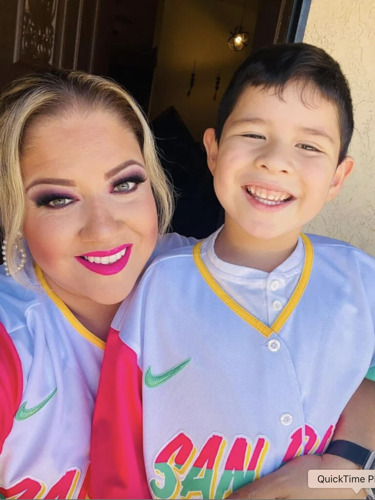


Danny Arredondo is one of more than 60,000 Arizonans who receive services from the DES Division of Developmental Disabilities. His mother has had to invest time in educating herself and ensuring that her son receives care appropriate to his autism condition. She is concerned that changes to the assessment process could reduce the hours of paid care that have been authorized for him. (Stephanie Casanova/Somos Tucson)
This article was originally published in Spanish by Somos Tucson.
Danny Arredondo loves dinosaurs. He plays with them constantly. learning the scientific names and characteristics of each one.
“He’ll tell you, ‘This used to be known as a dinosaur, but now it falls into the category of flying reptiles,’” Danny’s mother, Patricia M. Salas, said. “The minds of autistic children are a world of their own.”
When he was between two and three years old, Danny would meticulously line up his toys. By that age, he still wasn't speaking much and when he did speak, he would merely repeat what others said to him rather than offering a response. He wasn't developing at the same pace as other children his age, Salas told Somos Tucson.
More than two years later — in 2023, when he was nearly six years old — Danny was diagnosed with Level 2 autism. He has also been diagnosed with anxiety and Attention Deficit Hyperactivity Disorder (ADHD).
Armed with the autism diagnosis — and with the support of a community of mothers raising children with developmental disabilities in Arizona — Salas applied for the government benefits to which Danny is entitled. Since then, Salas has learned how to navigate her son's developmental needs to ensure he progresses in school and life.
Salas became certified in caring for children with developmental disabilities so she could serve as her son's caregiver through the Parents as Paid Caregivers Program (PPCP). Under this program, she is paid for a number of hours each week to provide her son with care tailored to his specific condition. This arrangement, she said, has been immensely beneficial for her son.
The state government, however, is altering the way children with developmental disorders are evaluated. Families and advocates fear that these changes could result in a reduction of paid care hours for some program participants.
The new assessment tool proposed by the state in September would have stripped many children of a significant portion of those care hours, according to parents interviewed for this article. For Danny, that meant his 40 hours of weekly care were going to be cut down to nine.
“They weren’t taking something away from us, but rather from the child. They were stripping children of that right. That’s why we said, ‘no!’” said Salas.
As of June 30, 2025, the Division of Developmental Disabilities (DDD) was providing services and support to 61,892 Arizonans with developmental disabilities, according to a report by the Department of Economic Security (DES), a DDD agency. Among them, nearly 60% are minors.
After thousands of parents opposed the changes and wrote emails and submitted comments to the Arizona Health Care Cost Containment System (AHCCCS), Gov. Katie Hobbs halted the new assessment system.
In November, AHCCCS released a draft of its new assessment plan, which has yet to be finalized. With the help of the Raising Voices Coalition — an organization that advocates for changes in disability policy in Arizona and trains families and allied providers to voice their needs — parents have remained informed about the proposals and have submitted more than 2,000 comments expressing their views on the new plan.
Brandi Coon, executive director of Raising Voices, told Somos Tucson that the new plan was a significant improvement over the September proposal.
“I do think it will be a much better evaluation for members and then if parents or families think there are certain exceptions, there is a route built into that for exceptions to be implemented as well,” said Coon.
However, advocates remain watchful regarding the final version of the plan, as they know that things can change. A draft of the plan that AHCCCS released in May 2025 was vastly different from the one they attempted to implement in September of that same year, Coon noted.
Parents as paid caregivers
The Parents as Paid Caregivers Program began as a temporary initiative in 2020. During the pandemic, parents of children with vulnerable health conditions feared having caregivers constantly entering and leaving their homes. At the same time, caregivers for children with developmental disabilities began quitting for that very same reason.
But after a few years, Coon and other advocates realized that the program was also alleviating many difficulties that had existed long before COVID, such as workforce shortages.

Patricia Salas and her son, Danny Arredondo. Patricia became certified as a caregiver for her son, who has autism, and thanks to the Parents as Paid Caregivers Program, she is able to dedicate a large portion of her time to providing him with specialized care. (Photo courtesy of Patricia Salas)
“That was a big point we rallied and advocated on was, ‘this might have been a temporary solution to what you thought the problem was, but we're seeing this solve problems that existed prior to COVID and really help to ensure the continuity of care for members across the board,” Coon said. She has an 11-year-old son, Tyson, who has cerebral palsy and epilepsy. He uses a wheelchair and is non-verbal.
“I've navigated these services and medical systems, education systems, for him,” Coon said. “And it was just an area I felt really passionate about helping to create, you know, the programs and refine the programs that he needs and others in this community do as well.”
In 2023, Coon, along with other advocates and parents in Arizona, called for the Parents as Paid Caregivers program to be made permanent, a goal that was achieved in April 2025.
The state mandated that Medicaid overhaul its rehabilitation assessment tool for personal care assistance. The assessment tool that had been in use since 2020 was designed for adults and subsequently adapted for minors, Coon noted. However, there were significant inconsistencies in its implementation. Some families were not receiving sufficient support, while others may have been receiving too much.
The September proposal argued that certain levels of care should be considered the responsibility of parents rather than that of the public system.
“We did a lot of public pressure and campaigning to highlight how you know broad age caps were not going to really help members on an individual level and would actually do harm in a lot of instances,” she said.
Coon would like to see an assessment tool that provides training to the staff conducting these evaluations on how to individually assess and support children.
An ideal assessment would have “a tool that asks really in depth questions of what those members’ activities of daily living look like, what their behaviors are. You know, having age be a piece of that puzzle, but not the entire picture, comparing that to developmental milestones,” Coon said.
Coon noted that the state is moving closer to achieving this, “but it requires all of those pieces together to be really effective.”
The impact of changes on children
To qualify as a parent caregiver through the PPCP, Salas was required to complete a course in cardiopulmonary resuscitation (CPR) as well as a course on the laws protecting individuals with disabilities.
Two coordinators evaluate Salas every three months.
One with the DDD conducts an assessment to authorize care hours for Danny. The other with the caregiver agency with which Salas is employed evaluates whether she is providing proper care for Danny and working toward the goals they established together. Every day, Salas shares notes with her coordinator and fills out a chart tracking Danny’s progress.
“When the two coordinators come to visit, they have to see that the child is showing developmental progress — in what he’s learning and in the activities I do with him. And, of course, they have to ensure that his environment is clean and safe and they have to physically observe the child,” said Salas.
If Danny’s care hours were cut, Salas would have to work more hours at another job, she said. She owns a small keto baking business, so she would likely focus more on expanding that venture. She started Danny’s Keto Bakery and Sweets around the same time her son was diagnosed, so Salas had to put her business’s growth on hold while she coordinated Danny’s care and support.
She could also continue working 40 hours a week caring for other children with developmental disabilities, Salas noted. Either way, she would have to find someone to look after her son while she works. However, it would be difficult to afford to pay someone certified to care for a child with autism, Salas said.
Children with autism require a routine and she has to constantly encourage Danny every day to ensure he keeps learning. The goal is to allow him to grow as independent as possible so that he can integrate into society and become self-sufficient, said Salas.
“I’m not sure that if we change his routine and have a different person telling him what to do he would actually follow those instructions. So, it causes stagnation or regression in children,” she said. “I believe that is a huge advantage for children — having their parents serve as their own service providers — because I feel that, ultimately, no one knows our children and their needs better than we parents do and we are best positioned to observe their progress.”
On April 10 and 14, community forums will be held on the tool used to assess children's needs, as well as the policies for reviewing extraordinary care services.

Danny Arrendondo. (Stephanie Casanova/Somos Tucson)
Reaching a diagnosis: A long journey
After three years spent learning how to secure services for her son, Salas now helps other mothers of children with developmental disorders — mothers who find themselves in the very position she was in when Danny was three years old.
However, when she first embarked on this process, Salas had to navigate a somewhat complicated system.
Before Danny was diagnosed with autism, Salas mentioned to his pediatrician what she and Danny’s caregiver suspected. The pediatrician then referred Danny for an evaluation.
Initially, the most difficult hurdle for Salas was getting Danny approved for AHCCCS. At the time, the income of Danny’s father exceeded the eligibility threshold for approval. Yet, many evaluation agencies do not accept private health insurance to a private provider. Or, if they do accept the case, they charge over a thousand dollars for an evaluation, said Salas.
“You feel trapped, because you say, ‘Okay, time is passing, and my child isn’t developing at the same pace as other children his age,’” said Salas. “He needs help; he needs support.”
Professionals trained in early childhood development include:
Licensed physician (such as a family doctor or neonatologist)
School psychologist
Early childhood education specialist
Specialized nurse
Physician assistant
Licensed psychologist
Pediatrician (including developmental pediatrician)
Neurologist
Clinical geneticist
A developmental evaluation must come from one of these specialists in order for a child to be approved to receive services through the DDD. To qualify, a person must be diagnosed with one of the following disabilities:
Autism
Cerebral palsy
Epilepsy
Intellectual (cognitive) disability
Down syndrome
Since she already had Danny’s autism diagnosis, a psychologist from the agency Axis for Autism sent Salas the forms required for Danny to receive care services.
To do this, she had to apply to both the DDD and ALTCS — a long-term care program administered through AHCCCS. With ALTCS coverage, a person with a developmental disability remains eligible for services until age 18 without the need for annual re-evaluations, said Salas.
Asking for help is vital
When Salas was navigating this initial stage of Danny’s diagnosis, another mother from a community of mothers raising children with autism who had already gone through the same experience stepped in to help her. Salas invited her to breakfast, Salas printed out the forms they had sent her and the friend helped her fill them out, explaining the purpose of each form and where to submit.
“You see so much paperwork that you just say, ‘What do I do first? Where do I go? Where do I send this?’” said Salas. “I mean — and I think that’s why we moms of autistic children have created this kind of support community among ourselves — because I’ve personally had to step in and support three other moms, telling them: ‘OK, apply here, apply there; go here, go there; apply for the child’s AHCCCS coverage; ask for this.’ Because, well, we know what it’s like.”
Salas has found support groups on Facebook, in both English and Spanish, that have been immensely helpful in teaching her about her son’s care and development. There are also support groups for children with other developmental disabilities, such as cerebral palsy, which require different types of services, Salas noted. She also created a WhatsApp group with her friends where they share information in Spanish, ranging from policy changes proposed by the state to local events offering support for children with autism.
“It’s just so much. You can’t do it alone,” said Salas. “I certainly couldn’t do it alone.”
Coon always recommends that parents contact Encircle Families shortly after receiving a diagnosis. Encircle Families is a resource center that provides assistance and support to families. They help families identify the appropriate state-run programs (such as Medicaid) to ensure their children qualify for coverage. The organization also facilitates peer-to-peer consultations — available in both English and Spanish — helping families connect with others facing similar circumstances.
“What I've seen in my own life is the sooner we kind of tap into those resources and community and therapies and things of that nature, it really helps create a family system that is encouraging and supporting that loved one with disabilities in a more robust way, with supports, versus trying to just kind of survive and figure it out on your own,” Coon said.
Finding support is especially crucial for Latino families, Coon emphasized, saying that it’s both important for her to find support for her family and others who might struggle with language barriers and cultural differences.
“Their children and loved ones deserve those services and support just as much and that's very much forefront in my mind as I'm down there talking with legislators and involved in this work. It’s a huge piece of why I do what I do,” Coon said.
Salas says it is important for immigrant parents to keep in mind that their citizen children are entitled to care services and mental health therapies. Some agencies require only a Taxpayer Identification Number (ITIN), which some immigrants possess for tax purposes, to be hired under the Paid Caregiver Program for Parents, Salas noted. And even if they lack the necessary documentation, their citizen children still retain the right to a specialized caregiver.
Forms from the DDD and ALTCS do not request information such as Social Security numbers or proof of the parents' legal status in the United States.
At times, Salas has found it difficult to find acceptance for her son within the Latino community, she said. She has observed that taboos and skepticism regarding autism still persist.
“When I told my family, ‘There is a possibility that Danny has autism,’ my family would always say, ‘He looks perfectly fine to me. The boy walks, and speaks just fine,’” Salas recounted. “However, I have noticed, especially among fathers, that some parents go into denial when they are told, ‘Your child shows signs of autism.’”
Sometimes, within Salas’s own family, people misinterpret Danny’s behavior and tell him, “Don’t be rude to your mom.” But Salas knows Danny well. She knows when he is simply misbehaving, like any child his age, and when he is becoming overstimulated, she says. Overstimulation occurs when multiple stimuli are present simultaneously, such as noise, bright lights, movement or excessive activity. Some children may react to this with irritability, crying, frustration and so on.
To protect Danny, Salas avoids taking him to parties where there will be many children, because she knows he will feel overstimulated and begin speaking without a filter. When Danny gets angry and reaches his breaking point, he sometimes feels an impulse to hit, Salas noted.
But when he is in a good mood, Danny is very affectionate.
One recent afternoon, Danny was playing in his backyard with his dinosaurs, some of which were nearly as big as he was. He pretended the dinosaurs were fighting and he made the semi-aquatic ones swim. After playing outside for a while, he came inside, ran straight to his mom, gave her a tight hug and planted a big kiss on her cheek.
Then, he ran off to his room to keep playing.










(0) comments
Welcome to the discussion.
Log In
Keep it Clean. Please avoid obscene, vulgar, lewd, racist or sexually-oriented language.
PLEASE TURN OFF YOUR CAPS LOCK.
Don't Threaten. Threats of harming another person will not be tolerated.
Be Truthful. Don't knowingly lie about anyone or anything.
Be Nice. No racism, sexism or any sort of -ism that is degrading to another person.
Be Proactive. Use the 'Report' link on each comment to let us know of abusive posts.
Share with Us. We'd love to hear eyewitness accounts, the history behind an article.