
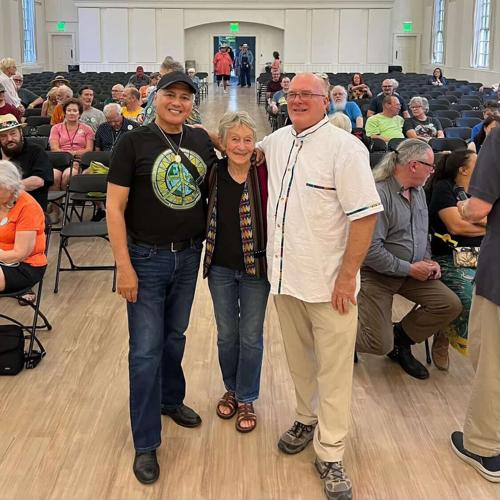

David Damián Figueroa, a documentary filmmaker and member of the Samaritans (left), stands with Shura Wallin (center) and Pastor Randy Mayer, co-founders of the organization of Green Valley-Sahuarita. (Samaritans)
GREEN VALLEY, Ariz. – At 84, Shura Wallin doesn't talk about retirement; she talks about commitment. As long as her body allows, she continues crossing the Arizona-Sonora border to help migrants who walk with fear, exhaustion and hope.
Like her, dozens of volunteers with the Samaritans of Green Valley-Sahuarita have been demonstrating for over 25 years that solidarity knows no borders.
Wallin co-founded the organization with Pastor Randy Mayer. Both remain active to this day.
In an interview with CALÓ News, Mayer recounted that the organization began in 2000 when members of the Good Shepherd United Church of Christ in Sahuarita — a town less than 25 miles south of Tucson — started wondering why so many migrants were knocking on their doors asking for help. That concern led to conversation, and that conversation to action. In June of that year, several churches met to find a concrete answer. From there, a clear mission emerged: to help.
After that meeting, they began bringing water to the desert in partnership with the organizationHumane Borders. Later, aSamaritan group was started in Tucson, and in 2005, theSamaritans of Sahuarita-Green Valley group was formed.
Today, their church-organized operations include volunteering at border shelters, such as theKino Border Initiative, teaching English to migrants, and, as their primary function, delivering at least 500 gallons of water annually to the desert.
“The project is about going into the desert and finding people who need help, migrants. We’ve found many, many,” Mayer commented.

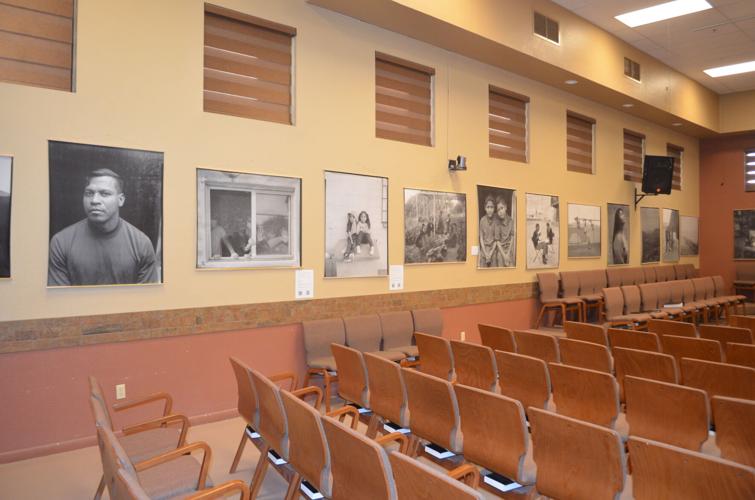
Portraits of migrants hang inside the Good Shepherd United Church of Christ in Sahuarita, Arizona. (César Barrón/CALÓ News)
A mission to assist migrants
Mayer recalled that in the beginning, there were about 20 people without equipment or off-road vehicles — necessary for navigating the unstable Sonoran Desert terrain — using their own cars to make the water deliveries. It wasn’t until someone donated $4,000 to the organization that they were able to buy their first 4x4. That’s how they began traveling between the border in Nogales and Sasabe, near Arivaca.
Most of the migrants they encountered needed medical attention for their feet, and some even had fractures. During the summer months, dehydration and heat illnesses were the main concern.
Now they operate with three all-terrain vehicles to go into the desert and two vans with which they can cross into Mexico to carry out their work. Additionally, a group visits Sasabe, Sonora, to bring food and clothing to the community.
The pastor made it clear that the project is very open; people from other churches or who don't belong to any church are part of the group, since the word Samaritan means someone who offers help to others without judgment.
"We believe it's very important at this time when people from the United States need to cross the border and make friends. We need to build bridges, to care for our neighbors," Mayer commented.
One of the experiences that has marked him occurred about three years ago when they found a migrant from Guatemala in Madera Canyon, located approximately 40 miles from the border. It was winter, and the man had fallen into a stream, suffering from the low temperatures typical of desert areas.
When he found him, an elderly couple had already arrived to help. The man was lying on the ground, hugging the migrant to keep him warm. The migrant couldn't speak; he had hypothermia, so they called 911, and he was taken to a hospital, he recounted.
"It was very moving to see this elderly couple helping this man as if he were their son; it was a beautiful thing," Mayer said.
Years ago, they would bring between two and three thousand gallons of water to the desert to assist an average of 500 migrants a day they encountered. They even set up a camp in Sasabe where migrants could wait to turn themselves in to the Border Patrol.
Now, they don't encounter as many people, and they bring about 500 gallons of water to the desert each year.
According to figures from U.S. Customs and Border Protection, border agents have recordeda drastic drop in monthly encounters with migrants at the southern border — from more than 106,000 in October 2024 to fewer than 12,000 in September 2025. Mayer commented that, according to statistics, they now detain 30 people a day or about 1,500 a month at the Arizona border. However, they believe that if they detain few, others succeed in crossing.
The flow of migration has changed, but the need remains. From his perspective, for many years, they encountered large groups of migrants walking, mostly men. Then they began to see families, and in the last 10 years, Mexican cartels have become even more involved in migrant smuggling.

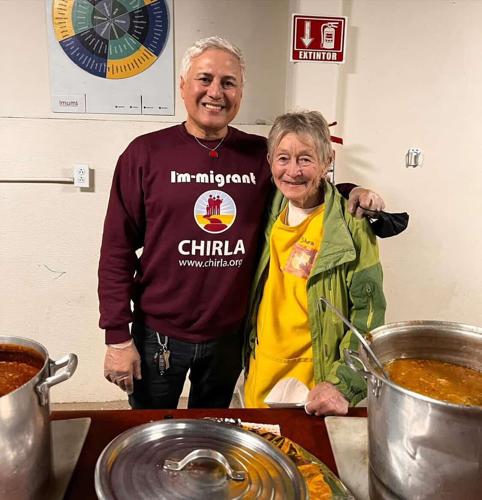
David Damián Figueroa, a documentary filmmaker and member of the Samaritans (left), stands with Shura Wallin, co-founder of the organization of Green Valley-Sahuarita. (Samaritans)
Helping others through border action
Like Good Samaritans, Mayer said, they have helped many migrants, hikers, ranchers and farmworkers.
The Bible is very clear, he said. Humanitarian aid is not against the law; it's better to love your neighbor, Mayer said.
For Wallin, it all boils down to a childhood lesson. Originally from Rockford, Illinois, she shared that her parents instilled in her a value that still guides her: helping those in need, regardless of their color or race.
“I’m never going to retire,” she affirmed. “The day I can no longer move, that’s when I’ll stop.”
She saw that many people were suffering in the desert, leaving their towns because of the violence, and she wanted to do as much as she could to help the migrants. That’s how it all began, she recounted.
David Damián Figueroa, a documentary filmmaker and member of the Samaritans, finds satisfaction in helping others. In 2025, Figueroa presented “Samaritans,” the third installment of the documentary trilogy about humanitarian aid on the Arizona-Sonora border, with a special focus on the work of the organization of the same name.
Born in Arizona and with experience working in the fields near the border, Figueroa travels weekly to Sásabe, Sonora, where they are rehabilitating a library and bringing food and clothing. With Wallin, he goes once a week to the Kino Border Initiative in Nogales, Sonora, to help with daily tasks.
The organization's website states that the Samaritans are people of conscience who respond directly and practically to human and civil rights crises on the U.S.-Mexico border. A diverse group of volunteers united by the desire to alleviate human suffering and honor human dignity. Spurred by the growing number of deaths in the desert, they came together in early 2005 to provide water, food, and medical assistance to migrants. This work continues to this day.
Beyond words, the story of the Samaritans confirms something simple: as long as people are walking in the desert, there will be hands willing to offer water, shelter, and dignity.










(0) comments
Welcome to the discussion.
Log In
Keep it Clean. Please avoid obscene, vulgar, lewd, racist or sexually-oriented language.
PLEASE TURN OFF YOUR CAPS LOCK.
Don't Threaten. Threats of harming another person will not be tolerated.
Be Truthful. Don't knowingly lie about anyone or anything.
Be Nice. No racism, sexism or any sort of -ism that is degrading to another person.
Be Proactive. Use the 'Report' link on each comment to let us know of abusive posts.
Share with Us. We'd love to hear eyewitness accounts, the history behind an article.