
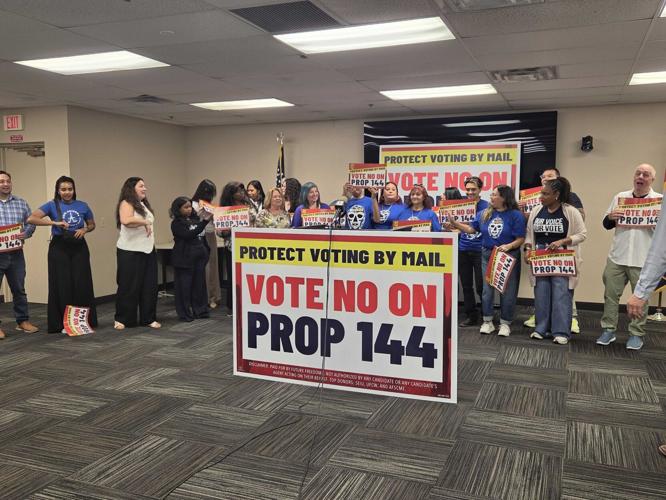


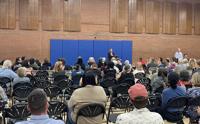
Phoenix organizers gather in support of the Vote No on Prop. 144 campaign during a press conference on Tuesday, Oct. 20, 2026. (Analisa Valdez/CALÓ News)
The midterm election is less than two weeks away for Arizona registered voters looking to cast their ballot in person. But for those who signed up for the Active Early Voting List (AEVL) — a secure form of voting-by-mail that Arizonans have utilized for the last two decades — their preferred voting method could be at risk should voters pass Proposition 144.
“I’ve been voting by mail in Arizona since I was a Sun Devil at ASU. And like millions of other Arizonans, I’ve come to rely on that as a secure, reliable way to make my voice heard and give me time with my very lengthy ballot that I get every two years. Especially in the general election with all these ballot measures on it,” Joel Edman with Will of the People Arizona said at a Tuesday news conference held in opposition to the ballot measure.
Hosted in partnership with Will of the People, Living United for Change in Arizona (LUCHA), the Arizona Alliance for Retired Americans, Our Voice Our Vote (OVOV) and the African American Christian Clergy Coalition, advocates got the chance to speak out against the proposition and how voters can take action against yet another attempt to alter the voting-by-mail process.
“In Arizona, there are 1.3 million registered voters over the age of 65. We’ve been voting for over 50 years and we are some of the biggest users of vote-by-mail. When it was implemented in ‘91, we took advantage of that and we’ve voted every year,” Dora Vasquez, from the Arizona Alliance for Retired Americans, said, referencing 1991 as the first year that Arizona allowed voters to request and vote via absentee ballot. “Seniors are already swamped with paperwork, and Prop. 144 will make voting by mail seem like a nightmare trip to the DMV.”
Brought forth by Republican legislators, Proposition 144 seeks to mandate that voters present a valid form of government-issued identification to cast each and every vote for every election after January 2028 to “reaffirm” citizenship. While the “Fast Election Results Act” has been pitched by GOP Representatives as a solution for faster, secure election results when tabulating ballots directly at the polls, the proposition’s language does not indicate how ID’s would be verified when voting by mail. According to Arizona Democrats and local advocates, the measure would effectively eliminate the vote-by-mail system utilized by millions across the state.
“You’ve heard what Prop. 144 does. I want to talk a little bit about the word underneath it: proof,” Sena Mohammed, OVOV executive director, said. “In this country, Black Americans have been asked for proof — proof we could read, proof we could pay and proof that we deserve to vote. Every one of those tests came with a nice name and every one was sold as protecting the integrity of elections. So, when a measure calls itself ‘fast’ and ‘secure,’ I want to ask, ‘secure for who?’”
Our Voice, Our Vote is the largest Black-led voter engagement organization in Arizona and is mission-oriented on advocating for progressive policies, holding officials accountable and connecting with community members. Those residents, Mohammed said, are the reason why OVOV is speaking up against the measure.
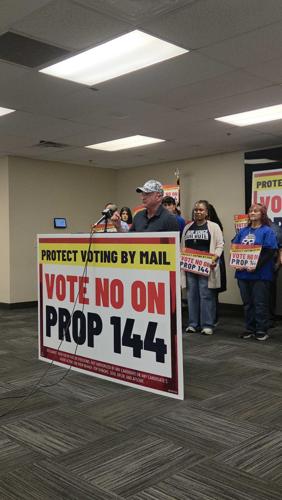
Also present was Democratic U.S. Sen. Mark Kelly, who urged voters to pose important questions about how this proposed arbitrary process would work for military members stationed at sea or overseas, senior citizens unable to leave their homes, or older voters who have trouble keeping track of important paperwork.

U.S. Sen. Mark Kelly speaks out against Proposition 144 during a press conference on Tuesday, Oct. 20, 2026. (Analisa Valdez/CALÓ News)
“[Prop. 144] is just putting a barrier in front of people to make it harder for them to vote because there is a certain segment of our society that feels that if it’s harder for people to vote, they win. They want to remain in power. It is the same reason you saw a President send a mob to Capitol Hill to attack the other branch of government when he didn’t like the outcome of an election,” Kelly said in reference to the infamous Jan. 6 insurrection that stemmed from the unfounded fraudulent election claims made by President Donald Trump in 2020.
These claims have equally been supported and continued by his far-right supporters and loyal allies — fanning the first flames of mass public distrust in the country’s election process.
According to Ballotpedia, there have been at least 11 proposed voter identification ballot measures nationwide since the 2020 election. A threat against mail-in votes from the executive branch was also thwarted this summer when a federal judge blocked the Trump administration’s attempt to strong-arm the U.S. Postal Service (USPS) with a proposed rule that would have barred the delivery of mail-in and absentee ballots in states that refused to turn over voter rolls.
In 2022, Arizonans voted against Proposition 309 that, if passed, would have similarly added what critics deem "unnecessary" steps for mail-in voting verification. Heading into the 2026 midterm, Kelly and local advocates are now asking Arizona voters to vote a resounding ‘no’ on yet another restrictive ballot measure.
“I think of Fannie Lou Hamer who endured brutal violence and refused to surrender her demand for political participation. I think of John Lewis and those who walked across the Edmund Pettus Bridge facing clubs and tear gas because they believed the promise of this country could reach every citizen,” Pastor Aubrey Barnwell with First New Life Church and chairperson of the African American Christian Clergy Coalition said. “Will we exercise the vote they fought to secure? Will we protect our neighbors’ opportunity to do the same? Will we recognize a barrier even when it arrives dressed up in respectable language? Will we know the history? The history of literacy tests, poll taxes and rules designed to decide whose voice will be counted. That history makes it our responsibility to examine every new voting restriction carefully. Every proposal must answer a basic question: What problem does this solve? Who will bear the burden of impact of a so-called solution?”
On Nov. 3, registered voters can elect party nominees for several statewide and federal seats, including governor, school superintendent, secretary of state, members of Congress, and state representatives, and vote for or against eight measures on the Arizona ballot this year, including Proposition 144.
Eligible voters can find their nearest polling location by visiting my.arizona.vote/WhereToVote. Maricopa County voters can sign in to their dashboard using household and personal information to get a sample ballot and additional information on seats and candidates at elections.maricopa.gov/voting/voter-dashboard.
Absentee or mail-in ballots should be mailed no later than Oct. 27.
“This is about maintaining power even when there is not a problem,” Kelly said. “I think it’s no coincidence that we’re in a mid-term election year and that the most popular way to vote in Arizona is under attack,” Sen. Kelly said. “Arizonans have just two weeks. I implore them not to be fooled by this Proposition.”
Analisa Valdez (she/her) is a freelance journalist based in Phoenix. Her reporting includes community & culture, social justice, arts, business, and politics.







(0) comments
Welcome to the discussion.
Log In
Keep it Clean. Please avoid obscene, vulgar, lewd, racist or sexually-oriented language.
PLEASE TURN OFF YOUR CAPS LOCK.
Don't Threaten. Threats of harming another person will not be tolerated.
Be Truthful. Don't knowingly lie about anyone or anything.
Be Nice. No racism, sexism or any sort of -ism that is degrading to another person.
Be Proactive. Use the 'Report' link on each comment to let us know of abusive posts.
Share with Us. We'd love to hear eyewitness accounts, the history behind an article.