
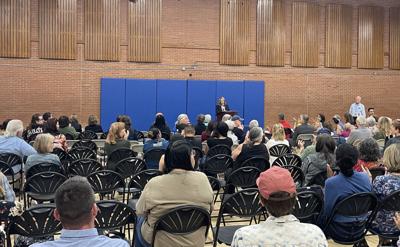


Attorney General Kris Mayes delivers opening remarks before taking questions from community members during a conversation about data centers on Wednesday, Oct. 14, 2026. (River Graziano/CALÓ News)
On Wednesday evening, Arizona Attorney General Kris Mayes heard from community members at a town hall in Mesa, where Valley residents raised environmental concerns and questions about local agency power as data center projects continue to be greenlit statewide.
Mayes first announced the “Community Conversation on Data Centers” event after calling for a statewide pause on data center approvals, citing rising energy costs and diminishing water resources as reasons to intervene until Arizona can establish a growth plan for the industry.
“I felt the community opposition welling up against [data centers],” Mayes said at the town hall. “I saw our Colorado River water supplies being cut, and I saw the rate increase requests that [Arizonans] were having to intervene against, and the anguish and the pain for communities that are seeing these [data centers] drop like an anvil in the middle of their neighborhoods.”
Alongside concerns of physical data center impacts, Mayes recently joined seven other attorneys general in suing ChatGPT developer OpenAI for “hurting Arizona children, deceiving parents, and violating Arizona law,” a decision she announced Wednesday morning. Specifically, the lawsuit alleges that OpenAI violated the Arizona Consumer Fraud Act by failing to disclose “reasonably foreseeable” risks of harm to minors using ChatGPT.
“[OpenAI] knew it was dangerous, and they put the technology out there,” Mayes said to reporters after the event. “I wish Congress would take action. They have consistently failed to protect our children from big tech and from countries like Meta [and] TikTok.”
Mayes held her town hall at the Eagles Community Center in Mesa for a few dozen community members and several state legislators. During her opening presentation, Mayes said her office identified 110 active data centers in the state, while 10 were under construction and 40 in planning stages.
“Those planned data centers, if they're built, will consume significantly more power than all the existing data centers in Arizona combined,” Mayes said.
According to Mayes, these new constructions would increase the stress on local water resources by 32%; especially following the 20% cut in water supply from the Colorado River confirmed earlier this year, this would place a significant burden on critical infrastructure.
Mayes also addressed concerns that large utility users may pass the costs on to the average consumer. A report submitted to the ACC on Oct. 2 by citizen activist and data analyst Abhay Padgaonkar, and reviewed by an independent utility consultant, found that homeowners and businesses paid a total of $537 million between 2023 and 2025 for costs associated with the large-load industry.
“We need answers about [Padgaonkar’s report] as well,” Mayes said. “Unfortunately, APS has not provided those answers to the state… we wrote a letter to the [Arizona] Corporation Commission, urging them to answer those questions.”
Several public speakers mentioned the 2006 Proposition 207, which expanded eminent domain to allow property owners to seek compensation if a zoning decision reduces their property value. Throughout 2026, at least 11 Phoenix landowners and developers have used this law to request compensation for the effects of data center development.
Mayes said that her office was analyzing these cases, but “Prop. 207 does not prevent me as your attorney general from filing a nuisance lawsuit against a data center.”
Citing her experience as an ACC commissioner, Mayes said that utility companies must be held accountable for prioritizing profits over community health and sustainability.
“[The utility companies] already said their loads will double as a result of the data centers that are being planned. That is music to the ears of any utility,” Mayes said.
Audience members also asked about the role other government agencies might play in slowing or halting data center development. According to Mayes, she has encouraged the Legislature and Gov. Katie Hobbs to act within their respective powers to implement a moratorium, referencing Texas Gov. Greg Abbott’s order to temporarily halt data center permits.
“We could maybe someday get a corporation commission that would actually scrutinize these projects and force the utilities to scrutinize the projects before there's any approval of them,” Mayes said.
Many comments and questions were directed at a specific data center site in Ahwatukee, currently under construction by Menlo Digital. Residents located only a couple hundred feet away from the site raised concerns about late-night construction noise and potential pollution.
Local attorney Anthony Ramirez, who submitted an ethics complaint against Phoenix City Councilman Kevin Robinson alleging a conflict of interest with Menlo Digital, also asked Mayes’ office to help advance the complaint.
Mayes asked residents to send any evidence they have to her office and promised to hold a future town hall in Ahwatukee, potentially as soon as next month, to discuss the site and related issues in greater detail.
“If I were in the legislature, I would pass a law tomorrow, saying there has to be a [community] vote on whether or not the data center goes in the city,” Mayes said after the town hall. “What you saw today from the actual community, from our actual Arizonans, is overwhelming concern about these projects.”
River Graziano is a freelance journalist for CALÓ News. They grew up in the Ahwatukee area of Phoenix and later attended ASU in Tempe, where they spent two years as an editor at The State Press. Their reporting with CALÓ News covers advocacy efforts impacting Latine communities across the Valley.









(0) comments
Welcome to the discussion.
Log In
Keep it Clean. Please avoid obscene, vulgar, lewd, racist or sexually-oriented language.
PLEASE TURN OFF YOUR CAPS LOCK.
Don't Threaten. Threats of harming another person will not be tolerated.
Be Truthful. Don't knowingly lie about anyone or anything.
Be Nice. No racism, sexism or any sort of -ism that is degrading to another person.
Be Proactive. Use the 'Report' link on each comment to let us know of abusive posts.
Share with Us. We'd love to hear eyewitness accounts, the history behind an article.