


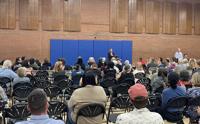
Zarco Guerrero, co-founder of Cultural Coalition and maker of the skull-inspired masks for Mikiztli, speaks to a crowd at the Arizona Center on Saturday, Nov. 1, in Phoenix, Arizona. (Nicole Macías Garibay/CALÓ News)
Masks, characters and stories that look death straight in the eye.
Each of these masks has a distinct identity and its own way of understanding Día de los Muertos: what it means, what it reminds us of and, above all, what it has to tell us about life.
Behind them is Zarco Guerrero, the artist who for decades has used theater, humor and other forms of art to explore Mexican American identity and memory in Arizona.
On Oct. 10, he performed his “Masked Storytelling with Zarco Guerrero!” at the University of Arizona Museum of Art. The show was part of the opening activities for the museum's exhibition “Staged: The Art of Performance."
His characters come to life through monologues. “El Vato Poeta,” “La Comadre,” “El Abuelito,” “El Narizón” and others explore the meaning of miquiztli, a Nahuatl word meaning “death.” Nahuatl is an Indigenous language of México, spoken by various Indigenous peoples since pre-Hispanic times.
But for the 74-year-old artist, talking about death goes deeper. It dates back to pre-Hispanic times. “Miquiztli does not simply represent death,” he tells Arizona Luminaria. “But transcendence.”
“I tell that ancestral story and what the calaca means,” Zarco says in the joking tone of someone talking about death as an old acquaintance.
Día de los Muertos is commemorated on Nov. 2. It is one of the most deeply-rooted celebrations in México and in other communities across Latin America and the U.S. It is a time to honor those who have transcended and keep their memory alive through prayers, food, flowers, music, verses and altars with mementos of things they loved. Calacas, represented by smiling skeletons adorned with flowers, are part of the celebration.
Born and based in Mesa, Arizona, and faithful to his Indigenous roots, Zarco says “it is a source of pride to be descended from Ópatas and Yaquis.” He says his parents instilled in him from an early age “a love for and recognition of the importance of Indigenous identity,” which is where his interest in storytelling and traditions such as Día de los Muertos comes from.
The artist is celebrating 50 years of his career with the exhibition “Zarco Guerrero: A Mask Maker’s Legacy,” bringing together 120 pieces from different stages of his performances. The exhibition is open now through Jan. 24, 2027, at the Mesa Arts Center.
The gallery showcases his work in various techniques, including wood and bronze carving, puppets, installations and, of course, colorful masks. The display also reflects his artistic journey through countries such as México, Brazil, Japan and Indonesia, where he worked with master carvers who shared their traditions and knowledge with him.
Now he is preparing to bring these creations and stories to Tucson. “It is a play with masks about Día de los Muertos,” Zarco says.

Community altar at the Cultural Coalition’s Mikizlti festival at the Arizona Center on Saturday, Nov. 1, in Phoenix, Arizona. (Nicole Macías Garibay/CALÓ News)
Death, a celebration of life
The first character on stage is “El Vato Poeta,” who, through Zarco, introduces the audience to the ancestral history of Día de los Muertos and develops a dialogue about another conception of death.
Then comes “El Narizón,” a colorful character who arrives without knowing the Nov. 2 tradition, convinced that it is some kind of Mexican Halloween. “He doesn’t like spooky things,” Zarco says.
But through his friends, “El Narizón” discovers that the celebration is not about death but about life. About flowers, music and memories of loved ones.
“Along the way, he discovers that he wasn’t afraid of death, but of living. Finally, he accepts that truth and begins to celebrate Día de los Muertos every year, with joy,” Zarco says.
“At last I can die in peace”
Zarco tells what he considers the deepest story, that of “El Gringo,” a white man who despises Mexican culture and supports former Sheriff Joe Arpaio. “But this man is very sick, he has lung cancer. He is alone and depressed,” the artist says of his character.
One Nov. 2, “El Gringo” goes to a park. “He finds it full of Mexicans dressed in folkloric costumes, mariachi musicians, music, the fragrance of copal, the smell of carne asada, entire families, grandmothers with their grandchildren.” For him, Zarco says, it was “another world.”
Back home, “El Gringo” creates his own altar: “he takes out photographs he has kept, prepares food and does everything he learned.”
Then, he invites his children, whom he has not been in contact with for a long time. He tries to convince them to come and bring the grandchildren.
When they arrive, “El Gringo” is surprised to see that his grandchildren are of different colors and cultures, “because his children married Mexicans, Black people, Chinese people, people from different backgrounds,” Zarco says.
One of his grandchildren approaches him and tells him that he loves him very much, and that when he is no longer around, he will build an altar in his honor every year.
He realizes that he is not alone and says: “At last, I can die in peace, thanks to Mexican culture.”

Tempe Union High School District teacher Cecily Cano dresses as a Catrina for the Mikiztli festival at the Arizona Center on Saturday, Nov. 1, in Phoenix, Arizona. (Nicole Macías Garibay/CALÓ News)
The dead return
In another monologue in Zarco’s performance, “La Comadre,” an older woman, creates an altar for her deceased husband. She places his favorite food, lights candles, arranges flowers and plays music while explaining every detail of the offering she is preparing to welcome her husband’s spirit.
At times, “La Comadre” — personified by Zarco — appears cheerful as she prepares the altar. Then she breaks down in tears because she misses her husband. “She tries to get her husband’s spirit to come and be with her,” Zarco says.
And he comes.
“She knows that there is a season of the year when the ancestors, the deceased, come, and above all, her husband comes, the man she is still so deeply in love with,” he says.
The artist says the scene speaks to a way of understanding death that does not end with absence, but remains in memory.
A form of resistance
Zarco wants those who hear his stories to discover the depth and beauty of Mexican traditions and the way they can enrich a life.
His message takes on another weight in the political and social moment the United States is going through. “Especially now, with the attacks on immigrants, with ICE, with all this hatred toward immigrants,” he says.
For the Arizona artist, art can become a form of resistance. He wants Mexicans and Chicanos to recognize the value of what identifies them and not allow others to dictate who they are.
“I want them to feel proud, to see how precious and important it is to have an identity. Because without identity we have no dignity; we are slaves,” he says.
Zarco pauses briefly before finishing the thought. He takes a breath.
“And this system is trying to erase our identity,” he adds.
His voice becomes firmer. He speaks of identity not only as memory, but as a way of healing.
“Culture heals, and we are sick physically and spiritually,” the artist says. “Our community needs medicine, not only for the body, but for the spirit.”
This article first appeared on AZ Luminaria and is republished here under a Creative Commons Attribution-NoDerivatives 4.0 International License.







(0) comments
Welcome to the discussion.
Log In
Keep it Clean. Please avoid obscene, vulgar, lewd, racist or sexually-oriented language.
PLEASE TURN OFF YOUR CAPS LOCK.
Don't Threaten. Threats of harming another person will not be tolerated.
Be Truthful. Don't knowingly lie about anyone or anything.
Be Nice. No racism, sexism or any sort of -ism that is degrading to another person.
Be Proactive. Use the 'Report' link on each comment to let us know of abusive posts.
Share with Us. We'd love to hear eyewitness accounts, the history behind an article.