
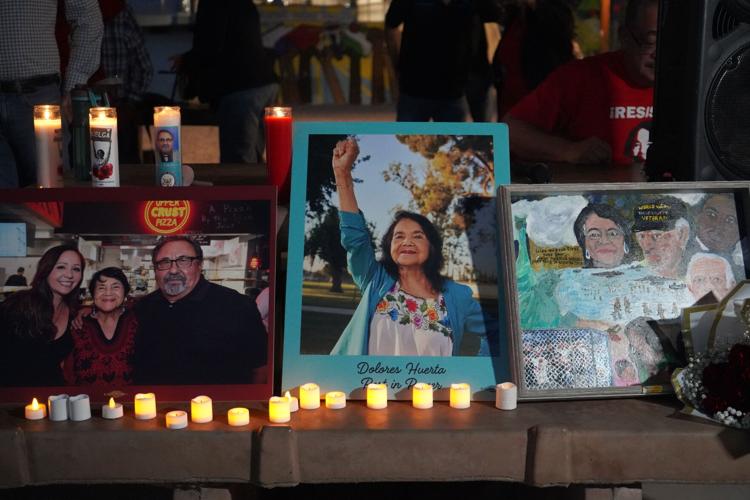
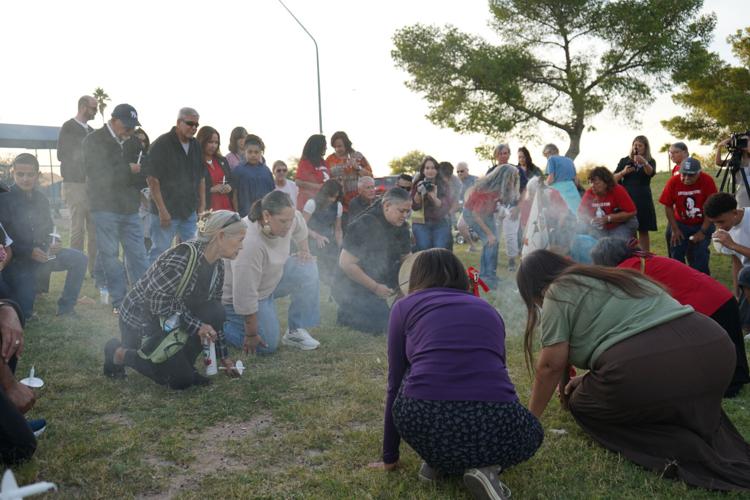
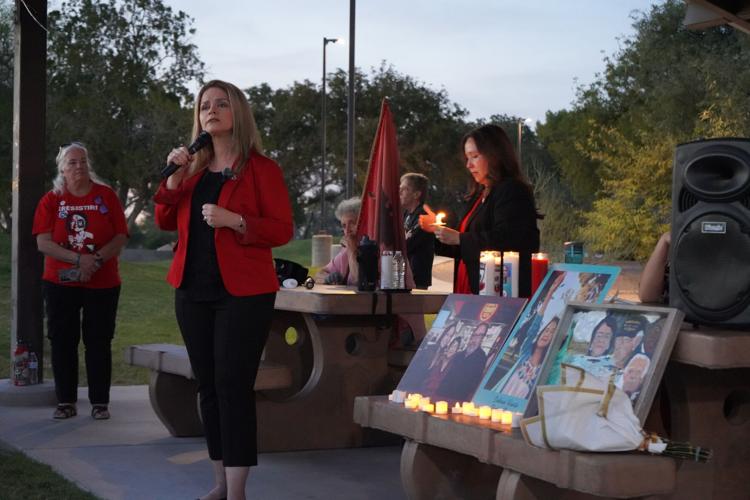
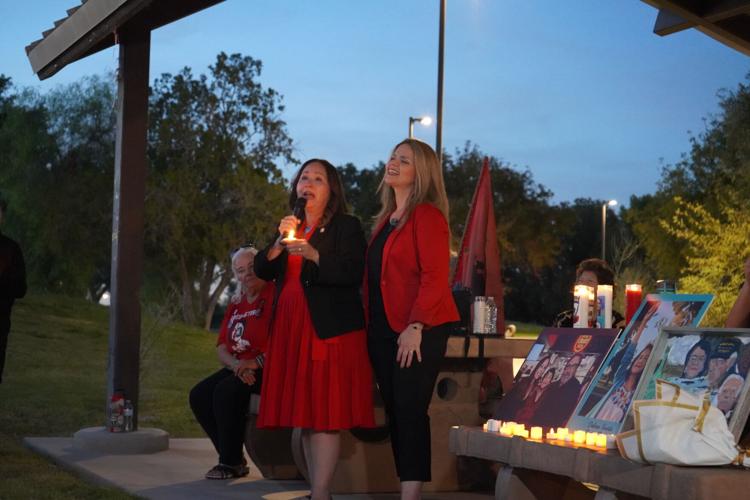

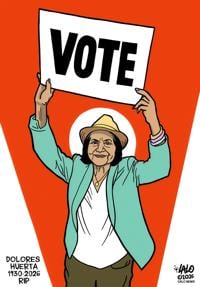
Dolores Huerta, who passed on Oct. 28, 2026, led the farmworker’s movement and fought for social justice for other marginalized communities. Community members gathered at a park in Tucson on the night of her passing to honor her life. (Susan Barnett/CALÓ News)
Dozens gathered for a vigil in Tucson at Joaquin Murrieta Park on the west side to honor activist Dolores Huerta, who passed away from cancer on Wednesday at the age of 96.
Huerta leaves a long legacy of fighting for workers' rights, women’s rights and civil rights, and is known for co-founding the United Farm Workers, the nation's longest-enduring labor union for agricultural workers. Her advocacy had a resounding impact on farmworkers and other marginalized communities. Many who attended her vigil described her as always working tirelessly for a greater cause.
“Many people think she just championed the plight of farm workers, but she was a champion for all people who needed to be heard. She spoke out for all workers' rights, for all immigrant rights, for all LGBTQ+ rights. She fought for humanity in unity,” said Eva Carrillo Dong, co-chair of the Dolores Huerta Unity Coalition, a Tucson-based community organization that advocates for human rights and social equity. “We mourn her now, we weep for her now, but then we must pick ourselves up like she always has and did, and honor her by using our voices and the power we all have within us to fight for justice, to fight for humanity and unity through our struggles.”
While Huerta’s loss is felt nationwide, drawing comments from national leaders, Huerta’s passing is felt much more personally in Tucson. The renowned activist knew the city and its people very well.
Huerta often stayed at Tucson Mayor Regina Romero's home when she was in town and considered Huerta a friend and a mentor. Romero, the child of immigrant farmworkers who followed seasonal crops between Arizona and California, credits Huerta’s organizing efforts as part of her family and her own story.

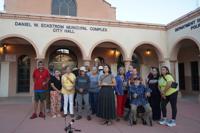
Tucson hosts a vigil to honor the life of Dolores Huerta, who died at the age of 96 on Oct. 28, 2026. (Susan Barnett/CALÓ News)
It was in Arizona in 1972 that Huerta coined the iconic movement motto, “¡Sí, se puede!” after an Arizona law made it illegal for farmworkers to strike during harvest season and tried to keep the UFW out of the state, according to the U.S. National Archives. Her response to the “no se puede” she was given after trying to organize and being told she couldn’t strike in Arizona birthed the rallying cry still echoed today.
“She changed my and my family's life without even knowing us. It was because of her that my parents had better working conditions,” Romero said at the Wednesday vigil. She said the UFW’s organizing fought for water breaks and dental and health care benefits for farmworker families like hers in Somerton.
Later, in Tucson, Romero met Huerta, and the two grew close, with Huerta attending her and her husband Ruben Reyes’ wedding, as well as Congresswoman Adelita Grijalva’s.
Huerta's last time in Tucson was to attend the funeral services of the late Congressman Raul Grijalva, a southern Arizona leader who championed Indigenous sovereignty, environmental conservation and progressive civil rights throughout his career, including for immigrants and farmworkers.
Huerta and Congressman Grijalva met in the 70s during the UFW-organized lettuce and grape boycotts. The two were Chicano behemoths who fought for change side by side.
“I have a picture of Dolores and my dad sort of like talking to each other, like they had some sort of chisme secret that we're not supposed to hear,” said Rep. Adelita Grijalva. “And so it gives me a lot of peace and comfort knowing that my dad has someone else to chismear with up there.”

Congresswoman Adelita Grijalva and Tucson Mayor Regina Romero stand together as they address attendees at a vigil in Tucson in honor of Dolores Huerta. Both women credit Huerta with the path they forged. (Susan Barnett/CALÓ News)
Grijalva said women like Huerta paved the way for her and Romero to hold the political offices they hold now, breaking the “glass ceilings” and creating more opportunities for future generations.
Earlier this year, after news broke of allegations Huerta made against César Chávez — who’d fought and co-founded the UFW alongside Huerta — Romero renamed March 31 from César Chávez Day to Dolores Huerta Day.
“Everybody talks about her meeting with presidents, kings, organizers, flying all over the world, but it was here in Tucson that she felt at home,” Reyes, District Director at U.S. House of Representatives, said. “Dolores is one of those international figures that belongs to us. It's up to us to keep that spirit, keep that flame going and keep its momentum going.”
“We're going to cry today… tomorrow, we gotta get to work”
Huerta was never one to shy away from politics, according to Romero.
Born in Dawson, New Mexico, she was familiar with organizing and gaining political power. Her father was a farmworker, miner and union activist who was elected to the New Mexico Legislature in 1938, according to the National Park Service. Her mother owned a local hotel and restaurant that catered to farmworkers and lower-wage workers, according to the U.S. National Archives. The two divorced when Huerta was three and she moved with her mother to Stockton, California.
“She went on to fight for the soul of our country and for democracy. Her call to action was always organized, organize, organize. She was convinced that people can change things,” said Steven Valencia, a long-time labor and community activist with Tucson Jobs with Justice — a workers’ rights organization. “We will take her spirit and leadership to the voting booth and move our country to a real humanity in these midterms.”
Huerta continued to advocate for justice well into her 90s, keeping an eye on Tucson’s political landscape and staying in touch with local political leaders in the city that had become like family to the movement leader.
“This morning I received a call from her daughter. We spoke and we talked about the things that we usually talk about. Usually, you know, what's next? And… she was very forceful, saying, ‘whatever you got going in Tucson, keep it up y dale gas. Keep it up and keep it going,’” Reyes said. “The only regret that Dolores Huerta has is that she's not going to see the butt kicking we're going to do on Nov. 3. She said that. So mourn. Do what you gotta do, but don’t stop organizing. Don't stop working. Don't stop living. Don't stop moving forward. Because there's still a lot of people that need our help.”

Tucson Mayor Regina Romero addresses attendees at a vigil in Tucson in honor of Dolores Huerta. She considered Huerta a dear friend and mentor. (Susan Barnett/CALÓ News)
Mourners left the vigil with one clear call to action, something the speakers said Huerta would have wanted.
“We're going to cry today, we're going to give each other hugs today because that's what we need today. And tomorrow, we gotta get to work,” Rep. Grijalva said. “Every single one of you here better be at headquarters, knocking on doors, calling people, getting out the vote because we have an opportunity to change this country and we have to do it for Dolores.”
Susan Barnett is an independent journalist in southern Arizona covering the immigrant and Latine community. She is a recent graduate from the University of Arizona, where she received her Master of Arts in Bilingual Journalism. She previously worked at La Estrella de Tucson and co-founded Tucson Spotlight.






(0) comments
Welcome to the discussion.
Log In
Keep it Clean. Please avoid obscene, vulgar, lewd, racist or sexually-oriented language.
PLEASE TURN OFF YOUR CAPS LOCK.
Don't Threaten. Threats of harming another person will not be tolerated.
Be Truthful. Don't knowingly lie about anyone or anything.
Be Nice. No racism, sexism or any sort of -ism that is degrading to another person.
Be Proactive. Use the 'Report' link on each comment to let us know of abusive posts.
Share with Us. We'd love to hear eyewitness accounts, the history behind an article.