
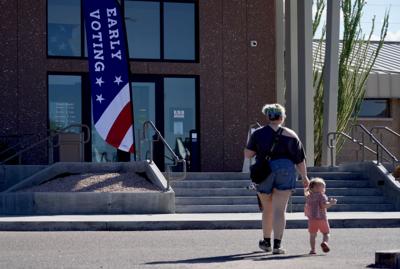

People walk near an early voting center in Kingman, Ariz., Wednesday, Oct. 7, 2026. (AP Photo/Ty ONeil)
Arizona voters will decide on eight statewide propositions in the Nov. 3 election. Understanding what each measure would change or impact can be challenging, especially when the ballot language is filled with legal jargon and technical wording.
Here’s a breakdown of the statewide propositions on your ballot, explaining what each measure would do and what a “yes” and “no” vote would mean.
Prop. 141: Vehicle mileage taxes
Proposition 141 would amend the Arizona Constitution to prohibit state and local governments from imposing taxes or fees based on how many miles a person drives. It also would restrict governments from monitoring or limiting vehicle mileage without a driver’s consent.
Arizona does not currently have a statewide mileage tax. Drivers who purchase gasoline generally pay the state’s fuel tax, which helps fund transportation-related expenses. A mileage tax is one potential alternative for collecting transportation revenue as vehicle technology and fuel consumption change.
Voting “yes” would add a constitutional prohibition on mileage-based taxes and fees and restrict government monitoring or limits on vehicle mileage without consent.
Voting “no” would reject the proposed amendment and keep the existing constitutional taxation unchanged.
Supporters include Republican state officials Sen. Jake Hoffman and Reps. Joseph Chaplik and Rachel Kashel. The Maricopa County Libertarian Party, Arizona Free Enterprise Club, Home Builders Association of Central Arizona (HBACA) and National Motorists Association also support the measure.
Opponents include Democrat state Rep. Adelita Grijalva and Ted Maxwell, CEO of Southern Arizona Leadership Council. Civic Engagement Beyond Voting, Rural Arizona Action and CHISPA AZ also oppose the proposition.
Prop. 142: Preferential treatment and discrimination
Prop. 142 would amend Arizona’s constitutional provisions prohibiting preferential treatment and discrimination based on race or ethnicity. It would restrict certain diversity, equity and inclusion (DEI) requirements and practices in public education, employment and government contracting.
The proposal would add more restrictions on how public institutions address race and ethnicity, including certain DEI-related activities and requirements. It would prohibit requiring people to support certain race-based policies or make statements about race and ethnicity to qualify for school, jobs, or government contracts. It would also restrict the use of public money for public education positions that promote race-based preferential treatment or discrimination and exclude schools and workplaces from disciplinary practices that treat people differently based on race or ethnicity.
The amendment includes some exceptions, such as health services and legal requirements.
Arizona already has a constitutional prohibition on state-sponsored preferential treatment and discrimination based on race, sex, color, ethnicity or national origin. Prop. 142 would add specific restrictions addressing public institutions and DEI-related practices.
Voting “yes” would add the proposed restrictions to the Arizona Constitution, including limits on certain DEI-related requirements and the use of public funds.
Voting “no” would reject the amendment and keep the existing constitutional rules.
Supporters include Republican state Sens. Frank Carroll and Janae Shamp and state Reps. Leo Biasiucci, Walter Blackman and Selina Bliss. The Arizona Free Enterprise Club, Arizona Women of Action, Goldwater Institute and Heritage Action for America also back the measure.
Opponents include Democrat state Sen. Denise Epstein and Rep. Adelita Grijalva. Other opponents include the ACLU of Arizona, Civic Engagement Beyond Voting, League of Women Voters of Arizona, Mi Familia Vota, Our Voice Our Vote, Will of the People, Activate 48 and CHISPA AZ.
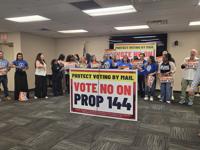
Prop. 144: Election I.D. requirements
Prop. 144 would amend the Arizona Constitution to change election requirements, including requiring voters to present a government-issued ID when voting in person and by mail; however, the proposition’s language does not specify how IDs would be verified for mail-in voting. It would also address citizenship requirements, campaign contributions from foreign nationals and election administration.
The proposal would give voters the option to have their ballots tabulated at their voting location on Election Day. It would also establish a new constitutional standard for reviewing election laws.
Voting “yes” would approve the proposed constitutional changes, including government-issued ID requirements for all voting methods and additional election administration rules.
Voting “no” would reject the amendment and keep the current constitutional rules for voting and election administration.
Supporters include Republican state Sens. Shawnna Bolick, David Fransworth, and Jake Hoffman, along with state Reps. Joseph Chaplik and Ralph Heap. James Roger, a candidate for the state House in District 10, also supports the measure, as do the Arizona Freedom Caucus, Arizona Free Enterprise Club, Arizona Women of Action and Heritage Action for America.
Opponents include Democratic state Sens. Denise Epstein, Analise Ortiz, Priya Sundareshan, and state Reps. Oscar De Los Santos and Adelita Grijalva as well as former Phoenix Mayor Paul Johnson and former state Sen. Raquel Terán. The ACLU of Arizona, Arizona Public Health Association, Civic Engagement Beyond Voting, Our Voice Our Vote, Lumen Strategies, CHISPA AZ, Activate 48, and Arizona Independent Voters Network also oppose it.
Prop. 316: Local grocery taxes limit
Prop. 316 would limit cities and other local governments' ability to impose or increase grocery taxes. The measure would cap applicable local grocery taxes at 2% and require voter approval for new or increased taxes.
The proposal would restrict local government from creating new grocery taxes or increasing existing ones from July 1, 2025, through June 30, 2027. After that period, voters would need to approve any new or increased taxes, and they could not exceed the proposed 2% limit.
Voting “yes” would approve the proposed restrictions, including the 2% cap and voter approval requirement.
Voting “no” would reject the proposal and leave existing state laws governing local taxes in place without adding the restrictions proposed.
Supporters include Republican state Sen. Warren Petersen, state Rep. Leo Biasiucci and Chandler Mayor Kevin Hartke.
Opponents include Democratic state officials such as Bisbee Mayor Ken Budge and Rep. Adelita Grijalva. The Arizona Municipal Clerks’ Association, Civic Engagement Beyond Voting and LD3 Democrats Northern Maricopa County also oppose the measure.
Prop. 317: Arizona Department of Homeland Security
Prop. 317 would classify drug cartels as terrorist organizations under Arizona law and establish the Arizona Department of Homeland Security, directing the agency to use all lawful means within its authority to address threats posed by cartels.
The measure defines cartels as groups involved in human smuggling, drug trafficking for profit, or acts of terrorism under state law. It also states that the measure does not support a person’s claim for asylum under federal law.
The state-level classification should not be confused with federal designation of a foreign terrorist organization. Prop. 317 would establish a classification under Arizona law. Its effects would depend on the authority and resources available to state agencies.
Voting “yes” would approve the proposed classification of drug cartels as terrorist organizations under state law and establish the Arizona Department of Homeland Security with the specified responsibilities.
Voting “no” would reject the proposal and leave existing state laws governing terrorism and the department’s proposed responsibilities unchanged.
Supporters include Republican state Reps. Michael Carbone, Nick Kupper, and Michele Pena, House Speaker Steve Montenegro and candidate for House of Representatives George Khalaf.
Opponents include Democratic state Sen. Catherine Miranda and Rep. Adelita Grijalva. Coconino County Democrats, Civic Engagement Beyond Voting, ACLU Arizona, LD3 Democrats Northeastern Maricopa County and CHISPA AZ also oppose the measure.
Prop. 318: Student athletics
Prop. 318 would require public and private schools, colleges, and athletic associations to designate sports teams as male, female or co-ed based on a person’s biological sex as recorded on their original birth certificate. It would also restrict access to restrooms, locker rooms and showers based on sex and allow athletes to sue schools or athletic associations that knowingly violate the proposed rules.
The proposal would expand restrictions to cover additional schools and athletic associations. Arizona already has laws restricting transgender students from participating on sports teams that correspond with their gender identity. Prop. 318 would extend the requirements and add restrictions involving private spaces.
Voting “yes” would expand the proposed sex based rules to additional schools and athletic associations. It would also establish the proposed restrictions and enforcement.
Voting “no” would reject the proposal and retain existing laws governing student athletics.
Supporters include Republican state Sens. Shawnna Bolick, Warren Petersen and Selina Bliss, state Reps. Andy Biggs, Alexander Kolodin and Steve Montenegro, Chandler Mayor Kevin Hartke and Superintendent of Public Instruction Thomas C. Horne. Arizona Women of Action, the Center of Arizona Policy and Liberty Counsel Action also support the measure.
Opponents include Democratic state officials such as Sen. Denise Epstein, Rep. Adelita Grijalva and JoAnna Mendoza, a candidate for U.S. House. The Arizona Coalition for Working Families, Arizona Students Association, Equality Arizona Action, Mi Familia Vota, Save Our Schools Arizona, Will of the People, Activate 48 and CHISPA AZ also oppose the proposition.
Prop. 319: Photo enforcement systems
Prop. 319 would restrict traffic cameras used to photograph or record drivers suspected of violating traffic laws, including speeding and running red lights.
Under the proposal, state agencies and local governments could not use these systems unless they were provided under a contract by Dec. 31, 2026. Local governments would also need voter approval to keep using the systems.
The measure would change the rules governing automated traffic enforcement. Communities that rely on traffic cameras could face new requirements for continuing those programs. The potential impact would depend on existing contracts and local voter decisions. The proposal would not establish a uniform statewide ban on all existing systems regardless of their contractual status.
Voting “yes” would approve the proposed restrictions on photo enforcement and require local voter approval for continued use of covered systems.
Voting “no” would reject the proposed restrictions and leave current laws governing traffic cameras in place.
Supporters include Republican state Sens. Mark Finchem and Wendy Rogers.
Opponents include Democratic state Rep. Adelita Grijalva, AAA Arizona, the Arizona Public Health Association, Civic Engagement Beyond Voting and the League of Arizona Cities and Towns.
Prop. 320: School district budgets
Prop. 320 would require certain Arizona school districts to spend at least 60% of their operating budget on direct classroom expenses. The measure would apply to districts with 7,500 or more students and to districts in Maricopa, Pima, and Pinal counties.
The state’s auditor general would define which expenses qualify as direct instructional spending. Districts that fail to meet the 60% requirement each year would lose 25% of their Classroom Site Fund.
The proposal would change how affected school districts allocate and report their operating expenses rather than leaving spending decisions entirely to local budgeting processes. The potential effect on a district would depend on its current budget and how the auditor general defines qualifying expenses. The definition of “direct instructional expenses” matters because it determines which costs count toward the 60% threshold.
Voting “yes” would establish the proposed 60% spending requirement and impose a 25% reduction in Classroom Site Fund money for districts that fail to meet it.
Voting “no” would reject the proposed requirement and penalties, leaving existing school district budgeting rules in place.
Supporters include Republican state Sen. Jake Hoffman and state Rep. Matt Gress. Arizona Women of Action and the Goldwater Institute also support the measure.
Opponents include Democratic state officials such as Sen. Denise Epstein, Rep. Adelita Grijalva and former state Rep. Isela Blanc. The Arizona Education Association, Arizonans for Quality Education, Civic Engagement Beyond Voting, League of Women, Mi Familia Vota, Rural Arizona Action, Will of the People, Activate 48 and CHISPA AZ also oppose the proposition.
Barbara Flores is a freelance writer for CALO News. She grew up in San Diego, California, before moving to Tucson, where she studied journalism at the University of Arizona. She reports on elections, Latino communities, sports and community events.






(0) comments
Welcome to the discussion.
Log In
Keep it Clean. Please avoid obscene, vulgar, lewd, racist or sexually-oriented language.
PLEASE TURN OFF YOUR CAPS LOCK.
Don't Threaten. Threats of harming another person will not be tolerated.
Be Truthful. Don't knowingly lie about anyone or anything.
Be Nice. No racism, sexism or any sort of -ism that is degrading to another person.
Be Proactive. Use the 'Report' link on each comment to let us know of abusive posts.
Share with Us. We'd love to hear eyewitness accounts, the history behind an article.