
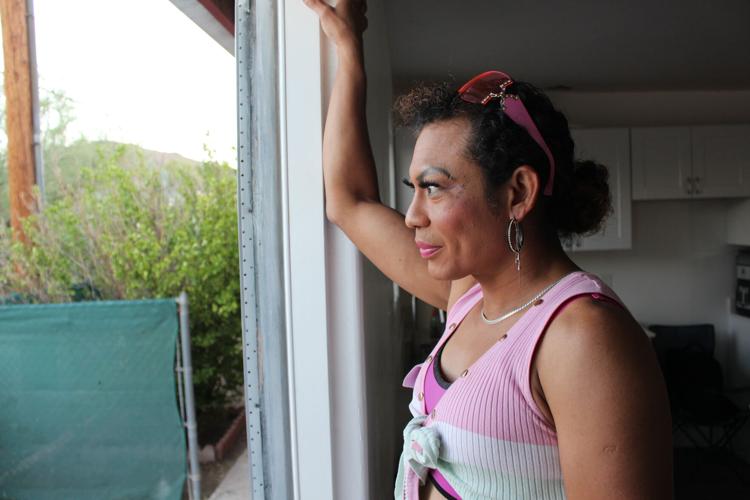







Joselin Colibrí looks out onto the side patio of Casa Mariposa in Tucson, Ariz., on July 2, 2026. (Stephanie Casanova/CALÓ News)
This story was produced with the support of Altavoz Lab, an organization dedicated to uplifting the work of community journalists.
Joselin Colibrí's body trembled the first time she visited migrants in detention in Florence. Her heart started beating faster, louder.
Before walking past the barbed wire fence and into Florence Service Processing Center, she had to calm herself down.
"Everything will be OK," she told herself. “You’re going to receive; you’re going to make the other person feel good, put them at ease. But you’re going to get out.”
Her body remembered the isolation and mistreatment she experienced years ago, when she spent months in a detention center in New Mexico similar to the one she was now visiting.
Colibrí, 39, a Tucson resident and migrant rights organizer, would visit LGBTQ+ migrants in detention four more times before the anxiety subsided, she said. She kept showing up because she understood how important those visits are for the people in an immigration prison.
Her presence there gave her time to listen and let them vent. She would leave the detention center carrying their stress, sometimes exhausted but also glad she could bring them a smile and help them recharge.
“When you go to a detention center and listen to them — to see how they are feeling — they open up; they release everything they're feeling and have felt," she said. "And as you listen, both body and mind receive it.”
That first visit was in 2023, when she was volunteering with Mariposas Sin Fronteras, the organization that supported her through her own detention in Cibola County Correctional Center in New Mexico in 2017.
When she was in detention after turning herself in to officials at the border in Nogales, without family in the U.S. to visit her, she looked forward to seeing her lawyer and reading letters from Mariposas volunteers. The written notes brought her joy.
"'I’m not alone,’” she remembers telling herself each time she received a letter. “It gives you the courage to keep hanging in there.
There were days when she considered signing deportation papers, giving up on her asylum case, especially when immigration agents told her that she would never leave the detention center, she said.
The agents' claims impacted her mental health; the community letters helped her keep fighting.
Now a co-organizer working full-time with Mariposas, Colibrí is returning the love she received during that time — visiting migrants, writing them letters, talking with them over the phone and supporting them when they're released from detention. Mariposas Sin Fronteras also supports LGBTQ+ migrants in detention with commissary funds for food and hygiene products, and transitional housing, mental health support and other needs once they’re released — all services Colibrí helps facilitate.
Narda Rivera, a co-organizer with the organization, said she has learned to step back and allow Colibrí to lead, adding that it has been a joy to watch her grow confidently into that leadership.
"Her story keeps being testimony of hope and liberation," Rivera said.
When Colibrí was detained, she wrote to escape, filling her pages with her goals and hopes for her future. Now, she encourages those being held in Immigration and Customs Enforcement (ICE) prisons to do the same in order to escape the harsh reality they are living.
Colibrí reminds migrants that their detention is temporary, that their minds are powerful and that they are supported.

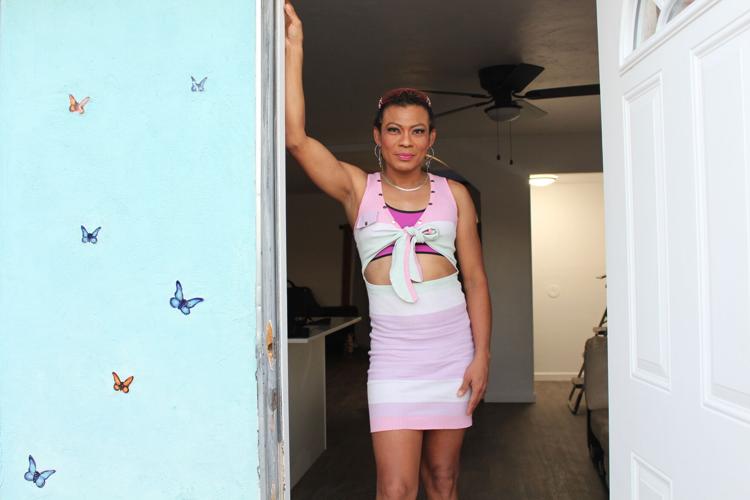
Joselin Colibrí poses for a photo at Casa Mariposa in Tucson, Ariz., on July 2, 2026. (Stephanie Casanova/CALÓ News)
A timid girl grows bold
On a recent Monday evening, Colibrí stopped by Mariposas Sin Fronteras’ office in Tucson. She wore a shiny black pleather skirt, a black corset top and tall black heeled boots. Her dark brown curly hair crowned her face, pink blush highlighting her cheekbones. Long, thick lashes curled up to her eyebrows.
She dresses boldly, often wears pink and loves wearing heels. At 5-foot-8 without shoes, when she walks into a room in her high-heeled boots, she's a towering presence.
But it wasn´t always like that.
When she was a little girl, she was timid. Her classmates would pick on her and she didn't fight back. Instead, she'd run off and cry, often confiding in her sister, who would turn around and tell her, “‘But look, they're just little kids! Hit them back!’”
She grew up in León, Nicaragua, going back and forth between her dad's home in the city, where he lived when he needed to find more work, and her family's ranch in the outskirts of town.
In 2013, she was invited to apply to the National Autonomous University of Nicaragua at Leon, after receiving high assessment scores. But when she was asked to sign paperwork that required her to commit to dress as a man — cutting her hair, not wearing makeup — she felt her identity as a woman was being rejected.
Colibrí worked with other trans women to organize a protest outside the university. When they arrived to start protesting, police were waiting for them. They spent two months in prison, she said. Human rights organizations have recorded testimony of trans women who say they've been forced to follow gender-normative dress codes imposed by universities, including the National Autonomous University of Nicaragua.
Colibrí also received death threats for being trans, she said. Without education or job prospects, Colibrí left home ten years ago — a difficult but necessary choice, she said.

Joselin Colibrí during a kickball game in Tucson, Ariz., on Sept. 26, 2026. (Stephanie Casanova/CALÓ News)
Her journey north
While riding "La Bestia" in Mexico in 2016 — the dangerous freight trains migrants often use to reach the U.S. — masked cartel members kidnapped a group of migrants, Colibrí among them. It was her third attempt to make it to the U.S.-Mexico border, after being deported from Mexico to Guatemala twice.
Organized criminal gang kidnappings of migrants has become the norm in Mexico over the years, as several news investigations and human rights reports have shown. A report from the Migration Policy Institute published in 2021 estimated that between 72,000 and 120,000 migrants went missing or were forcibly disappeared in Mexico between 2006 and 2016.
Mexico's Comisión Nacional de los Derechos Humanos (Mexico's National Commission of Human Rights) found that between Sept. 2008 and Feb. 2009, there were at least 198 kidnapping cases in which 9,758 migrants were taken. Based on information provided by Mexican authorities as well as migrant testimony, trains and train tracks were often cited as places where the kidnappings happened, specifically the train route migrants use through Mexico to reach the northern border.
After being taken, the kidnappers asked Colibrí and other migrants for their family’s information, she said. “I gathered my courage and said, ‘Well, I don’t have any family,’” she said. “And I was scared, but I would just put on a serious face and tell them, ‘If you’re going to kill me, kill me.’”
She remembered what her dad used to tell her: “If you can’t beat the enemy, join them. If you can’t fight the current, just go with the flow. Don’t worry — God provides for everything.”
After being held captive and abused for months, Colibri and the others were eventually rescued by Mexican authorities.
Colibrí would continue north with a caravan of LGBTQ+ migrants, dubbed the "Rainbow 17." The group of 11 trans women and six gay men, all from Central America, were the first "Caravan Trans-Gay Migrante" to cross the U.S.-Mexico border, according to the Transgender Law Center.

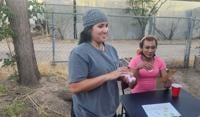
Lizbeth Oquite (left) and Joselin Mendez, co-organizers of social programs for Mariposas Sin Fronteras, play Millenial/Gen-Z Loteria with volunteers as they write letters to detained LGBTQ+ migrants in Tucson, Arizona, on Sunday, May 25, 2025.
“I felt like a criminal”
On Aug. 10, 2017, they turned themselves in at the Dennis DeConcini Port of Entry in Nogales. As they walked along Calle Internacional to the border, the group held up a banner and chanted, "¡Que tiemble, que tiemble, que tiemble migración! ¡América unida, una casa, una nación!"
They were immediately detained by immigration enforcement agents.
"I felt like a criminal, but the worst kind," she said.
They cuffed her wrist, her neck, her waist and her ankles, she said, grabbing each body part aggressively, demonstrating how the agents arrested her.
With a strong case for asylum, the group thought they would only spend a few days in detention. Instead, they were all sent to immigration detention centers in New Mexico, where some of them were incarcerated for months.
Lawyers at the Transgender Law Center, with help from the National Immigrant Justice Center, prepared a 655-page parole request for the group. Some migrants were released within two months, but Colibrí and a few others had no such luck.
In 2017, under the first President Donald Trump administration, USCIS increasingly denied bond and parole requests to asylum seekers, according to a letter community advocacy organizations sent to then-director of ICE, Thomas D. Homan.
Colibrí was eventually released on parole as she continued to fight her asylum case. Her first home was Casa Mariposa, run by Mariposas Sin Fronteras, in Tucson. The space — which includes a main home and a casita — has given LGBTQ+ migrants a safe place to land after detention.
After being closed since 2020, due to COVID-19 and leadership changes, the transitional housing program reopened earlier this year. Since January, four migrants have benefited from Casa Mariposa's housing program.
On a Tuesday in July, Colibrí, her partner Junior Grande and Flor, a resident of Casa Mariposa who was released from detention in June, unloaded donated furniture from Grande’s truck. They carried tables, chairs and couches into the back room, which serves as a makeshift office, and stacked them against the wall.
Toward the front of the house, three couches fill the living room space. Throughout the late spring and summer, the main house was remodeled and furnished, and appliances were installed to get it ready for new residents.
Finding her place in Tucson
When Rivera and Lizbeth Oquita, both co-organizers with Mariposas, asked Colibrí if she wanted to help rebuild the organization, she jumped at the opportunity. She was working part-time as an operator with No More Deaths and would volunteer at Casa Mariposa in her free time. Her dedication led her to a part-time job and eventually the full-time position she now holds as co-organizer.
"I think that having migrant trans women-led organizations [and] coalitions is really critical because they know firsthand what support is needed," Rivera said. "And [they] can envision what liberation means to the whole collective."
In the spring of 2026, Rivera started training Colibrí for her new role in supporting migrants after their release. As her role at Mariposas has changed, Colibrí has learned how to find LGBTQ+ migrants in the ICE detainee locator and add funds to their commissary and communications accounts.
Rivera's voice broke as she talked about Colibrí's growth.
"I just felt overwhelmed with pride for her, you know, to build her capacity and build her skills," Rivera said. "It's really cool."
A decade ago, Colobrí was fighting to live freely as her true self in Nicaragua. Sometimes she can't believe how far she's come in life, all through her efforts and the help of Mariposas and the people who have supported her, she said.
Colibrí has also used those leadership skills outside of her organizing work with Mariposas — playing kickball, a passion of hers that she hadn’t picked back up since leaving Nicaragua. About a year ago, she joined an LGBTQ+ league.
Colibrí started playing kickball at eight. By 19, she managed an all-women's team in Nicaragua and played on an all-gender team. Her talent was evident almost immediately when she started playing in Tucson, she said.
When she first joined the league in Tucson, Colibrí struggled with language barriers and communicating with her teammates. Eventually, she recruited her own team, made up of mostly BIPOC queer and trans players. The Queers Del Desierto have played two seasons now.
In the dugout, English and Spanish conversation blends with the pop and R&B the Queers Del Desierto blast through a small speaker. A handful of her teammates understand Spanish and help translate for the rest of the team, the opposing team and the umpire.
Two of the women currently living in Casa Mariposa have joined Colibrí's team this season, a way for them to be part of the community and do something healthy as they work to rebuild their lives. Unlike Colibrí, they're not as familiar with the sport or playing sports in general.
On a recent Saturday, one of the women, who goes by Leche, is visibly nervous as she's up to kick next. Colibrí gives her a few pointers and encourages her to kick with confidence. As Leche walks up to the plate, Colibrí shouts, "¡Sin miedo! ¡Sin miedo, al éxito! ¡Tú puedes!" ("Don't be afraid! Don't be afraid — go for success! You can do it!")
Leche kicks it high in the air. A defensive player goes to catch it, but drops the ball, and Leche makes it to first base. In the next inning, Colibrí gets two of the three outs, quickly getting them back on offense.

Joselin Colibrí slides into third base during a kickball game in Tucson, Ariz., on Sept. 26, 2026. (Stephanie Casanova/CALÓ News)
"A light inside of her"
Colibrí met her partner, Grande, through kickball. Once a spectator, he's now part of her team.
Grande first noticed her on the field a little more than a year ago, when she caught a fly ball during a game.
"Like she was running hard, and she caught it," he said. "It was just like, 'Wow! I have to tell her it was a good catch,' you know. And so after the game I went and talked to her and the rest is history."
After that first meeting, they slowly got to know each other.
"I just saw a light inside of her," Grande said. "She made me smile a lot. She's funny, she's very funny."
When they first started hanging out, they would use Google Translate to communicate. They still do, but more sparingly, he said. Grande understands Spanish but doesn't speak it fluently. Both are learning each other’s native language.
The more he learns about her past the more amazed he is, Grande said. Despite everything she's been through, he has watched Colibrí move forward with humor and with a positive attitude.
"Her message was always so clear. It was just never give up, and life is what you make it," Grande said. "And I think that's why it resonated with me because I try to have that optimistic attitude and perspective, but she really lives it."
Colibrí’s positivity has pushed Grande to keep working on himself. He said seeing her stay informed about what is happening in the world and still be optimistic is inspiring.
Her dedication to helping migrants and people she cares about in general is also inspiring, Grande said. He has seen her answer calls late at night and help people through personal situations, always cheering them on and encouraging them to move forward.
Her love for people is unconditional, Grande said. That's something he's still learning to understand, he admits.
"She never loses hope in people," he said. "She always has hope that they're gonna come out of whatever they're going through. So that's a beautiful way to live."
“She’s a guerrera, a butterfly”
As immigration enforcement has become more aggressive in the last two years, some of the anxiety Colibrí felt when she first started visiting detention centers returned. She stopped visiting Eloy and Florence in April, afraid she may be detained despite her protected status. Colibrí was granted asylum in 2019 and received a work permit in 2020, but has not yet received her green card.
After seeing that Karla Saenz, a trans migrant activist from Phoenix, was detained in March and held at Eloy Detention Center for more than a month, Colibrí decided to take her lawyer’s advice and support detained LGBTQ+ migrants from outside the centers.
But she hopes to start visiting migrants in detention again soon, she said.
"I feel empowered, raising my voice and the voices of those inside," she said. "I will keep going to detention, even if I feel afraid because I feel that responsibility, because I have to keep fighting. I have to keep up the struggle, because it’s when we’re silent when they oppress us the most."
For now, Colibrí organizes letter-writing events and supports those who move into Casa Mariposa after their release.
When people move into the temporary home, Colibrí accompanies them to ICE check-ins and to El Rio Community Health Center for medical care. She teaches them how to use the public bus system so they can explore Tucson safely. And, most importantly, she encourages them to get outside to avoid depressive thoughts.
The first three days after she was released from detention, Colibrí was anxious. She would lock herself in her room, struggling to sleep. She knows the toll detention takes on a person's mental health, so she works to ensure others don't fall further into depression once they're out.
“I’m doing it with enthusiasm and love because I’ve been there and it feels awful,” Colibrí said of the work she does.
Not long after Flor moved in, Colibrí took her on a hike up Tumamoc Hill in Tucson.
At the top, she told Flor, "Pega un grito duro" (“Shout really loud"). She wanted Flor to release everything she had been holding in while detained.
A few weeks after her release from detention, Flor walked into the living room to talk with Colibrí. In a mother-like tone, the Mariposas organizer reminded Flor that she was supposed to let her know before leaving the house — not because she wants to control Flor's movement, she said, but because if anything bad happens, Colibrí needs to be able to help her.
"You're free, but you have to take care of yourself," she told her.
Colibrí practices self-care daily and is learning how to meditate. She dances Zumba at home, goes for walks with her partner around Tucson, takes leadership and empowerment training classes, is learning English and is focused on reaching her personal goals.
Rivera said she's "honored to witness" the way Colibrí prioritizes her personal development and she's grateful to know her and work alongside her.
"She's a guerrera," Rivera said of Colibrí. "A butterfly."









(0) comments
Welcome to the discussion.
Log In
Keep it Clean. Please avoid obscene, vulgar, lewd, racist or sexually-oriented language.
PLEASE TURN OFF YOUR CAPS LOCK.
Don't Threaten. Threats of harming another person will not be tolerated.
Be Truthful. Don't knowingly lie about anyone or anything.
Be Nice. No racism, sexism or any sort of -ism that is degrading to another person.
Be Proactive. Use the 'Report' link on each comment to let us know of abusive posts.
Share with Us. We'd love to hear eyewitness accounts, the history behind an article.