


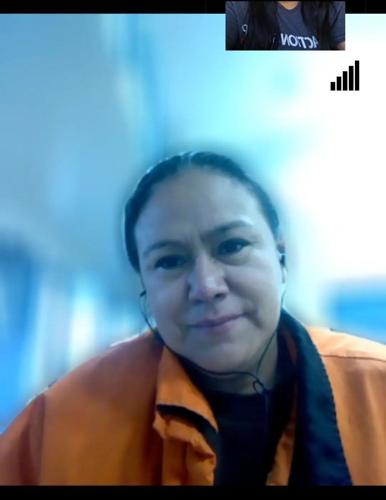

Left: Marta Alicia Dominguez , 51, is from El Salvador. She entered the U.S. in 2017 after her son was murdered and her family threatened in her country. | Right: Dominguez and her daughter, Josselyn Iglesias pose for a photo. (Photos provided by Josselyn Iglesias)
A 51-year-old woman from El Salvador has been detained in Eloy Detention Center in Arizona for nearly a year despite a judge granting her asylum in October 2025. While the Department of Homeland Security (DHS) is appealing the case — despite the fact that she entered the U.S. “the correct way” — the woman’s family is demanding she be released given her rapid health decline.
Marta Alicia Dominguez has been in detention since May 2025. She won her asylum case on Oct. 1, 2025, but that same month, the DHS filed an appeal, adding Dominguez to a growing list of tens of thousands of people who say they are being held illegally by Immigration and Customs Enforcement (ICE).
In an interview with CALÓ News, Josselyn Iglesias detailed the ongoing fight to get her mother released and returned to her home state of Texas, a feat that has proven difficult even with the law on their side.
Dominguez was arrested on May 19, 2025 after a family dispute with her son led to her arrest by the Dallas Police Department. Her case was dismissed and her family was told she would be released soon, but because of her pending asylum case, that release never came and she was instead transferred over to ICE custody.
“She never left prison,” Iglesias said, referring to her being transferred from one agency to another. “I was waiting and… she called me from the jail and said, ‘mija, ICE is taking me away because an immigration hold has been placed on me. Come find me, I don't know where they're going to take me.’"
According to DHS, Dominguez was placed into ICE custody on May 21, 2025 after the agency lodged a detainer with Dallas Police. ICE detainers are federal requests issued by ICE to a local agency to hold a person suspected of being in the country without authorization. Dominguez spent two months in Prairieland Detention Center in Alvarado, Texas before being transferred to Eloy in July 2025.
In a statement, DHS told CALÓ News that Dominguez had entered the country without proper authorization on Jan. 18, 2017 and that she would “remain in ICE custody pending a full conclusion of her immigration proceedings.” However, the DHS statement contradicts court documents filed by the attorneys representing the agency, which state that Dominguez “presented herself at a port of entry and applied for admission into the United States” — a process considered a legal form of entry.
Iglesias shared that her family turned themselves in at the Paso Del Norte port-of-entry, which separates El Paso, Texas from Ciudad Juarez, Chihuahua, in 2017. She and her family slept on the bridge for a week and requested entry multiple times before — and at the discretion of agents at the port-of-entry — they were allowed to enter the U.S. and granted a credible fear interview.
“She’s an ‘arriving alien', meaning that she did actually do things the right way, she didn't just illegally enter into the United States,” said Bianca Villalpando, the attorney helping Dominguez. “She did what everybody thought that needed to be done and she asked for permission to enter [and now] she's actually being punished for entering the correct way.”
On Feb. 13, Villalpando filed a habeas corpus petition in Dominguez’s case, after which DHS is obligated to make its case as to why she should not be released.
Habeas Corpus is a legal process wherein the petitioner asks the federal government to give an appropriate reason as to why they are holding someone. It’s used to argue unlawful detention and though historically it has not been used for immigration cases, people held up in immigration detention centers are now turning to this process as a last resort.
On Feb. 23, DHS responded that Dominguez was not entitled to a bond hearing because of her status as an arriving alien. Under the Immigration Nationality Act, people designated as arriving aliens aren’t entitled to a bond hearing and DHS can hold immigrants in mandatory detention or release them at the agency’s discretion.
"At that time, in 2017, when she presented herself, ICE used their discretion to parole her, to allow her to enter while she fought her case,” Villalpando said, adding that under the current administration, that same level of discretion is not being seen. “They're detaining as many people as possible for whatever reason possible.”
Dominguez is one of the over 43,000 people in detention centers across the country who’ve filed a habeas corpus since January 2025, according to data collected by ProPublica.
“If she has to wait through a lengthy appeals process, then at the very least they should release her,” Iglesias said. “She isn’t going to disappear. In fact, she is afraid to leave the United States because she doesn’t know which country to go to. El Salvador is not a safe country for us, even if they claim otherwise.”

A screenshot of a video call between Josselyn Iglesias and her mother, Marta Alicia Dominguez, who is being held in the Eloy Detention Center. (Photo provided by Josselyn Iglesias)
‘She looks tired, deteriorated’
Dominguez arrived in the United States with her family in 2017 after her son was murdered in El Salvador and her family received death threats. They were allowed entry into the country at ICE’s discretion after spending a week in a holding cell, releasing Dominguez with an ankle monitor that required her to appear for future appointments.
Up until 2019 — when Dominguez and her family applied for asylum — she had a pending petition, meaning that while she was allowed entry into the U.S., she wasn’t under protected legal status and was not shielded from detention or deportation. Her asylum case, however, had been dismissed by a judge by the time she was detained in May of last year.
May 21 will mark one year since Dominguez has been in ICE custody and, according to Iglesias, her health has drastically declined since. Prior to being detained, Dominguez had health issues with her gallbladder which she’d planned to have surgery on.
Since she’s been in detention, Dominguez has contracted Hepatitis A and Hepatitis B — highly contagious and serious liver infections caused by contaminated food, water and bodily fluids.
While she’s been in custody, “they took her to the hospital one time because of the pain she was in,” Iglesias said. “She said that… she only remembers fainting and that when she woke up, she was in the hospital — naked, with her hands and feet tied to the bed.”
Dominguez has lost over 30 pounds in detention and has also developed depression symptoms, spending her days in bed yet not being able to sleep, although she hasn’t been diagnosed, Iglesias said.
“(She) is doing very poorly. Her eyes look tired, she is exhausted,” Iglesias said. “Now, whenever she calls me, she’s crying. She looks tired, deteriorated — she looks really bad, honestly.”
There have been many first-hand testimonies of unsanitary conditions in both Eloy and Florence detention centers, the two largest in Arizona. Reporting and addressing conditions has become increasingly difficult since DHS’s layoffs and restructuring in March 2025 that dealt major cuts to the agencies that provide oversight to the conditions in detention centers.
Earlier this year, the Florence Immigrant and Refugee Rights Project released a report where they spoke to 60 people detained in Eloy. They detailed human rights violations, including “medical neglect, broken air conditioning in the summer, abuse by guards, and strip searches (that) have become so unbearable that many people report that they prefer to risk their lives and ask for deportation to dangerous situations in their countries of origin to escape from the detention center.”
‘I would like to see her free’
With Dominguez in detention, Iglesias spends about $50 a week to call her mother two times a day. She estimated that so far she’s spent about $4,000 in phone calls and commissary and thousands more on lawyer fees — one for the asylum case and a separate one to file the habeas corpus.
“The client and the immigrants are having to spend double the money to file an appeal and do all of these things for absolutely no reason whatsoever. It doesn't help correct the status of anybody,” Villalpando said, adding that the high cost of it all pushes people toward giving up. “Nothing that [DHS is] doing really makes sense and I don't see an objective other than to delay and to frustrate the immigrant so much that they just give up their case, just decide to leave, which [DHS has been] been successful in doing.”
Iglesias has taken out loans and even started a GoFundMe to help cover legal costs.
“The public needs to be aware that the primary reason for holding these individuals is because the corporations that own these prisons are making millions of dollars on tax payer paid daily amounts that come in per detainee,” said Mo Goldman, an immigration attorney in Tucson who is not related to the case. “They’re profiteering off of this and it's just despicable.”
Last year, Congress passed the One Big Beautiful Act, which designated $45 billion for building new immigration detention centers, something Goldman said doesn’t align with releasing people currently in detention centers.
Other than waiting for a decision and sharing their stories, there is not much more people who are detained or have family members who are detained can do once a habeas petition is filed. Ultimately, the fate of people in detention is up to the judge in the case, he said.
As the number of people in detention centers reaches unprecedented levels, and for-profit private prison facilities continue to enter into contracts with the federal government to open up more detention centers — like in Marana and Surprise — the number of people held without adequate due process will continue to proliferate; diseases in detention centers will continue to spread; stories of human rights abuses will continue to unfold; and people will be forced to spend thousands of dollars to defend their rights.
For now, Dominguez is waiting in detention for a decision on the appeal from the Board of Immigration Appeals and from a federal district judge on the habeas petition, both of which haven’t seen any movement.
“I would like to see her free,” Iglesias said. “She has 10 grandchildren. My children cry for her often. When they pray, they tell God to free her... I miss her, because she has always been my support, my friend, and everything.”
Susan Barnett is an independent journalist in southern Arizona covering the immigrant and Latine community. She is a recent graduate from the University of Arizona, where she received her Master of Arts in Bilingual Journalism. She previously worked at La Estrella de Tucson and co-founded Tucson Spotlight.










(0) comments
Welcome to the discussion.
Log In
Keep it Clean. Please avoid obscene, vulgar, lewd, racist or sexually-oriented language.
PLEASE TURN OFF YOUR CAPS LOCK.
Don't Threaten. Threats of harming another person will not be tolerated.
Be Truthful. Don't knowingly lie about anyone or anything.
Be Nice. No racism, sexism or any sort of -ism that is degrading to another person.
Be Proactive. Use the 'Report' link on each comment to let us know of abusive posts.
Share with Us. We'd love to hear eyewitness accounts, the history behind an article.